Introduction: Character Sketch of Nathan:
Kamala Markandaya has depicted character sketch of Nathan in novel Nectar in a Sieve with great skill. In Kamala Markandaya’s novel Nectar in a Sieve, Nathan stands as a central figure whose quiet strength and unwavering resilience shape the emotional and moral backbone of the story. As Rukmani’s husband and the head of their impoverished rural household, Nathan embodies the dignity and endurance of the traditional Indian farmer.
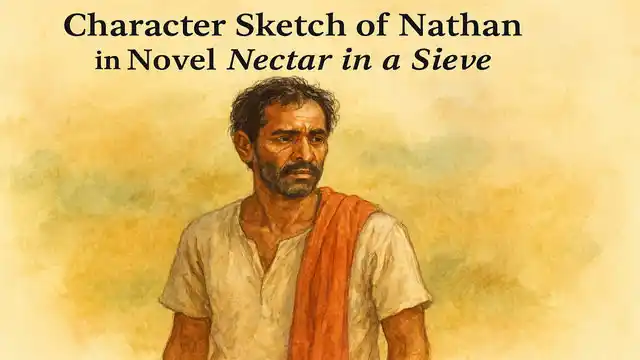
His character reflects the harsh realities of peasant life—its uncertainties, its dependence on the land, and its constant struggle against nature and poverty. Though soft-spoken and gentle, Nathan’s deep sense of responsibility, loyalty to his family, and acceptance of suffering reveal a man whose courage is rooted not in extraordinary acts, but in everyday perseverance.
Through Nathan, Markandaya portrays the silent heroism of ordinary people who labor tirelessly, often without recognition, to sustain both their families and their fading way of life.
Kamala Markandaya deals with social themes of great importance in her novels. She calls Nectar in a Sieve, a novel of rural India. Her purpose becomes clear with the sub-title of the novel that she intends to present a true picture of rural India in this novel. With this purpose she develops the character of Nathan and his wife, Rukmani, the narrator of the story.
A Fortunate man:
Nathan considers himself fortunate, for although he is poor, he has married into a respected family. His wife, Rukmani, came from wealth, but her parents, lacking financial foresight, gradually lost their prosperity. In the end, Rukmani was given in marriage to Nathan, a poor farmer. She was not regarded as beautiful, and with her father no longer affluent, this match seemed the most suitable under the circumstances.
During the vidaai, Rukmani’s parents were filled with sorrow, blaming their own lack of planning for having to marry their beloved daughter into poverty. Nathan, however, a man of dignity and self-respect, believes that the true dowry he received is simply his bride herself.
A Confident Man:
Nathan carries himself with quiet confidence. He takes pride in the labour that defines his life and believes he can shape his future through honest effort. Although he is aware that Rukmani comes from a wealthy household, he shows her his small hut without hesitation, feeling a deep satisfaction in having built it himself. Rukmani, however, is taken aback when she first sees her husband’s home, for it is bare and offers almost nothing of comfort.
“I woke: I looked. A mud hut, thatched, small, set near a paddy field, with two or three similar huts nearby. Across the doorway a garland of mango leaves, symbol of happiness and good fortune, dry now and rattling in the breeze.”
“This is our home,” my husband said. “Come, I will show you.”
Hearing his words, she stepped down from the cart and walked inside. The house had only two rooms—one served as a storage space for grain, while the other held everything else they owned. A third room had been started but never completed; its mud walls rose barely half a foot from the ground. Yet, being an ideal homemaker, she paid little attention to the poverty around her.
What truly stood out to her was Nathan’s unwavering confidence. He believed he would shape his own destiny with vibrant colours through hard work and determination. In this humble hut, Nathan’s love for Rukmani was the other precious possession.
His thoughtfulness moved her so deeply that she found herself gathering courage in response. He said: “Perhaps you are frightened at living here alone, but in a few years we can move; may be even buy a house such as your father’s. You would like that?”
It was his dream but not in vain for he had full faith in his labour and land. Rukmani discovered there was something in his voice, a pleading, a look on his face. It impressed her enough to declare:
“No,” I said, “I am not frightened. It suits me quite well to live here.”
He did not reply at once but went into the granary and came out with a handful of paddy. With great pride he made a display of it before his wife.
“Such harvests as this,” he said, sliding the grains about in his hand, “and you shall not want for anything beloved.”
It is her maturity that without any complaint she adjusts with what she gets in her husband’s house.
His Non-interfering Temper:
Nathan’s gentle, non-intrusive nature stands out. He allows Rukmani to manage her home and her life in her own way, never smothering her with instructions or restrictions. He does not even direct her on something as simple as where she should wash clothes. As a result, Rukmani quickly adapted to her new surroundings.
She grew comfortable with the neighbours and eventually found a small pool of water that served well for washing. There she met Kali, who had come with two other women, Kunthi and Janki. It was they who told her that Nathan had built the little house with his own hands, just for her. The thought filled Rukmani with gratitude; though her husband was poor, he possessed a generous and loving heart.
With her new companions, Rukmani enjoyed visiting the village market to buy household necessities. By this time, she had come to know many people in the village and would go to the market once or twice a week. Among her friends, Kunthi remained quiet and withdrawn, while Kali and Janki taught her much about the rhythms of village life. Rukmani joined in every community activity, and Nathan, pleased with how well she had settled in, affectionately called her “Ruku.”
His Modern Outlook:
Despite spending his life in a small village, Nathan possesses a remarkably progressive outlook. He feels proud that Rukmani can read and write, and he supports her abilities without a trace of jealousy or insecurity. When Rukmani mentions seeking medical help from an English doctor, he readily accepts the idea and even welcomes the doctor into their lives. In time, Selvam is trained as Dr. Kenny’s assistant. Later, when Ira faces infertility, Rukmani takes her to Dr. Kenny as well, and Ira eventually becomes a mother—something Nathan never opposes.
It is true that Nathan initially felt a tinge of disappointment at Ira’s birth, having hoped for a son. But two points are important to remember: as a farmer, he longed for a son mainly to have an extra pair of hands in the fields, and despite that desire, he deeply loved Ira. When her husband abandoned her, Nathan protected and supported her like a forward-thinking father, even though the family was struggling in extreme poverty.
His modern attitude is further evident when he openly confesses to Rukmani that he fathered Kunthi’s two sons—an incident that occurred before his marriage, when Kunthi took advantage of him.
His Fortitude:
Even in the depths of suffering, Nathan’s bravery remains evident. The fate of Indian farmers often rests in the hands of nature and the whims of the weather. Soon after Ira’s wedding in June, the rains began—far earlier than anyone expected. It was not the usual season for rainfall, and its premature arrival caught everyone unprepared.
Typically, poor farmers repair their huts just before the monsoon so they can endure the rainy months with some comfort. But that year, the early showers denied them this chance. Nathan and Rukmani, too, had not yet reinforced their hut. The downpour was relentless, and water spread everywhere. Nathan’s paddy field lay completely submerged under the flood. Nathan reported Rukmani: “The rains have destroyed much of our work; there will be little eating done this year.”
The rain kept pouring, and the village remained submerged. Eventually, the downpour grew into a fierce storm, plunging everything into darkness. Thunder and lightning raged through the night, filling everyone with fear. By morning, the sky had cleared and the air was still, yet Nathan’s field lay completely ruined.
Many families had been left without homes. Kali’s small hut had collapsed in the storm, and she went to Rukmani hoping to borrow some palm leaves. But Rukmani had none to give. Nathan mentioned that palm leaves and rice were usually available in the village, but the storm had wiped out all supplies, leaving devastation everywhere. With no goods coming in and only limited stock remaining, prices for everything had begun to soar.
Another year the village had no rains. After some days Sivaji came to take the landlord’s dues. Nathan had nothing to pay. Sivaji warned that Nathan should pay at least the half if he wanted to save his land. Nathan and Rukmani decided to sell their all to collect the money. They had to eat even grass in hunger. In town Nathan breaks stones in spite of his illness.
An Ideal Father:
Nathan embodies the qualities of an ideal father. He cares deeply for his children and never voices complaints about them. He does not stand in the way of their choices. Though he hopes for their support on the farm, he raises no objection when they take up work at the tannery.
Even when they decide to leave for Ceylon, he urges Rukmani to allow them to follow their path. He readily agrees when Murugan chooses to move to the town. Nathan is not like those self-centered fathers who insist their sons remain at home in the belief that doing so will secure their own comfort in old age. His sons, in return, remain dutiful and respectful.
His Struggle:
Nathan’s entire life is marked by relentless hardship. Though diligent and hardworking, he remains helpless before the forces of nature. At times floods ruin his crops, and at other times drought withers the fields, leaving his family on the verge of starvation. In the end, he is compelled to leave his village and go to the town to stay with Murugan, with Rukmani accompanying him.
However, life in the town brings new troubles. Their small savings are stolen, and after walking a long distance, they arrive at the Collector’s house, hoping to meet their son. Instead, they encounter only Murugan’s wife, Ammu—a slender young woman with unkempt hair—who informs them that Murugan abandoned her nearly two years earlier and has since left the city altogether. She advises them to return to their village. With heavy hearts, Nathan and Rukmani take their leave.
To survive, Nathan and Rukmani begin breaking stones, earning eight annas a day. This small but steady income encourages them, for they believe they can save enough within two months to return home. But constant labor in the pouring rain weakens Nathan. Eventually, he collapses and never rises again, bringing an end to his humble and unassuming life.
Nathan’s journey, though tragic, leaves behind the image of a truly inspiring man.
