Introduction:
Kamala Markandaya has remarkably depicted character sketch of Rukmani in novel Nectar in a Sieve. Rukmani, the central protagonist of Kamala Markandaya’s Nectar in a Sieve, stands as a poignant symbol of endurance amid poverty, change, and loss. Through her eyes, the novel presents the struggles of rural Indian life during a period of social and economic transition.
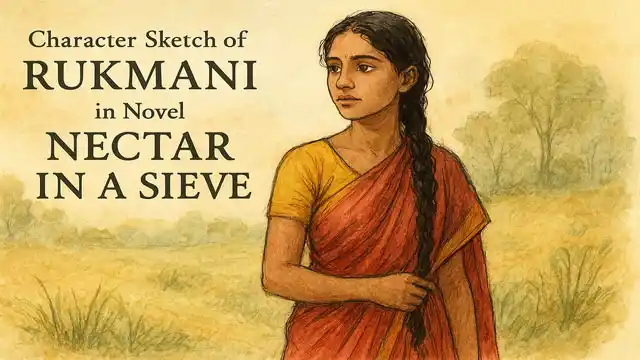
Rukmani’s character embodies quiet strength, dignity, and an unwavering sense of hope, even as she faces hardships such as natural calamities, personal tragedies, and the erosion of traditional village life. Her voice—gentle yet resolute—shapes the emotional core of the story, making her not only a narrator but also a representation of countless women whose resilience sustains their families and communities.
Kamala Markandaya deals with social themes of great importance in her novels. She calls her Nectar in a Sieve, a novel of rural India. Her purpose becomes clear with the sub-title of the novel that she intends to present a true picture of rural India in this novel. With this purpose she develops the character of Rukmani, the narrator of the story.
A Victim of Poor Planning:
Rukmani was born into a wealthy household, yet her parents had no understanding of how to manage or secure their finances. As the years passed, their fortune steadily vanished. Her eldest sister, Shanta, had been married into an extremely affluent family, and the grandeur of her wedding was remembered in the village for years. Padmini, the next sister, also found a respectable match, though not as prosperous as Shanta’s. The third sister, Thangam, was married to an ordinary family within their own village.
In this way, the family’s prosperity dwindled, leaving behind only stories of their once-glorious past. Rukmani, the fourth and youngest daughter, was dearly loved by her parents, but by the time it was her turn to marry, they were too financially strained to offer any dowry. Ultimately, Rukmani was married to Nathan, a poor farmer. She lacked conventional beauty, and her father, no longer wealthy, could arrange nothing better.
At the time of her departure, her parents were overwhelmed with sorrow, regretting their lack of foresight and planning, which had compelled them to give their beloved youngest daughter in marriage to a poor man.
An Ideal House Wife:
Rukmani is an ideal house wife. For example when Rukmani saw her husband’s hut she was shocked for here she found nothing.
“I woke: I looked. A mud hut, thatched, small, set near a paddy field, with two or three similar huts nearby. Across the doorway a garland of mango leaves, symbol of happiness and good fortune, dry now and rattling in the breeze.”
“This is our home,” my husband said. “Come, I will show you.”
When she heard it, she stepped down from the cart and went inside. The dwelling consisted of two rooms—one used as a granary and the other for all their remaining needs. A third room had been started but left incomplete, its mud walls rising no more than half a foot. Yet, being the ideal housewife she was, she paid no mind to their poverty; what truly stood out to her was Nathan’s unwavering confidence. He believed he would carve out a future bright with promise, for he was a hardworking, resolute young man. His love for Rukmani was the other priceless possession within that humble hut. His tenderness moved her so deeply that she felt compelled to show a little bravery.
“Perhaps you are afraid to live here by yourself,” he told her, “but in a few years we can move—maybe even buy a house like your father’s. Would you like that?”
It was his cherished dream, and not an empty one, for he had complete faith in his own labour and in the land. In his voice Rukmani sensed something more—a quiet pleading, and on his face, an expression that revealed his hope. It impressed her enough to declare:
“No,” I said, “I am not frightened. It suits me quite well to live here.”
He did not reply at once but went into the granary and came out with a handful of paddy. With great pride he made a display of it before his wife.
“Such harvests as this,” he said, sliding the grains about in his hand, “and you shall not want for anything beloved.”
It is her maturity that without any complaint she adjusts with what she gets in her husband’s house.
Her Social Temper:
Rukmani possesses an admirable social nature. She quickly forms bonds with the people around her, becoming friendly with the neighbours soon after her arrival. One day, while discovering a small pool of water ideal for washing clothes, she met her neighbour Kali, who was there with two other village women, Kunthi and Janki. It was they who told her that Nathan had built their hut with his own hands—a revelation that made Rukmani feel fortunate, for though her husband was poor, he was kind-hearted and devoted.
Rukmani enjoyed accompanying her new friends to the village market to buy household necessities. Gradually, she became familiar with many villagers and began visiting the market once or twice a week. Kunthi, though quiet and reserved, became part of her circle, while Kali and Janki taught her much about the rhythm of rural life.
Rukmani involved herself in every village affair, and Nathan was pleased with her sociability, affectionately calling her “Ruku.” She cared for Kunthi when her son was born, and later, during the birth of Rukmani’s own daughter, Kali supported her wholeheartedly. Rukmani also developed a close bond with Old Granny, who played a key role in arranging Ira’s marriage. Because of her warm and open disposition, Dr. Kenny never hesitated to offer help to her family.
Her Modern Outlook:
Although Rukmani lives in a small, traditional village, she possesses a distinctly modern mindset. She is literate and educated, and when she fails to conceive another child after Ira, she does not hesitate to seek medical help from an English doctor. One day, Dr. Kennington notices her sadness and asks the reason for it. Rukmani admits that she feels unfortunate because she has not borne a son. He reassures her that the solution lies not in fate but in medical science. After treating her, Rukmani gives birth to a son.
Up to this point, she has not mentioned Dr. Kennington to Nathan, fearing that her husband might disapprove of her consulting a foreign doctor. However, the treatment proves so effective that Rukmani eventually bears four more sons—Arjun, Thambi, Murugan, Raja, and Selvam. Ira, the eldest, takes on the responsibility of caring for her younger brothers.
Rukmani’s ability to read and write strongly influences Arjun, who develops a deep interest in learning. He spends most of his time with books, showing little inclination toward farm work. Later, Selvam becomes Dr. Kenny’s trained assistant. When Ira herself later struggles with infertility, Rukmani once again turns to Dr. Kenny for help, and Ira is able to become a mother.
Her Minute Observation:
It is Rukmani’s minute observation that she declares the tannery is a curse to the village.
“Never, never. They may live in our midst, but I can never accept them, for they lay their hands upon us and we are all turned from tilling to barter and hoard our silver since we cannot spent it, and see our children go without the food that their children gorge, and it is only in the hope that one day things will be as they were and we have done these things. Now that they have gone let us forget them and return to our ways.”
Kunthi welcomed all the changes taking place around her. She considered herself a woman of the city, so the idea of the village slowly transforming into an urban space delighted her. Soon, she imagined, there would be shops, tea stalls, even a bioscope. Bit by bit, this quiet settlement would grow into a bustling little town. When Rukmani voiced her fears about the transformation, Kunthi dismissed her, saying, “You are a village girl—you cannot understand these things.”
Kunthi’s joy only increased when her two sons found well-paid work at the tannery. With their earnings, her days of hardship faded, and the tannery became, in her eyes, a blessing. But Rukmani saw it differently. To her, the tannery signaled the village’s downfall; wealth had shifted, prices had risen, and life had grown more difficult.
Her Fortitude:
Even in the harshest circumstances, Rukmani’s strength shines through. The fate of Indian farmers is tightly bound to the whims of nature, which can either sustain or destroy them. Soon after Ira’s wedding in June, unexpected showers began. This was not the usual time for rain—its arrival was unusually early that year. Typically, poor farmers repair their huts just before the monsoon to endure the season with some comfort. But the premature rains robbed them of this chance.
Nathan and Rukmani, too, had been unable to reinforce their dwelling. The downpour was so intense that water spread everywhere, and Nathan’s paddy fields lay submerged under the relentless flood. Nathan reported Rukmani: “The rains have destroyed much of our work; there will be little eating done this year.”
The rain kept pouring, flooding the entire village. When it finally swelled into a storm, darkness covered everything. All through the night, lightning flashed and thunder rolled, filling everyone with dread. By morning, the sky had grown still and silent, but Nathan’s field had been completely destroyed. Many families had lost their homes, and Kali’s hut had collapsed in the storm. She went to Rukmani hoping to borrow a few palm leaves, only to find that Rukmani had none to spare.
Nathan mentioned that palm leaves and rice were usually available in the village, but the storm had ruined every source of supply. The entire place lay in devastation. With no goods coming from outside and only limited stocks remaining, the prices of essentials soared. Rukmani was stunned when she received barely two ollocks of rice—roughly a pound—for two rupees.
Another year passed without a drop of rain in the village. After some time, Sivaji arrived to collect the landlord’s dues, but Nathan had nothing to offer. Sivaji warned him that unless he paid at least half the amount, he would lose his land. Desperate, Nathan and Rukmani decided to sell whatever they owned to gather the money. During this troubled time, Kunthi came to Rukmani asking for rice. Rukmani barely had enough for her own family, yet Kunthi threatened to reveal Rukmani’s secret visits to the doctor if she refused. Forced by fear, Rukmani agreed.
Later that night, when she went to the rice store, she discovered that the grain was missing. Nathan then confessed that he had taken it to give to Kunthi because he was the father of her two sons. With no rice left, the family was pushed to such extremes that they survived on grass to ease their hunger.
An Ideal Mother:
Rukmani exemplifies the qualities of an ideal mother. She treats all her children with equal affection, showing no trace of gender bias, and is especially loving toward Ira. Without relying on Nathan, she carefully saves money for Ira’s marriage and even finds a suitable husband for her. When Ira’s husband abandons her, calling her barren, Rukmani tries to reason with him, assuring him that the condition can be treated. After Ira is cured, Rukmani takes her to meet him again, only to discover that he has already taken another wife.
Despite these hardships, Rukmani never scolds Ira harshly. The one time she strikes Ira, it stems from deep concern and responsibility rather than anger. When Ira eventually gives birth to a son, Rukmani embraces the child with warmth and affection. She raises her sons with strong values, and they trust her enough to give her their earnings. They remain devoted and obedient to both parents.
Rukmani also ensures that her children receive an education. Her guidance enables Selvam to become a trained assistant to Dr. Kenny. Tragedy strikes when her son Raja is caught stealing at the tannery; he is beaten to death. The family—Nathan, Rukmani, and Ira—is devastated. A few days later, tannery officials visit Rukmani and Nathan, attempting to convince them that Raja alone was at fault and that the watchman was merely performing his duty. They disclaim any responsibility for compensation. Rukmani protested:
“You cannot blame my son,” I said wearily. “We live from hand to mouth, as you can se. there is no wealth here, such as your goods might have brought.”
Rukmani said that she was not going to claim any compensation. What she lost was invaluable.
Her Struggle:
Rukmani’s life is shaped by constant hardship. Although she is the youngest daughter of a prosperous landlord, she is married off to a poor tenant farmer. Nathan, her husband, is diligent and sincere, yet powerless against the forces of nature. Floods at one time and drought at another push the family repeatedly to the edge of starvation.
Eventually, circumstances compel Rukmani to leave her village and travel with Nathan to the town where their son Murugan lives. Once there, their troubles only deepen when their small savings are stolen. After a long and exhausting journey, they finally reach the house of the Collector, where Murugan works. But instead of their son, they find only his wife, Ammu—a frail young woman with unkempt hair—who informs them that Murugan abandoned her nearly two years earlier and has even left the city. She advises them to return to their village, and with heavy hearts, Rukmani and Nathan take their leave.
To survive, Rukmani begins reading and writing letters for people, earning a few annas each time. A year passes in this manner. Later, both Nathan and Rukmani take up breaking stones, managing to earn eight annas a day. This modest income gives them hope: if they continue working, they can save enough to return home within two months.
But relentless labor in rain and hardship weakens Nathan. His health fails, and one day he collapses, never to rise again. Rukmani is left to make the journey back to her village alone, returning as a widow with nothing but her grief.
Her Emotional Depth:
Rukmani’s profound emotional nature becomes evident when she thinks of her late husband and the sons she has lost. She continues to feel his presence, unable to accept fully that he is gone. Her loyalty and devotion stand in stark contrast to certain modern, upper-class urban women who easily pursue divorce to remarry. For Rukmani, her husband remains alive in her heart, even though he was never able to offer her the material comforts of a wealthy life.
“Sometimes at night I think that my husband is with me again, coming gently through the mists, and we are tranquil together. Then morning comes, the wavering grey turns to gold, there is a stirring within as the sleepers awake, and he softly departs.”
“One by one, they come out into the early morning sunshine, my son, my daughter. Puli, the child I clung to who was not mine, and he no longer a child. Puli is with me because I tempted him, out of my desperation I lured him away from his soil to mine. Yet I have no fears now: what is done is done, there can be no repining.”
Now on the screen of her mind appear other figures. Many of them have gone far from her yet she remembers them. She is lost in the memory of her parents and her sisters. Conclusion-Thus, Rukmani is an inspiring character.