Introduction:
We find the cultural encounter between East and West in Nectar in a Sieve during the period of colonial and early post-colonial India. Set in a rural village, the novel depicts how the traditional, agrarian lifestyle of Indian peasants comes into direct contact with the forces of Western industrialization, modernity, and capitalist values.
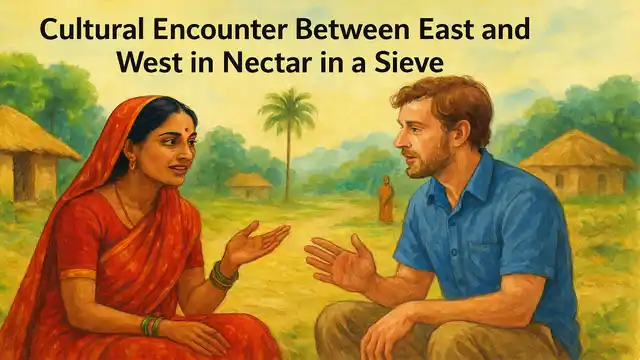
This East–West encounter is not presented merely as a clash of cultures, but as a nuanced interaction that reshapes the lives, identities, and destinies of individuals like Rukmani and Nathan. The arrival of the tannery—a symbol of Western economic intrusion—disrupts the village’s social structure, moral codes, and economic stability, bringing both opportunities and hardships.
Through the characters’ responses to these changes, Markandaya highlights themes of cultural displacement, resilience, adaptation, and the human cost of modernization. The novel Nectar in a Sieve ultimately portrays the East–West encounter as a transformative force, revealing how global influences penetrate even the most rooted traditions and challenge the harmony of rural existence.
Post-independence literature in India deals with the theme of East- West encounter in Hindi as well as Indo-Anglian novel and drama. The English rule ended, the rulers went back but they left behind their art, culture and trade. It is a great irony that even those who fought for free India could not keep India free from the impact of English art, culture and trade. In Nectar in a Sieve, the West is represented by human and mechanic forces in the form of Dr. Kenny and the Tannery.
Dr. Kenny: Truly a Blessing
In the novel Nectar in a Sieve, Dr. Kenny emerges as a genuine blessing in the lives of the characters. He symbolizes the hopeful and constructive side of scientific advancement. Through him, the narrative challenges the belief that a woman’s inability to conceive is the result of fate or divine displeasure. Instead, Dr. Kenny shows that infertility is often a medical condition that can be treated with proper care.
This becomes clear in Rukmani’s experience. When her mother fell gravely ill, a new doctor named Kennington was summoned. During one of his visits, he noticed Rukmani’s sadness and asked her about it. She confided that her misfortune lay in being unable to bear a son. Dr. Kenny assured her that the problem was not destiny but something science could address. After his treatment, Rukmani was finally able to give birth to a son.
When Ira was seven years old, Nathan hosted a grand feast for the entire village. Rukmani was assisted by Kali, Janki, and Kunthi in preparing for the celebration. The occasion was filled with music, laughter, and dancing. Until then, Rukmani had not mentioned Dr. Kennington to Nathan. Because he was a foreigner, she worried that Nathan might disapprove of him. However, the doctor’s treatment proved so effective that Rukmani went on to bear four more sons—Arjun, Thambi, Murugan, Raja, and Selvam. As the eldest child, Ira lovingly took care of her younger brothers.
Dr. Kenny: A Figure of Compassion
One morning, at daybreak, Rukmani met Kennington and told him that she was now the mother of five sons. She invited him to visit her home, and he agreed. When they arrived, Nathan had already left for the fields. The small hut had no chair to offer, and Kennington found it difficult to settle himself on the floor mat. Ira came forward with a bowl of rice-water, which he accepted with genuine pleasure. He praised Ira warmly and blessed her, clearly delighted by her simple offering.
After some time Nathan came. Rukmani introduced Nathan and Kennington with each other. Nathan welcomed him. Nathan said he had no means to welcome him properly. Kennington said Nathan that the father five healthy sons could not be poor.
Dr. Kennington often visited her home with sweets for children. One day, he came and found that Rukmani was feeding her three years old Selvam. He asked Rukmani that her son should not be given breast feeding for it would be harmful for her. She replied that she had no money to buy milk from the market. Then Kenny arranged cow’s milk to her youngest son.
Rukmani went to meet Dr. Kennington, hoping he would agree to treat her daughter Ira. He assured her that he would do whatever was possible for the family’s well-being. When he learned that Ira was expecting a child, Kenny seemed genuinely satisfied. “You’ll feel better once the baby arrives,” he told her. “There is nothing wrong with a child conceived in a moment of chance.”
Dr. Kenny also needed someone to assist him at the hospital, so he asked Rukmani if Selvam could take up the position. She trusted that her son would learn only good and useful things under Kenny’s guidance, especially since the doctor was in the process of building a hospital. Selvam himself was eager for the opportunity, and Kenny was happy to have him. Becoming Kenny’s assistant filled Selvam with joy, for the task was gentle and dignified.
When Kenny mentioned that the funds for the hospital had been raised in his own country, Rukmani found it difficult to comprehend. She wondered why people from far away would donate money to build a hospital in her village or concern themselves with the health of its inhabitants. Having lived her whole life within the bounds of the village, she had never encountered such ideas of humanitarian service and care for others. Watching Kenny work tirelessly, she could not grasp why a foreigner would be so devoted to a place that was not his own.
Selvam continued working with Kenny and took charge of overseeing the hospital’s construction. Their plan had been to complete the building within a year, but the work dragged on for seven long years, plunging them into financial difficulties. In the meantime, Old Granny passed away without receiving the medical care she desperately needed. The news left Rukmani deeply saddened. She mournfully remarked that no one would treat the poor without payment. Selvam, however, disagreed, explaining that Kenny had told him that in some countries the poor are given medical care free of cost. As for Kenny’s own hospital, Selvam added, it required an unending flow of money to keep it going.
Dr. Kenny: A Man with a Mission:
At long last—and only after overcoming countless obstacles—the hospital finally stood completed. Within two years, Selvam had learned enough to handle minor cases on his own, for which Kenny offered him a small salary, though even that was not always paid on time. Still, Dr. Kenny’s purpose had been fulfilled: he had managed to establish and operate a functioning hospital in that remote rural community.
The Tannery: A Blessing as Well as a Curse:
A tannery was slated to be built in the village, and the place buzzed with activity as bricks were unloaded from bullock carts. The commotion drew nearly everyone—Kali and her husband, Kunthi, Janki, the old granny—each curious to see what was happening. Opinions varied widely. Some villagers believed the tannery would bring prosperity, while others feared it would spell trouble.
Workers from neighbouring villages had been hired for the construction. Temporary huts were set up in an open field, where the labourers stayed with their families. It took nearly two months for the building to be completed. Throughout this time, the workers lived in those makeshift shelters with their wives and children.
Once the tannery stood finished, the labourers departed, leaving behind the empty huts scattered across the field. A week went by, yet no one arrived to occupy the tannery or the huts. Rukmani and Nathan grew anxious, waiting for the new arrivals who never came. With no one to buy Rukmani’s vegetables and village prices inflated by the visiting labourers, she found herself increasingly resentful of the outsiders.
“Never, never….. They may live in our midst, but I can never accept them, for they lay their hands upon us and we are all turned from tilling to barter and hoard our silver since we cannot spent it, and see our children go without the food that their children gorge, and it is only in the hope that one day things will be as they were and we have done these things. Now that they have gone let us forget them and return to our ways.”
After some days, different people came. The empty huts were occupied by them and their family. Town men had started living there. Kunthi was happy with all this change. According to her, she was a city girl and it was good the village was going to be turned into a city. Now there would be shops, tea-stalls and bioscope. Gradually, this village would be turned into a small town. When Rukmani pleaded against it, Kunthi said, “You are a village girl. You do not understand.”
The Tannery: Source of Employment and Earning at the Cost of Deserting Farming:
Kunthi’s two sons got employment in the tannery at handsome wages. She was happy for her poverty was removed. Tannery had become a boon for her. Rukmani regarded it as a curse for her village. According to Rukmani due to tannery, the village was ruined for money power was reduced and everything was costly. But Kunthi contradicted her: “Words and words….. Stupid words. No wonder they call us senseless peasant women; but I am not and never will be. There is no earth in my breeding.”
The construction work continued in tannery for another building was being constructed there. Now its work was spreading in village. The tanner-men had brought thousands of animal skins to be tanned. They tanned and dyed these skins and sent these back to the town for commercial production. There were nine or ten Muslims among them. They lived separated from others because there life style was a bit different from other people. They used to work hard till late night. Their ladies lived in the purdah and could hardly be seen outside. None had got any opportunity of seeing their faces. According to their religion, only their husbands could see their faces.
Once Rukmani went there to sell vegetables. She was alone. From one house a lady called her in to buy vegetables. Now Rukmani got opportunity to see the face of one of them.
“Her face was pale, the bones small and fine. Her eyes were pale too, a curious light brown matching her silky hair.”
It broke the prejudice that they were very beautiful. Arjun wanted to work in tannery. Rukmani asked Arjun to tell the reason for it. He replied: “You do everything you can. It is not enough. I am tired of hunger and I am tired of seeing my brothers hungry. There is never enough, especially since Ira came to live with us.”
Hearing it, Rukmani had to say: “Go if you must. You speak like a man although you are a child still. But I do not know whether you can obtain work at the tannery. People say that they have all the labour they want.”
Arjun said that Kunthi’s son had assured him for getting work in tannery. Rukmani did not like it that Arjun should take help from Kunthi or her son. She assured that Dr. Kennington would be very helpful in it for he had a great say there. After a few days, Arjun got employment in the tannery. After it, Thambi also joined in the tannery. It had an ironic effect on the family. It was good that family had got rid of poverty with increasing income but Nathan was sad for Arjun and Thambi did not help him in farming. Arjun and Thambi were good boys in the sense that they helped their family with their earnings. Once again they started to live a good life.
The Tannery: Exploitation and Inhuman Conditions:
It happened that one day Arjun and Thambi came very late in the evening. Nathan and Rukmani waited for them with great anxiety. When they asked the reason of being late, the sons replied that they had asked for higher wages. The masters agreed for it on the condition that their lunch time was changed to working time. Just a few days after it, there was a workers strike in the tannery. The demand was to increase their wages. Masters warned workers to come back to their job otherwise new workers would be appointed. It terrified many workers and they resumed their duty. Others remained out and they employed new men at lower wages. Arjun and Thambi did not go back to their job and became unemployed. It was the sad story of many people of the village who were now out of the tannery. Their families starved.
In Kali’s family, only one was back to tannery. Her two sons were out of job. Nathan favoured his sons and said: “……Our children must act as they choose to, not for our benefit, Is it not enough that they suffer?”
Arjun and Thambi learnt that there was a good job with higher wages in Ceylon. Nathan feared Ceylon was hundreds of miles away from the village. Arjun informed that all the arrangements of journey would be made by the masters. Against the will of Nathan and Rukmani, they decided to go to Ceylon Island.
One day Rukmani’s son Raja was caught stealing in tannery. He was beaten to death. Nathan, Rukmani, Ira all were very sad. After 2-3 days two officials came from the tannery to Nathan’s home. They wanted to satisfy Nathan and Rukmani that all the fault was of Raja and watch man only fulfilled his duty by stopping him (Raja). So they were not bound to pay any type of claim regarding this.
“You cannot blame my son.” I said wearily, “We live from hand to mouth, as you can see… there is no wealth here, such as your goods might have brought.”
“I am not blaming your son alone,” he said carefully, “but of course it is well known your sons have been troublemakers. Now we do not want any trouble from you, you understand. The lad was caught in the act of stealing, maybe, as you say, for the first time and in a moment of weakness-still, he was caught, and for the consequences that followed, no one was to blame except himself. He should not have struggled. In these circumstances you naturally have no claim on us.”
“Claim?” I said. “I have made no claim. I do not understand.”
He made a gesture of impatience. “You may think of it later, and try to get “Compensation,” I thought, “What compensation is there for death for felt confused, I did not understand what he was getting at. There was a pause.”
Hearing this Rukmani said that she was not going to claim any compensation. What compensation. I warn you, it will not work.” she lost was invaluable.