Introduction:
In Kamala Markandaya’s Nectar in a Sieve, Dr. Kenny is a Blessing and incarnation of humanity in novel Nectar in A Sieve. Dr. Kenny emerges as one of the most compelling and enigmatic figures, standing apart from the social and economic despair that shapes the lives of Rukmani and her family.
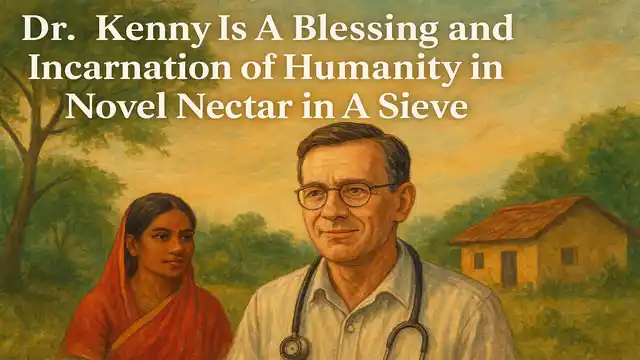
Amid the poverty, hunger, and suffering that define rural India in the novel, Dr. Kenny functions as a rare symbol of compassion, resilience, and unwavering humanitarian spirit. Though a foreigner and often misunderstood by the villagers, he repeatedly offers medical aid, moral support, and hope at moments when Rukmani’s world threatens to collapse.
His presence acts as a lifeline, not only easing physical afflictions but also challenging passive acceptance of fate. As a doctor driven by empathy rather than reward, Dr. Kenny becomes a blessing in Rukmani’s life and an embodiment of the novel’s deeper theme: the capacity of humanity to shine even in the bleakest of circumstances.
Through his actions, Markandaya portrays him as an incarnation of humanity itself—someone who brings light where there is darkness, and who restores dignity where it has been eroded by misery.
Post-independence literature in India deals with the theme of East- West encounter in Hindi as well as Indo-Anglian novel and drama. The English rule ended, the rulers went back but they left behind their art, culture and trade. It is a great irony that even those who fought for free India could not keep India free from the impact of English art, culture and trade. In Nectar in a Sieve, Modern progress of the West is represented by human and mechanic forces in the form of Dr. Kenny and the Tannery. Dr. Kenny has come to the rural area with a mission that fruits of modern progress should be tasted by the whole mankind. The opposite faces of modern progress can be seen at one place in this novel. The selfish earn money and exploit the poor by establishing a tannery while the true servant of Ans, God builds a hospital for human welfare in the same rural area.
Dr. Kenny: A True Blessing:
In the novel, Dr. Kenny emerges as a blessing in the lives of the characters. He embodies the hopeful, constructive side of scientific advancement. Through him, the narrative challenges the belief that a woman’s infertility is the result of destiny or a curse; instead, he shows it to be a medical condition that can be treated.
Rukmani meets Dr. Kennington by coincidence when her mother falls seriously ill and he is summoned to attend to her. Noticing Rukmani’s sadness one day, he asks her the reason. She confides that she feels unfortunate because she has not borne a son. Dr. Kennington reassures her that fate has nothing to do with it—medical science can help. After treating her, Rukmani gives birth to a son.
When Ira turns seven, Nathan hosts a feast for the entire village. Kali, Janki, and Kunthi assist Rukmani with the preparations, and the celebration is filled with music and dance. Up to this point, Rukmani has not told Nathan about Dr. Kennington’s involvement. Because the doctor is a foreigner, she fears Nathan might disapprove. However, the success of his treatment becomes undeniable as Rukmani goes on to bear four more sons: Arjun, Thambi, Murugan, Raja, and Selvam. Ira, the eldest, lovingly looks after her younger brothers.
Dr. Kenny: A True Embodiment of Humanity:
Dr. Kenny embodies humanity through his genuine concern for Rukmani’s family, even though she is too poor to pay him for his services. One morning, when Rukmani met Dr. Kennington and told him she now had five sons, she asked him to visit her home. When they arrived, Nathan was already out in the fields. The small hut had no chairs, so Dr. Kennington had to sit on the floor mat. Ira brought him a bowl of rice-water, which pleased him greatly. He blessed her and praised the simple drink. A short while later, Nathan returned, and Rukmani introduced the two men. Nathan offered his humble welcome, apologising for being unable to host him properly. Dr. Kennington reassured him, saying that a man blessed with five strong sons could never truly be considered poor.
His Commitment to Human Welfare:
Dr. Kennington is truly dedicated to the well-being of others. He carries no sense of ego or superiority, and his actions reflect genuine compassion. He would frequently visit Rukmani’s home, often bringing sweets for the children. On one such visit, he found Rukmani nursing her three-year-old son, Selvam. Gently, he advised her to stop breastfeeding at that age, explaining that it could harm her health. Rukmani confessed that she could not afford to buy milk. Moved by her situation, he arranged for cow’s milk for the little boy.
Later, when Rukmani approached him seeking help for her daughter Ira, Dr. Kennington assured her that he would do everything possible for the family’s well-being. When he eventually learned that Ira was expecting a child, he felt a deep sense of relief and happiness.Kenny replied: “You will feel better when it is born. A baby is no worse for being conceived in an encounter.”
His Commitment to Social Welfare:
Dr. Kenny is deeply committed to the welfare of society. He realises that doctors from larger towns would never come to serve in the village, where people have nothing to offer in return. Understanding this, he feels the urgent need to train local helpers with basic medical skills so that at least primary treatment can be given during emergencies. His first attempt is with Selvam, and it turns out to be a success.
Selvam begins working with Dr. Kenny and helps supervise the construction of the hospital. Their goal is to complete the building within a year, but the project stretches to seven long years, causing severe financial strain. During this time, Old Granny passes away due to lack of timely medical care, and the news leaves Rukmani heartbroken. She mourns that the poor can never expect free help, but Selvam reminds her that Dr. Kenny had told him that in some countries, the poor are treated without any charge. Speaking of the hospital, he explains that its construction demanded an unending flow of money.
Finally, after overcoming many obstacles, the hospital is completed. Within two years, Selvam is able to handle minor cases on his own. Dr. Kenny pays him a small wage, though not regularly. Yet, despite the struggles, Dr. Kenny’s mission is fulfilled—he has successfully built and established a hospital for the rural community.
A Man with a Mission:
Dr. Kenny arrives in the remote village with a clear purpose: he believes that the benefits of modern advancement should reach every human being. The poor, he feels, are just as entitled to quality medical treatment as the wealthy. A doctor’s duty is not confined to cities or to those who can pay; it extends equally to the neglected and underprivileged. With this conviction, he dedicates his entire life to establishing a hospital in the rural community.
In the novel, the contrasting sides of modern progress stand side by side. On one hand, the greedy exploit the villagers by running a tannery solely for profit; on the other, a true servant of humanity works selflessly to build a hospital for the welfare of the people.