Introduction of the Poem 9 “Here Is Thy Footstool” :
The poem “Here Is Thy Footstool” Poem 9 in Gitanjali is a deeply devotional work. It teaches that we must never despise the poor, the downtrodden, or the unfortunate, for it is among them that God dwells. God makes no distinction between the wealthy and the needy or between the high and the humble; such divisions are created by human beings, shaped by rigid traditions.
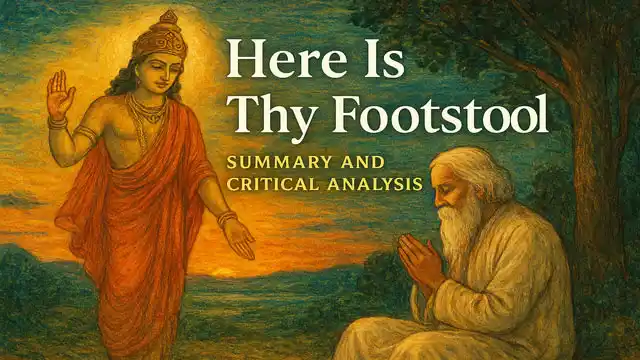
These differences arise from arrogance and vanity. The poet observes that people seek God in temples, mosques, and churches, offering elaborate rituals and worship. Yet God does not accept devotion expressed in this manner alone. The true path to the Divine is found through love and compassionate service to those who suffer.
Summary of the Poem 9 “Here Is Thy Footstool”:
Stanza:
Here is thy footstool and there rest thy feet where live the poorest, and lowliest, and lost.
When I try to bow to thee, my obeisance cannot reach down to the depth where thy feet rest among the poorest, and lowliest, and lost.
Pride can never approach to where thou walkest in the clothes of the humble among the poorest, and lowliest, and lost.
My heart can never find its way to where thou keepest company with the companionless among the poorest, the lowliest, and the lost.
Explanatory Word – Meanings:
1. Here is thy … lost = God resides among the poorest, the lowliest and the lost. 2. Here= at this place. 3. Footstool = God’s residence. 4. Lowliest = downtrodden. 5. Lost = the unfortunate people. 6. When I try … lost = the poet says that no words of prayer and worship can reach Him if he has no love for the suffering humanity. Love for the poorest, lowliest and lost is the greatest worship of God. 7. Bow= pay respect. 8. Obeisance = homage; tribute, worship 9. Pride … lost= the rich and the proud cannot find Him amidst the humble and the poor. 10. My heart … the lost = the poet confesses that he can never reach God because he has not been able to purify his heart of discriminating thoughts and feelings.
Paraphrase:
The poet suggests that no one can genuinely worship God while avoiding service to humanity. The divine presence dwells among the poorest, the humblest, and the forgotten. God makes no distinctions among people; differences such as wealth, status, or social rank are human inventions born of pride and arrogance.
True devotion to God requires a willingness to honour and uplift even the most destitute. This is impossible unless one abandons ego and vanity. The poet urges a life of simplicity and closeness to the poor, affirming that the Creator is found in the homes of the needy, the lonely, and the oppressed. It is through love and service to the downtrodden that one can hope to draw near to God.
Critical Analysis of the Poem 9 “Here Is Thy Footstool”:
Introduction:
The poem “Here Is Thy Footstool” is unmistakably devotional in tone. It suggests that worldly accomplishments—such as wealth, learning, and status—often breed desire and inflate human pride. This inflated sense of self-worth distances individuals from the rest of humanity. People become arrogant because they mistakenly believe themselves superior to others. A heart or mind stained with pride, the poem implies, cannot welcome the presence of God.
God does not dwell in grand temples, mosques, or churches; rather, His true abode is the humble heart of simple, modest individuals—many of whom are poor, marginalised, or burdened by misfortune. These people possess unwavering faith in the divine.
Ultimately, the poem urges us to recognise and respond to the suffering and needs of those less fortunate. By loving and serving them, we perform genuine worship and draw closer to God.
Thought – Content:
In the poem, the poet suggests that prayers and rituals hold no value if a person lacks compassion for those who suffer. To love the poorest, the forgotten, and the downtrodden is presented as the truest form of devotion to God. Genuine worship lies in embracing all human beings with a sense of equality and brotherhood.
Those who are wealthy and arrogant cannot discover God among the humble and the needy, for the dazzle of worldly comforts blinds them to the pain of others. Consequently, they fail to recognise the presence of the living God in the lives of the poorest and most neglected.
The poet urges us to seek God with humility rather than pride, and to look for Him among the meek and the lonely.
Tagore’s Intense Love for the Suffering Humanity:
Like every truly spiritual person, Tagore feels a deep compassion for the downtrodden and the marginalised — those who do not fit into society’s molds, the outcasts, the wanderers, and the forgotten. Since human beings reflect the divine, our love must extend to all: the unclothed and the starving, the ill and the lonely.
Through this poem, the poet seeks to teach that the most certain path to experiencing God lies in loving the poor, the deprived, and the unfortunate. Anyone who wishes to worship or serve God must first serve suffering humanity.
Tagore’s Mysticism:
According to Tagore, God dwells in each man. We should love and respect each person as the image of Eternal:
“Here is thy footstool and there rest thy feet where live the poorest, the lowliest, and lost.”
A person can rise in moral and spiritual strength by choosing a simple life and staying deeply connected with both humanity and the natural world. When separated from the divine, he becomes helpless and unhappy. The more he distances himself from nature, the lower he sinks in dignity and worth.
Language and Style:
Tagore’s poetry stands out for its graceful fusion of profound ideas, tender emotions, and the musical charm of language. He selects words that are precise, evocative, and drawn from a rich linguistic reservoir. His diction remains simple, clear, and suggestive, allowing him to express profound spiritual experiences with ease. Smoothness and musical rhythm form the essence of his style.
At times, a single word is placed so skilfully that it illuminates the entire meaning. His language stays close to everyday speech, with hardly any obscure terms. In his verses, simplicity walks hand in hand with grandeur.
The occasional use of archaic expressions like thee, thy, and thou lends his poetry an old-world charm and reflects the soul’s deep longing for unity with the divine. For instance:
“Here is thy footstool and there rest thy feet where live the poorest, and lowliest, and lost.”
“…… where thy feet rest among the poorest , and lowliest , and lost.”
In this poem, the poet skilfully employs repetition to great effect. Each of the four stanzas ends with the words “poorest,” “lowliest,” and “lost,” creating a refrain-like pattern. This recurring triad leaves a strong, enduring impact on the reader’s mind.