
Introduction of the Poem “My Grandmother’s House”:
In her poem “My Grandmother’s House,” Kamala Das revisits memories of her ancestral home and her late grandmother. Written in a confessional tone, the poem contrasts the poet’s present sense of emptiness with the warmth and unconditional love she once received from her grandmother.
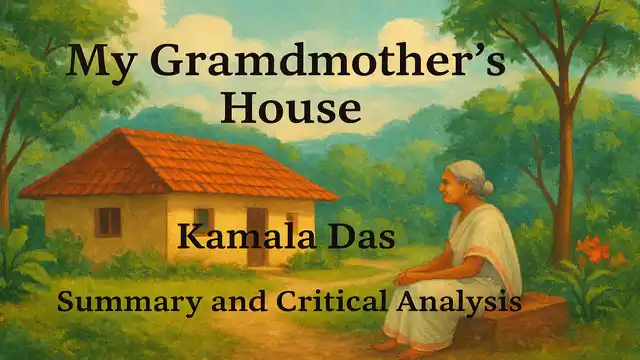
Although brief, comprising only sixteen lines, the poem carries immense emotional depth. It is part of Kamala Das’s debut collection, Summer in Calcutta, and captures her characteristic themes of love, loss, and longing.
Through vivid recollection, Das reflects on her childhood, a time filled with affection and peace—feelings absent from her present life.
The poem begins with a direct reference to her grandmother’s house, the place where she spent her early years. This home symbolizes security and emotional nourishment, both of which have vanished with her grandmother’s death. Beneath the simplicity of the verse lies a profound sense of nostalgia and displacement.
In a loveless world, the poetess’ remembrance of her grandmother becomes a poignant reminder of the deep emotional void within her. “My Grandmother’s House” thus emerges as a powerful expression of yearning and sorrow, blending tenderness with quiet despair.
Summary of the Poem:
The poetess fondly recalls her ancestral home in Malabar, where she spent part of her childhood enveloped in her grandmother’s deep love and affection. Her grandmother adored her, and the poetess cherished every moment spent in her company—those were some of the happiest years of her life. Later, she moved to a distant city, far away from that beloved home.
Now, she remembers her grandmother and the day of her passing with a heavy heart. At that time, the poetess was too young to read the books that lay untouched in the house. The loss of her grandmother left her emotionally numb, as if the warmth and sensitivity of her heart had been taken away with her grandmother’s death.
Critical Appreciation:
Introduction:
The poem “My Grandmother’s House” is taken from Kamala Das’ first poetry collection, Summer in Calcutta (1965). It expresses the poetess’ deep sense of nostalgia and longing for her ancestral home in Malabar, where she spent some of the happiest and most cherished days of her childhood. That home, once filled with her grandmother’s warmth and affection, remains etched in her memory.
In this poem, Kamala Das recalls both her grandmother and the house that symbolized love, comfort, and belonging. Although she now lives far away in another city, the memories of those days continue to haunt her tenderly. The overwhelming surge of emotion is conveyed through the use of ellipses, suggesting her unspoken pain. The phrase “the house withdrew” evokes a poignant image— as though the house itself were a living being, unable to endure the emptiness left behind after her grandmother’s passing.
Thought-Content:
The poetess fondly recalls her ancestral home in Malabar, where she had spent the early years of her life under the tender and protective care of her grandmother. Her grandmother adored her deeply, showering her with boundless affection. Now living far away in another city, the poet looks back with longing on those cherished days—the warmth of her grandmother’s love and the comfort of the family home where she grew up.
As a young girl, she often found herself surrounded by countless books, which, in her childish imagination, appeared strange and frightening—like coiled snakes. The death of her grandmother left her deeply shaken, rendering her cold and lifeless, like the pale moon. The poetess now yearns to return to that once-vibrant house, to gaze again through its windows—windows that are now lifeless and blind.
The home stands empty, abandoned, and silent. She wishes to sit there alone, listening to the haunting music of the cold winter winds, whose melancholy notes might bring back memories of her beloved grandmother.
When her visit to the old house ends, she will go back to her distant new home, yet the sorrowful memories of her childhood and her grandmother’s love will continue to linger within her. In her youth, she had known pure, selfless love; now, feeling its absence, she longs for affection—even if it must come from strangers.
The Theme of Unfulfilled Love:
In this poem she speaks of her misfortune in not having received true love or affection from any man:
“I who have lost
My way and beg, now at strangers’ doors to Receive love, at least in small change?” The Use of Imagery and Symbols:
The ‘window’ image in this poem is very remarkable and suggestive. It suggests a link between the past and the present. It also underlies the languishing desire of the poetess for a sentiment peep into her past and resurrection of her dreams and desires. The Grandmother’s House is a symbolic retreat for the poetess to a world of innocence, purity. love and simplicity from a world of corruption, sterility exploitation and cunningness. It is a sanctuary of love which is conspicuous by its absence in the harsh world of reality.
The Poetess’ Arousing Deep Sympathy:
The poetess’ life seems to be meaningless because she has always been deprived from true love. The sense of futility of life has most effectively been conveyed to us by this poem. There are some key phrases in the poem which convey us a sense of despair and the feeling of futility The house withdrew into silence, Just listen to the frozen air, And beg now at strangers’ door.
Style and Language:
A powerful emotional effect has been achieved by the author by a use of minimum possible number, of words. The poetess has shown a remarkable capacity to avoid garrulity and copiousness. The poem is compact and well-knit so far as its structure is concerned. The style of writing here is terse. ‘Cold like the Moon’ is quite an appropriate Simile. ‘An armful of darkness’ is quite a satisfactory metaphor. ‘Like a brooding dog’ is a clumsy simile. The phrase ‘in small change’ is a metaphorical way of saying ‘in a small quantity’.