Introduction of the Poem 10 “O Fool, To Try To Carry Thyself”:
Poem 10 of Gitanjali, beginning with the line “O Fool to try to carry thyself”, is one of Rabindranath Tagore’s most striking allegorical pieces. In this brief yet profound lyric, Tagore addresses the human tendency toward ego, self-reliance pushed to absurdity, and the illusion of control. By calling the speaker “O Fool,” he uses gentle rebuke to awaken the reader to a deeper spiritual truth: that life’s journey is not meant to be navigated through pride or isolation, but through surrender to the divine rhythm that carries all creation.
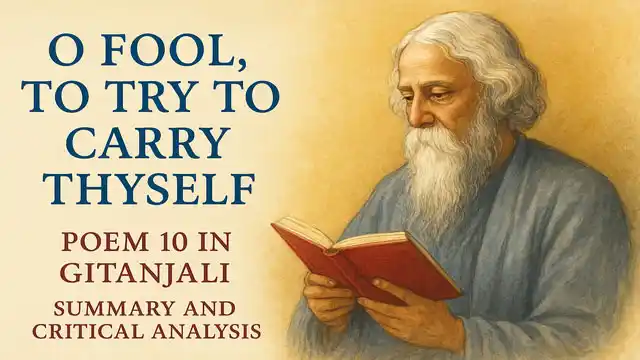
Tagore’s central image—of someone trying to carry themselves—functions as a metaphor for the spiritual burden we create when we rely solely on the self and ignore the sustaining presence of the divine. Instead of trusting the natural flow of existence, the human being insists on bearing unnecessary weight. Through simple language and a parable-like tone, the poem critiques the ego’s desire for autonomy and celebrates humility, trust, and alignment with the divine will.
As with many poems in Gitanjali, this lyric blends mysticism with psychological insight. It invites readers to let go of self-imposed burdens, to stop resisting life’s current, and to recognise the gentle support of a higher power. The poem thus becomes a call to surrender—not in defeat, but in liberation.
The poem “O Fool To Try To Carry Thyself” is a graceful expression of devotion and unwavering trust in the Divine. In it, the poet urges everyone to place complete faith in God’s boundless generosity and compassion, for He tends to every part of His creation. The soul, the poet suggests, must remain untouched by greed or desire. Since God has already provided all that is essential, we need not be anxious about the results of our honest and virtuous actions; instead, we should cultivate contentment. Being all-powerful, God has the ability to resolve our troubles and fulfil our needs in the most perfect way.
Summary of the Poem 10 “O Fool To Try To Carry Thyself”:
Stanza:
O Fool, to try to carry thyself upon thy own shoulders! O beggar, to come to beg at thy own door!
Leave all thy burdens on his hands who can bear all, and never look behind in regret.
Thy desire at once puts out the light from the lamp it touches with its breath. It is unholy – take not thy gifts through its unclean hands. Accept only what is offered by sacred love.
Explanatory Word – Meanings:
1. O Fool … shoulders= it is foolish on our part to bear the heavy burden of anxieties and worries of life on our shoulders. 2. O beggar … door= there is no sense in begging at our own door. 3. O Fool = the poet calls the man a ‘fool’ because he does not have faith in divine. 4. O beggar = the poet calls the man a ‘beggar’ who foolishly thinks that he can arrange himself whatever he needs. Man again does not recognise the supremacy of God. 5. Leave … in regret = we should put everything in the hands of God. We should not look to the past with regrets or with wistful longing. 6. Thy desire … breath= desires are wicked and the very presence of desire puts out the lamp of reason and wisdom burning in the human soul. 7. Puts out = extinguishes; destroys. 8. The light from the lamp = enlightenment and wisdom of soul. 9. It is unholy … hands= human soul must be purified of all such unholy desires before it is fit to accept the gifts of God. 10. Unholy= not sacred. 11. Accept….sacred love= man should desire this thing or that, but gratefully accept what is given to him by God.
Paraphrase:
The poet suggests that we act unwisely when we try to shoulder the weight of life—its anxieties, duties, and troubles—on our own. These burdens, he says, are better entrusted to God, who already sustains the entire universe. Surely, the One who carries such an immense load can support us far more effectively than we can support ourselves.
God will care for us, but only when we place complete trust in Him. When we depend on the Divine, our efforts prosper. We must surrender ourselves fully to God, confident that He will do what is best for us. Contentment and gratitude for what He provides should guide our hearts. We ought to face the future with hope and bravery, rather than dwell on the past with sorrow or regret.
Human beings must nurture absolute faith in the Divine. The flame of the spirit may shine brightly, but the winds of desire can snuff it out. Desire springs from ignorance, and it dims the light of reason, wisdom, and spirituality within the soul. So long as we cling to desire, our hands remain impure, and we are unprepared to receive divine insight. By renouncing these impure longings, we make ourselves worthy of receiving the sacred gifts of love.
Critical Analysis of the Poem 10 “O Fool To Try To Carry Thyself”:
Introduction:
The poem titled “O Fool To Try to Carry Thyself” is a moving expression of devotion and unwavering faith in God. The poet urges us to place our trust in God’s boundless compassion and generosity. God, being all-powerful and benevolent, lovingly cares for every being in creation.
The human soul, the poet suggests, should remain untainted by greed or selfish desire. Since God has already provided all that we truly require, we need not be anxious about the results of our sincere and righteous actions. True wisdom lies in faith in God, freedom from greed is the highest virtue, and contentment is the richest treasure one can possess.
Thought – Content:
In the poem, the poet urges human beings to place complete trust in God, surrendering their worries and burdens to Him, with the assurance that such faith will never bring regret. He emphasizes that one should not be anxious about the results of their actions, for God is compassionate and generous, always supporting His devotees.
The poet further advises people to cleanse their souls of the corrupting power of desire. The longing for more—especially for worldly possessions—draws individuals toward wrongdoing and moral decline. Instead, one should learn to remain satisfied with whatever God chooses to bestow.
Those who chase material success at any cost resemble people who obtain things through impure means; such gains cannot be presented before God, and even if offered, they will not be accepted. Therefore, the poet counsels that only what is earned through righteous and honest effort should be embraced.
Faith in Divine:
The poet asserts that human beings must place their faith in the divine and acknowledge God’s supreme authority. In the material world, a person is constantly beset by anxieties and stress. It is folly, the poet suggests, for man to burden himself with the weight of these endless worries. Instead, he should entrust them to God. As the Creator of the universe, God watches over every living being.
Human dissatisfaction, the poet observes, stems from his own desires, which enslave him. Therefore, the poet urges man to remain content with whatever God grants him. The wisest path is to move forward with courage and self-confidence, grounded in complete trust in the divine.
Language and Style:
Tagore’s language is marked by clarity, simplicity, and rich suggestiveness. He chooses plain yet precise words to convey profound spiritual emotions. A natural musicality and grace run through his style. His diction remains close to ordinary speech, though he occasionally uses archaic forms such as thee, thy, and thou, which lend his writing an old-world charm and echo the soul’s intense longing for unity with the divine. For instance:
“O Fool, to try to carry thyself upon thy own shoulders! O beggar, to come to beg at thy own door!”
Imagery is all pervasive in Tagore’s poetry and it gives a kind of unity to it. In the present poem, the lamp image in the last stanza is taken from the Gita: Lord Krishna says, “It is desire, it is wrath, begotten by the quality of motion: all consuming, all polluting, know thou this as our foe here on earth.”
“As a flame is enveloped by smoke, as a mirror by dust, as an embryo is wrapped by the amnion, so this universe is enveloped by it (Desire).” (III, 37 and 38)