Introduction to the Poem “A River”:
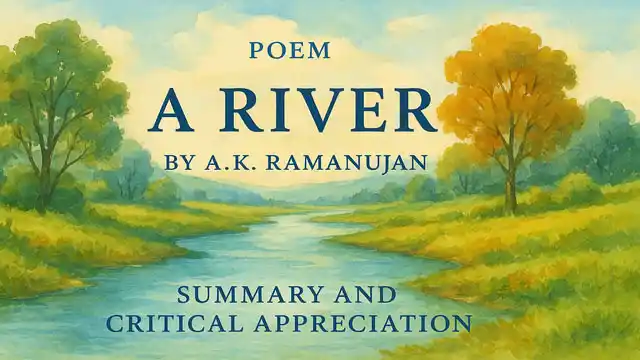
The poem “A River”, first published in The Striders in 1966, centers on the river Vaigai that flows through Madurai — a city long regarded as the cradle of Tamil culture. In this work, the poet exposes the attitude of both ancient and modern Tamil poets who remain indifferent and insensitive to human suffering during times of catastrophic floods. The poem stands out for its ironic contrasts and gentle satire, directed at poets who romanticise dramatic natural events like floods while ignoring their tragic human consequences.
Ramanujan criticises those who focus solely on the superficial beauty of nature, neglecting its deeper and often painful realities. His concern lies with the human dimension of such events, and he brings forth the harsh truths of life with unflinching honesty. The poem reflects a recurring tragedy familiar across India, where monsoon-swollen rivers frequently devastate villages and displace countless people.
Although deeply rooted in Indian sensibility, Ramanujan’s perspective is also shaped by his Western education and his years spent in the United States. This distance from his homeland refines his vision, allowing him to recreate vivid images of Indian life drawn from the rich reservoir of his memory.
Summary of the Poem “A River”:
The City of Madurai and Its River:
The city of Madurai is renowned for its magnificent temples and its rich legacy of poetry. Countless poets have sung praises of the city and its sacred shrines. Flowing through it is the river Vaigai, which dwindles during the summer months into a thin stream winding among heaps of sand that resemble ribs. Its watergates become clogged with straw and strands of women’s hair, while the metal bars gather rust. The bridge spanning the river bears patches of repair, marking its age. The damp stones scattered across the riverbed gleam in the sunlight like resting crocodiles, whereas the dry ones resemble shaven water buffaloes basking in the heat.
Poets’ Romantic View of the River:
Many poets of Madurai choose to celebrate only the beauty of the river in flood, ignoring the harsh truths of its destruction or its parched, lifeless state. They show little concern for scenes of suffering or discomfort. The river’s uglier aspects—whether in excess or in absence—do not interest them. Their verses dwell solely on the splendour of the swelling waters, not on the pain they leave behind.
The Visitor’s Experience in Madurai:
A traveller once spent a day in Madurai at a time when the river was on the verge of flooding. He personally witnessed the events that unfolded when the waters rose that year. The flood became a source of curiosity, fascination, and amazement for the townspeople, who eagerly gathered to watch the spectacle. However, to the visitor, it seemed a moment of real danger, for the swelling river threatened to bring serious damage and devastation to the villages along its banks.
People’s Indifference to Destruction:
Rather than expressing concern over the damage caused by the flood, people everywhere spoke about how steadily the water level was rising. They described how the water crept up the cobbled steps that led to the river, swallowing them one after another, until even the bathing ghats began to vanish beneath it. The visitor overheard talk of the flood sweeping away three village houses, a pregnant woman, and two cows named Gopi and Brinda — yet no one seemed alarmed. Incidents like these were considered ordinary whenever the floods came.
The Poets’ Fascination with Beauty:
The modern poets continued the legacy of their predecessors, composing verses solely about floods. They were deeply captivated by the charm and grandeur of the rising river, finding inspiration in its beauty and spectacle. However, they paid little attention to the grim realities that accompanied the floods. The devastation and human suffering left them unmoved. Detached from the emotions of humanity, they dwelled instead in a realm of imagination and aesthetic delight. To them, the swollen river was not a symbol of ruin, but a mesmerising vision of nature’s splendour.
The Drowning of the Pregnant Woman:
They failed to see the drowning of the pregnant woman — a scene that symbolized the loss of not just one life, but two or even three, the mother and the unborn child or children within her. As she sank beneath the waters, she might have felt the desperate movements of the little ones inside her womb, as though they were pleading to be freed from their watery prison. Yet, perhaps the poets chose not to envision such a heart-rending moment. Their imagination soared only where beauty existed, but it faltered when faced with the depths of human tragedy.
The Visitor’s Reflection on Poetic Reality:
The poet—or perhaps the visitor—who had spent just a day in the city, remarked that the river contained just enough water to appear poetic, to inspire verse only once a year. During the flood’s first half hour, it swept away three village homes, two cows named Gopi and Brinda, and a pregnant woman. It was said that the woman had been expecting identical twins, flawless and without a single distinguishing mole—nothing by which one could tell them apart once they were born.
The Tragic Fate of the Unborn Twins:
In simpler terms, the twins in the womb were identical—without any birthmarks or distinguishing features to tell them apart. They passed away before ever seeing the light of day. Despite their desperate efforts to emerge into the world—kicking and struggling within their mother’s womb—they could not escape. When their mother’s breath ceased, their tiny lives ended with hers.
Critical Appreciation of the Poem “A River”:
Introduction:
The poem “A River”, one of the most remarkable pieces from The Striders (1966), vividly portrays the image of a river while exposing the contrasting attitudes of both ancient and modern Tamil poets. R. Parthasarathy highlights their complete indifference and insensitivity toward human suffering during devastating floods. These poets, instead of empathising with the victims, choose to romanticise the river’s grandeur and beauty, celebrating its overflowing majesty while neglecting the misery it brings. They avoid addressing the harsh realities of human pain, fearing that such themes might tarnish the elegance or lyrical charm of their verse.
Through this poem, the poet also criticises the general apathy of society. People, rather than showing concern or offering aid to the flood victims, treat the calamity as a spectacle. They become eager onlookers, fascinated by the swelling waters and the drama of nature, yet remain unmoved by the destruction and loss that accompany it.
Thought – Content:
In the poem, the poet portrays a river flowing through the city of Madurai. He then turns his attention to the poets who live there. These poets prefer to celebrate the river’s splendour when it swells and overflows during the monsoon, yet they overlook the suffering and destruction the flood brings to human lives. The poet notices how ordinary people discuss the rapidly rising water — how it climbs over the stone steps leading to the river and how the floodwaters carry away village huts, a pregnant woman, and even cattle.
The Use of Irony:
The poem focuses less on the river itself and more on the mindset of those who value sensationalism above human compassion. Through irony, the poet exposes the apathy of both traditional and modern poets toward the suffering, misery, and immense devastation brought about by the flood. There is a striking absence of genuine human concern in their work. The poet satirises these writers for selecting trivial subjects for their verse and criticises them for hiding the harsh truths of human existence. The destructive power of the river is depicted with deep irony, emphasising this moral blindness.
The Use of Humour:
Although the poem deals with grave and serious events, it is not devoid of humour. We are entertained by amusing details such as the river’s watergates getting clogged with women’s hair and the cows being given names like Gopi and Brinda. Even the image of the unborn child—or children—restlessly kicking at the walls of the mother’s womb, eager to be born into the world, carries a touch of gentle humour.
“straw and women’s hair
clogging the watergates
at the rusty bars.”
“…… of the pregnant woman
drowned, with perhaps twins in her,
kicking at blank walls
even before birth. ”
The Use of Imagery:
The use of concrete imagery lends the poem a strong sense of realism and vividness. The images are both evocative and visually striking. The cameo-like depiction of the dried-up river reflects the poet’s keen observation and attention to subtle details. Moreover, the river’s desolation, as portrayed in the ensuing lines, symbolizes emotional barrenness and the lack of human sensitivity often found among poets.
“a river dries to a trickle
in the sand,
baring the sand – ribs,
straw and women’s hair
clogging the watergates
at the rusty bars. ”
The Use of Figure of Speech:
The poet has used the figure of speech simile to add the charm of the poem. He has compared the wet stones with the sleepy crocodiles. The dry stones have been compared with water buffaloes relaxing in the sun: “the wet stone glistening like sleepy crocodiles, the dry ones Shaven water – buffaloes lounging in the sun. ”