Introduction Poem “Harvest Hymn”:
Poem Harvest Hymn is a short, devotional lyric poem by Sarojini Naidu, one of India’s most celebrated poets and freedom fighters. The poem is a collective prayer offered by farmers to the divine forces of nature. It reflects the deep bond between rural life and the natural world, showing how the success of a harvest depends on rain, sunlight, soil, and the blessing of God.
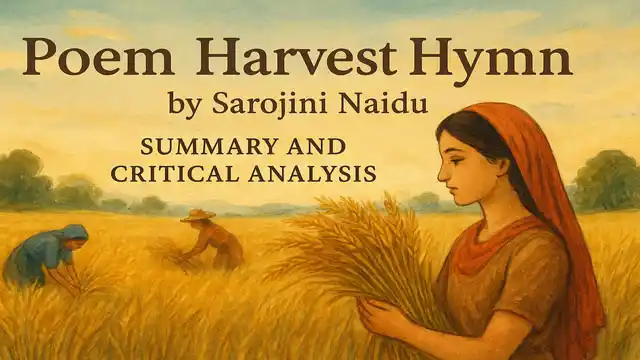
In this poem, Naidu highlights the humility, gratitude, and hope of the farming community. The farmers acknowledge their dependence on nature’s compassion and request protection for their crops from storms and disasters. The tone is reverent and musical—true to Naidu’s style, often called the “Nightingale of India” for her lyrical and melodious poetry.
“Harvest Hymn” ultimately celebrates faith, community, and the timeless rhythm of agricultural life, capturing both the vulnerability and the spiritual strength of those who live close to the land.
The poem “Harvest Hymn” unfolds like a choral performance—beginning with the voices of men, followed by women’s voices, and ending with a unified chorus. The poet evokes a vibrant, celebratory mood reminiscent of the Indian countryside during harvest season.
In the poem, the men offer their hymn to Brahma, Surya, and Varuna, while the women direct their praise to Prithvi. Ultimately, all voices rise together in a collective invocation to the Lord of the Universe, the eternal father, the indescribable Om.
Summary of the Poem “Poem Harvest Hymn”:
Stanza 1:
Men’s Voices
Lord of the lotus, lord of the harvest,
Bright and munificent lord of the morn!
Thine is the bounty that prospered our sowing.
Thine is the bounty that nurtured our corn.
We bring thee our songs and our garlands for tribute,
The gold of our fields and the gold of our fruit;
O giver of mellowing radiance, we hail thee,
We praise thee, O Surya, with cymbal and flute.
Lord of the rainbow, lord of the harvest,
Great and beneficent lord of the main!
Thine is the mercy that cherished our furrows,
Thine is the mercy that fostered our grain.
We bring thee our thanks and our garlands for tribute,
The wealth of our valleys, new – garnered and ripe:
O sender of rain and the dewfall, we hail thee,
We praise thee, Varuna, with cymbal and pipe.
Explanatory Word – Meanings:
1. Lord of the lotus … harvest = Brahma is known as the Creator of the universe. Men pay their thanks to Brahma for giving germinating power to the seeds and they sing hymn in His praise. 2. Bright … morn = they sing hymn in praise of the sun – god to main impart light to the plants. 3. Munificent = extremely generous. 4. Thine is … our corn = it is due to generosity of the sun – god that all the seeds sown in the fields, germinate well and the sun – god protect them. 5. Nurtured = brought it up. 6. Bounty = blessings and kindness. 7. The gold … fruit = the fields become prosper with corns and the fruits become juicy with the warm rays of the sun. 8. Mellowing radiance = the warm rays of the sun ripen the corn or crops. 9. We … flute = they sing in praise of sun – god with cymbal and flute. 10. Cymbal = a concave plate of brass which produces a sharp ringing when struck. 11. Flute = a woodwind instrument with a high pitch. 12. Lord of the rainbow … main = Varun, Lord of rain and Brahma perform a vital role in flourishing the harvest. 13. Beneficent = giver of kind gifts. 14. Cherished = nourished or prospered. 15. Dewfall = drops of dew falling at night.
Paraphrase:
People lift their voices in praise of Lord Brahma, who in Indian mythology is honoured as the Creator of the universe. It is widely believed that Brahma watches over the seeds and guides their sprouting. They also sing to the sun god, whose generosity brings light and helps the fields thrive. Because of his warmth, the grains receive proper nourishment and grow abundantly. In devotion, men offer garlands and chant hymns.
The farmers rejoice when they see their fields full and fertile. The sun’s gentle heat ripens their crops and fruits, and they gladly welcome its rays as they fall across the farmland. Accompanied by the notes of cymbals and flutes, they sing songs celebrating the sun god.
They worship Lord Varun as well, the deity of rain and lord of the vast oceans. Varun forms the clouds that bring life-giving showers, helping irrigate the fields. The moistened soil cools and refreshes the plants. With the combined blessings of Varun and Brahma, farmers reap abundant harvests.
As they offer garlands and sing hymns of gratitude, the farmers prepare new granaries for their yield. Blessed with rich harvests, they prosper and live in abundance.
Stanza 2:
Women’s Voices
Queen of the ground flower, queen of the harvest,
Sweet and omnipotent mother, O Earth!
Thine is the plentiful bosom that feeds us,
Thine is the womb where our riches have birth.
We bring thee our love and our garlands for tribute,
With gifts of thy opulent giving we come:
O source of our manifold gladness, we hail thee,
We – praise thee, O Prithvi, with cymbal and drum.
Explanatory Word – Meanings:
1. Queen … O Earth! = the women pay their homage to Prithvi, the ancient mystic Earth – goddess. They call her the queen of the flowers of large fruits such as pumpkin and watermelon and the queen of harvest. They sing in praise of sweet natured and all powerful mother. 2. Gourd = large fruit. 3. Omnipotent = all powerful. 4. Thine … feeds us = the mother Prithvi has an immense bosom to feed all the human beings. She (Prithvi) is able to bring up all the human beings. She is a universal mother. 5. Bosom = breasts. 6. Thine … have birth= a great treasure is hidden in the womb of Earth – goddess. She gives birth to a large number of things. She is the mother of broad heart. 7. We bring … tribute= the women, through their hymns, show great affection to their mother Prithvi and offer garlands to pay homage. 8. With gifts … we come= singing in praise of Earth goddess, they show their gratefulness for her generosity in providing them many gifts. It is Earth – goddess who has kept them alive and helped in surviving. Hence, they call her wealthy and generous. 9. Opulent = rich; abundant. 10. O source … drum = the mother earth is the greatest source of many forms of delight and joy. They hail the mother Prithvi and they sing hymns in praise of her with cymbal and drum.
Paraphrase:
After the men finish, the women raise their voices in hymns honouring the Earth goddess. They hail her as the sovereign of lush, fruit-laden blossoms and the ruler of the harvest. Though endlessly exploited, she remains serene. She is generous, gentle in spirit, yet boundlessly powerful. Her vast bosom symbolizes her ability to nourish every living being in the universe. She can nurture all creatures into existence. She is the richest of all beings, for an immense treasure lies hidden within her womb. From her, countless forms of life are born.
The women sing to express their gratitude and affection for her benevolence, offering garlands of flowers as a gesture of reverence. It is through her compassion and blessings that all creatures endure. She is the bestower of innumerable gifts, the source of countless joys and pleasures. The women greet her with their songs, praising her to the rhythm of cymbals and drums.
Stanza 3:
All Voices
Lord of the Universe, Lord of our being,
Father eternal, ineffable Om!
Thou art the Seed and the Scythe of our harvests,
Thou art our Hands and our Heart and our Home.
We bring thee our lives and our labours for tribute,
Grant us thy succor, thy counsel, thy care.
O Life of all life and all blessing, we hail thee,
We praise thee, O Brahma, with cymbal and prayer.
Explanatory Word – Meanings:
1. Lord … ineffable Om! = Brahma is invoked as the fountain head of all life and the Lord of the universe. He is the supreme and eternal and his power and influence are indescribable. 2. Ineffable= too great to be described in words. 3. Om= sacred monosyllable. It is also the symbol of Hindu Trinity. 4. Thou art … harvests = Brahma is present in the seed the farmers sow and in their scythe with which they reap the harvest. 5. Scythe= an implement with a long curved blade used for cutting long grass, grain, etc. 6.Thou art … Home= Brahma’s presence can be felt in farmers’ and workers’ hands, hearts and homes. 7. We bring … tribute = men and women sing that they gladly offer their lives and the fruits of their labour as tribute to the Eternal Creator. 8. Grant us … care = they pray Brahma to help, to guide and protect them. 9. Succour = to help or relieve in difficulty, need or distress; aid; assist. 10. Counsel =advice, suggestion. 11. O Life … thee = they hail him as Life of all life. 12. We praise … prayer = they sing hymns in praise of Brahma with cymbal and pray him to take them into his custody.
Paraphrase:
Men and women together raise their voices in praise of Brahma, the Creator of the universe. He is envisioned as the primordial source from which all existence springs. They call upon Him as the Lord who governs every creature and every element in the cosmos. His power is supreme, His creative force eternal, and His greatness is beyond the reach of language. His presence reveals itself in all things, living or lifeless. It lies hidden in the seeds that farmers press into the soil—seeds He guards and endows with the strength to sprout. It resides in the scythe with which farmers and labourers harvest their fields. It lives in their hands, their hearts, and their homes.
In essence, every form of life and every expression of nature draws its nourishment from Brahma. With gratitude, people offer their lives and the rewards of their toil to the Eternal Creator. As they sing His praises, they ask Him for support in hardship, for guidance when they lose their way, and for protection from misfortune. They celebrate Him as the Life within all life, lifting songs of devotion while joyfully playing cymbals and drums.
Critical Analysis of the Poem “Poem Harvest Hymn”:
Introduction:
The poem Harvest Hymns is structured as a choral piece, beginning with the voices of men, followed by those of women, and ending with both blending in a unified chorus. In this work, the poet vividly evokes the festive spirit of the Indian countryside during harvest season. The men’s voices offer praise to Brahma, Surya, and Varuna, while the women’s voices chant in honour of Prithvi. Ultimately, all voices merge together in a collective invocation to the Lord of the Universe—the eternal father, the indescribable Om.
Thought – Content:
In Harvest Hymns, the poet places on the lips of the men a song of praise to Surya, the sun-god—the most ancient of all deities—whose benevolence alone allows grain and fruit to mature. They also honour Varuna, the Lord of Rain, whose life-giving showers make all growth possible. The women, in turn, offer their heartfelt homage to Prithvi, the primal and enigmatic Earth-goddess. In the end, both men and women join together in exalting the Supreme Being, the source from whom every form and creature springs.
Theme and Moral of the Poem:
Human beings—whether belonging to the earliest societies or the most advanced civilizations—have always understood that their survival depends on a force greater than themselves, a force that brings forth the earth’s produce in its proper time. People may assist or obstruct its operation, but they cannot escape their reliance on it. Throughout history, they have created countless rituals to honour or appease this power, imagining it in many different forms. The Christian tradition celebrates it through harvest thanksgiving, while in India the same spirit finds expression in festivals like Durga Puja and Ramlila.
Style and Language:
Simplicity of language and directness of expression characterise this song . In simple and clear language, the poetess expresses the principle of unity in diversity or the spirit of oneness in the universe:
“Lord of the Universe, Lord of our being.
Father eternal, ineffable Om!
Thou art the Seed and the Scythe of our harvests,
Thou art our Hands and our Heart and our Home.
We bring thee our lives and our labours for tribute,
Grant us thy succor, thy counsel, thy care.
O Life of all life and all blessing, we hail thee,
We praise thee, O Brahma, with cymbal and prayer.”
The metre used is dactylic apparently in movement, but it is substituted in the second foot of the first line (lotus) by a trochee for the dactyl. The last (fourth) feet of the odd lines are truncated (shortened) into trochees, and the last of the even lines into a single stressed syllable. Lines scanned as dactyls would, beginning with we, O or The, must, be scanned as anacruses i.e., a syllable like a preparatory beat in music, outside the scansion of the line. But the lines may be equally well scanned as anapaests with frequent truncated first foot and extra – metrical syllable at the end.