
Introduction of the Poem “The Bangle Sellers”:
“The Bangle Sellers,” written by Sarojini Naidu, is one of her most celebrated poems, reflecting her deep sensitivity toward Indian culture, traditions, and the lives of ordinary people. The poem portrays a group of bangle sellers who travel from place to place, offering their colourful bangles for sale. Through their voices, Naidu explores the symbolic significance of bangles in an Indian woman’s life.
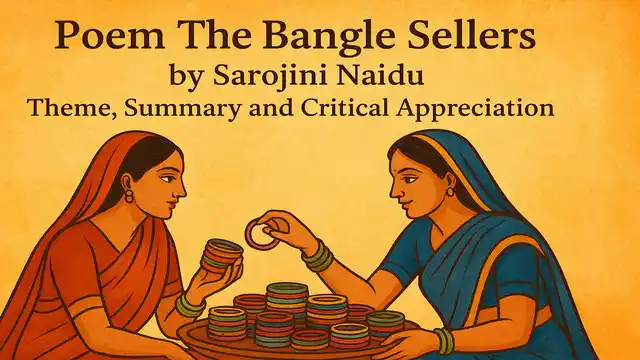
Bangles, in the poem, are not just ornaments—they represent different stages of womanhood, such as youth, marriage, and motherhood. Naidu uses rich imagery and melodious language to capture the beauty, emotions, and cultural meaning associated with these delicate ornaments. At the same time, the poem hints at the simple yet hardworking lives of the bangle sellers, showing their pride in the artistry of their craft.
Overall, the poem beautifully blends vivid description, symbolism, and cultural sentiment, making it a timeless piece in Indian English literature.
Sarojini Naidu’s poem “The Bangle Sellers”, included in her 1912 collection The Bird of Time, explores the cultural significance of bangles and the traditional roles assigned to women in Indian society. Naidu draws a vivid link between the various types of bangles and the stages of a woman’s life, highlighting how they bring joy to daughters, brides, wives, and mothers.
Through the voices of the hawkers, she reveals that these bangles carry deep religious and symbolic meaning. Since widows are forbidden from wearing them, bangles become a powerful emblem of good fortune and marital status, treasured especially by married women and those preparing for marriage.
The striking aspect of the poem is that the bangle seller never mentions his own poverty, struggles, or suffering, nor does he speak of gain or loss. Instead, he offers his bangles—objects rich in religious and spiritual value—with unwavering enthusiasm, revealing no trace of sadness. As he calls out his wares, he stays composed and cheerful, concentrating solely on the human emotions and experiences connected with the bangles.
The poem is a lyrical piece that portrays the social and cultural world of Indian women through the vivid imagery linked to these ornaments.
Summary of the Poem “The Bangle Sellers”:
Introduction of the Bangle Sellers:
The poem opens with the speakers identifying themselves as bangle sellers displaying their wares at a temple fair. They call out to the crowd, urging people to come and purchase their bangles. These vendors portray their bangles as fragile, gleaming, rainbow-hued rings of light. To attract buyers, they ask who among them will choose these ornaments for the women and girls in their families.
Bangles for Maidens:
From the second stanza onward, the speakers describe the various bangles they carry. Certain bangles are meant for a young unmarried girl, shimmering in shades of silver and blue reminiscent of mist drifting over the mountains. Others are tinted with soft pinks and pale reds, much like budding flowers along a forest brook. There are also bangles glowing in vivid green, echoing the hue of freshly sprouted leaves.
Bangles for a Bride:
Next, the bangle sellers mention that some of their bangles shine in a yellow hue, reminiscent of “sunlit cornfields.” Such bangles are considered ideal for a bride as she prepares for her wedding morning. Others glow in a vibrant red, symbolising the fire of a newly married woman’s sacred union — the warmth and passion of her new relationship. This red also reflects the deep desires of her heart. Described as “tinkling, luminous, tender, and clear,” the bangles capture the bride’s mixed emotions: the happiness of beginning a new life with her husband and the bittersweet pain of parting from her parents.
Bangles for a Mature Woman:
In the poem’s final stanza, the speakers continue promoting their bangles, calling out that some shimmer in purple or in grey dusted with gold. These pieces are meant for a woman in the middle stage of life—one who has travelled far through her experiences. They suit the woman who has lovingly raised her children, stayed devoted to her husband, and upheld her family’s honour. The speakers add that such bangles are ideal for the woman who has tended her home with dignity and worshipped the gods beside her husband.
Theme of the Poem:
Cultural Significance of Bangles:
The poem delves into the experiences of Indian women and the cultural traditions that shape their lives. Centered on bangles—one of the most cherished ornaments worn by women in India—it reflects the various phases of a woman’s journey within a traditional setting. By linking different colors of bangles to the joys and emotions of young girls, brides, wives, and mothers, the poem highlights how deeply these symbols are woven into Indian cultural identity.
Patriarchy and the Indian Woman:
In the poem, the poetess depicts the Indian woman as wholeheartedly devoted to fulfilling her social, religious, and spiritual duties within a male-dominated society. The text carries several subtle indications of a patriarchal structure. A man occupies a central place in a woman’s life—first as a father, then as a husband, and later as a son.
The final four lines have drawn criticism for seemingly endorsing patriarchal values. In these lines, the poet notes that the middle-aged married woman’s hands have nurtured, loved, blessed, and raised her fair sons; she has served her family with pride and is granted the honour of sitting beside her husband during religious rituals. Ultimately, the poet conveys a deep awareness of the gender inequality embedded in India’s patriarchal social order.
Lives of Bangle Sellers:
The poetess portrays the wretched and difficult lives of the bangle sellers, who, despite enduring constant hardships and facing both loss and gain, continue their work with cheerful voices. They never complain about their profession; instead, they take pride in offering bangles—objects crafted by human hands yet carrying deep religious significance.
Critical Appreciation of the Poem “The Bangle Sellers”:
Introduction:
The poem The Bangle Sellers is part of the third section of Indian Folk Songs from her second collection, The Bird of Time. It beautifully captures a quintessential Indian scene, highlighting the social, religious, and symbolic significance of bangles in Indian culture. In India, wearing bangles symbolizes happiness, joy, peace, and prosperity.
The poem celebrates the essence of Indian womanhood. Within its lines, the bangle seller endeavours to persuade his customers of the spiritual and symbolic importance of the bangles within a traditional Indian context.
The poem also traces the different stages of an Indian woman’s life, associating each stage with specific bangle colours—from the dreamy innocence of a young maiden, through the excitement of a bride, to the dignity of a mature matriarch.
Thought – Content:
Bangle sellers bring their vibrant bundles of bangles to the temple fair, ready to display them. These bangles are described as “lustrous tokens of radiant lives,” symbolising love, joy, and the bright moments in people’s lives. Crafted with care, they are meant for the daughters and wives whose lives they brighten.
The poetess notes that some bangles, intended for unmarried women, shimmer in shades of silver and blue. Others, designed for brides, shine like golden fields of corn in the morning sun, reflecting the warmth of marital bliss and the deepest desires of the heart. Their gentle tinkling mirrors the laughter and tears of a bride.
There are also bangles for the elder women, those who have lived through many seasons of life. These are tinted with deep purples and flecked with gold, representing years of devoted service, nurturing sons, and reverent worship alongside their husbands.
Moral of the Poem:
The poem emerges as a powerful social commentary, highlighting not only the experiences of Indian women but also the world of bangle sellers. While the narrative primarily traces the different stages of a woman’s life, it simultaneously sheds light on the existence of the bangle sellers.
Interestingly, the poem never explicitly mentions the poverty or struggles inherent in their trade, except for the phrase “shining loads,” which subtly hints at the weight of the bangles. The bangle seller’s cheerful tone masks the reality that their survival depends on selling these bangles.
The women in the poem are depicted as joyous figures, likely reflecting the idea that the bangle seller’s own happiness is intertwined with the happiness of the women she serves.
Form and Structure:
The poem carries a lyrical quality and is composed in the style of a folk song that celebrates the ideal Indian woman. It forms part of the poetess’s collection of folk poetry and is characterized by its simplicity, drawing upon everyday language and imagery from daily life. Its charm lies in the musicality of the words, conveying a single, pure emotion—happiness.
True to the nature of a good lyric, the poem is tightly structured and well-crafted. It is organised into four stanzas: the first sets the scene and introduces the theme, while the remaining stanzas explore significant stages in the life of an Indian woman. The rhyme scheme brings vibrancy to this lyrical folk song about bangle sellers, with the first line of each pair rhyming with the second, the third with the fourth, and the fifth with the sixth, following an aabbcc pattern.
The Use of Imagery:
The poetess employs vivid colour imagery throughout the poem. The phrase ‘rainbow-tinted’ bangles evokes multicoloured bangles, symbolising the diverse hopes, dreams, youthful energy, and aspirations of a woman.
The visual imagery of mountain mist is equally striking, as its hues shift between silver and blue, creating a dynamic and evocative scene. Colours are also carefully associated with different stages of a woman’s life: yellow for the bridal morning, and red or orange for the bridal night, reflecting the passionate longings of a bride’s heart; purple and gold for motherhood signify a woman’s sense of pride and fulfilment in her married life.
The poem includes a single auditory image—‘tinkling’—which comes alive only when the bangles are worn, adding a delicate musical quality.
The Use of Figures of Speech:
Metaphors are used to describe the colours of the bangles such ‘Rainbow tinted circles of light’ and ‘lust – tokens of radiant lives’.
There are some instances of simile: 1. ‘Some are flushed like the buds that dream.’ 2. ‘Some are like fields of sunlit corn.’ 3. ‘Silver and blue as the mountain mist.’
The poetess has used the figure of speech alliteration in the third stanza of the poem.
“Some are like fields of sunlit corn,
Meet for a bride on her bridal morn,
Some, like the flame of her marriage fire,
Or, rich with the hue of her heart’s desires
Tinkling, luminous, tender and clear
Like her bridal laughter and bridal tear.”