Introduction of “The Hag”:
Arun Kolatkar’s The Hag is a haunting and vividly imagistic poem that reflects his characteristic blend of irony, realism, and surrealism. Written originally in English and included in his celebrated collection Jejuri (1976), the poem portrays an encounter with an old, decrepit woman—“the hag”—who becomes a powerful symbol of decay, endurance, and spiritual desolation.
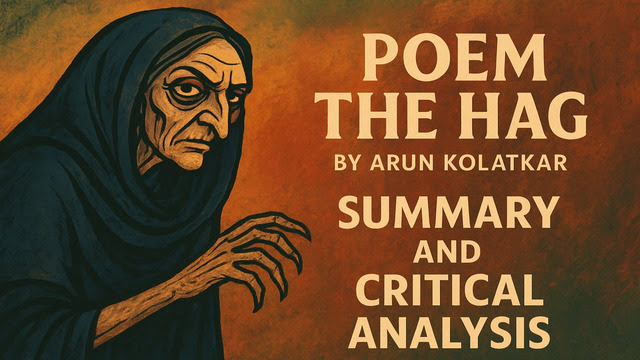
In Jejuri, Kolatkar explores the sacred town of Jejuri in Maharashtra, juxtaposing faith and scepticism, the divine and the mundane. Within this context, “The Hag” stands out as a moment where the poet’s eye catches the grotesque and the pitiful in human form, turning it into a reflection on mortality and neglect. The hag, with her distorted body and diminished vitality, is not merely an individual but an emblem of a withering world—perhaps of India’s ancient religiosity, eroded yet persistent.
Stylistically, Kolatkar’s spare diction and cinematic imagery turn an ordinary roadside sight into a moment of revelation. His detached tone, rich visual detail, and understated irony invite readers to look beyond appearances—to see beauty, horror, and truth mingled in the same frame.
Thus, “The Hag” encapsulates Kolatkar’s poetic genius: his ability to discover the sacred in the profane, to expose the contradictions of faith, and to render the smallest moment of perception into a profound commentary on human existence.
Summary of the Poem “The Hag”:
The Hag and Her Deafness:
This poem describes a hag eating an orange. This hag is absolutely deaf and cannot hear what anybody says to her. However, she does laugh when anybody says something to her jokingly because she can judge, from the way somebody has spoken to her, that he has made some kind of a joke.
The Hag’s Superficial Response:
She laughs only to please him, though her laugh is a vague one because she has not understood what he has said. She sits firmly behind a showy but dirty curtain and, to ward off any possible danger to her person or to her plans, she devours oranges.
Her Voracious Appetite for Oranges:
She likes the loose and pulpy oranges. Other people eat oranges, but this hag devours them. She seems to be attacking and assaulting the oranges. Other people peel an orange in order to eat it; but she tears an orange with great force into fragments.
The Imagery of Violence and Decay:
When thus torn into several pieces, an orange looks like a piece of costly, embroidered cloth which is worn – out and which looks like a rag. This hag seems to be urging her jaws to become more aggressive so as to be able to swallow orange – pieces briskly.
The Frenzied Act of Consumption:
As she has no teeth, she merely uses her jaws to devour the torn pieces of an orange. Indeed, it seems that she is in a rage or in a state of frenzy while eating an orange. She would not like to spare an orange or to miss any piece of it; and yet the expression in her eyes is such that she seems to deny the fact of having eaten an orange.
Critical Analysis of the Poem “The Hag” :
Introduction to the Poem and the Hag’s Description:
Here is an unusual poem. We, of course, have never seen a hag devouring oranges in the manner in which the hag in this poem is described as devouring them. Kolatkar must have witnessed this sight with his own eyes because otherwise he could not have given us such a graphic account of it. He, it seems, has seen a hag eating or devouring oranges in a greedy and gluttonous manner. She was obviously hungry and, perhaps, starving.
Effective Use of Words and Alliteration:
But the merit of this poem lies in the use of very effective words which have been used to describe the situation. She paws. She claws. She does not believe that an orange is to be peeled. She believes that an orange is to be torn. She urges her jaws to become more vigorous and active in order to be able to mob and maul a piece of orange.
(The alliteration in “mob and maul” is to be noted like the alliteration in the phrase “featureless fury” in the next line). Though the hag has been eating the orange most greedily and at great speed, her eyes seem to deny that she has done any such thing. The use of the phrase “the avid farce” for the whole operation of the hag’s eating an orange is an example of Kolatkar’s originality in phrase – making.
Wit and Tone of the Poem:
The whole poem is wittily written. The wit becomes obvious at the very outset when we are told that the hag, though stone deaf, laughs, of necessity, when somebody makes a joke. However, the poem begins in a somewhat solemn manner because a reference is made to the death which awaits this aged woman.
Lack of Sympathy and Overall Impact:
Kolatkar does not show the least bit of sympathy for the woman. In fact, we have the feeling that he has written the poem in too callous a vein. We would have enjoyed the irony and the satire more if the poem had been tinged with pity. Anyhow, he has given us a remarkable vignette.
Conclusion: The Poem’s Artistic Merit:
It is the portrait of a hag, and the poet has made an ingenious use of words. The poem is undoubtedly interesting, even arresting and gripping. The images presented in the poem are powerful indeed; and every image is sharply etched, to use a hackneyed phrase.