Introduction “Poet, Lover, Birdwatcher”:
“Poet Lover Birdwatcher” by Nissim Ezekiel is one of his most celebrated works, reflecting his mature poetic vision and disciplined artistic philosophy. It was first published in his collection The Exact Name(1965) and beautifully encapsulates Ezekiel’s belief in patience, observation, and inner stillness as essential qualities for creativity and understanding.
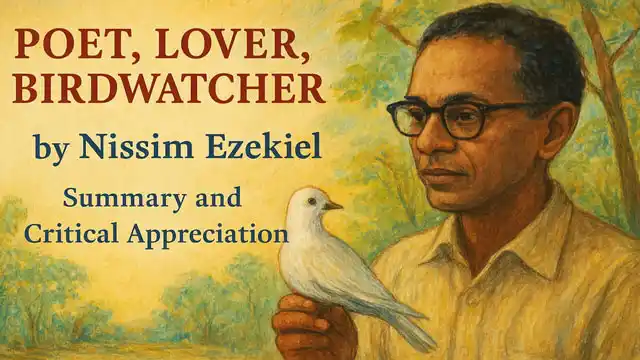
The poem draws a striking parallel between the poet, the lover, and the birdwatcher — three figures united by their quiet endurance, attentiveness, and quest for revelation. Using controlled imagery and meditative rhythm, Ezekiel suggests that true poetry, like love or the sighting of a rare bird, cannot be forced; it must come naturally to one who waits. The poem, therefore, serves both as an aesthetic manifesto and a spiritual reflection on the art of creation.
Summary of the Poem “Poet, Lover, Birdwatcher”:
The Patience of the Birdwatcher:
According to the poet, those who have a deep interest in observing and studying various kinds of birds, especially rare ones, are never in a hurry. Their work cannot be done hastily, as it requires a great deal of time for careful study and observation. They must closely examine the birds’ nature and behaviour, often spending hours waiting and watching patiently.
To observe rare birds, they must remain still in one place for long periods. If they try to complete their work within a fixed schedule, they cannot achieve satisfactory results. However, by remaining persistent and active in their efforts, they eventually succeed in their field.
In the same way, those who wish to study the nature and tendencies of women must patiently pursue their observation. For this reason, they often choose their beloved as the subject of study, as she can help them understand women better—but even this requires a great deal of time and careful attention.
The Poet’s Creative Process:
The finest poets are those who never compel themselves to write at all times. They wait patiently for the right words and expressions to rise naturally to the tips of their pens. When their thoughts and language run dry, they do not struggle against the emptiness; instead, they pause, allowing inspiration and feeling to return in their own time. Once their minds are illuminated again, they resume writing with renewed clarity.
True poetry, therefore, flows spontaneously—it cannot be born of labor or forced effort. Writing a poem should never feel like drudgery, for genuine art is not the result of toil but of inspiration. Just as a birdwatcher must wait quietly on a hilltop to glimpse a rare bird, so too must the poet wait for the rare visitation of insight.
Likewise, a lover must wait patiently for his beloved to surrender her heart willingly, only after she is convinced of his devotion. He cannot rush her or demand her affection; love must arrive of its own accord.
In these examples—the watchful bird lover and the patient suitor—the poet finds a reflection of his own creative process. He learns that poetry, like love or discovery, cannot be forced. The true poet begins to write only when an inner compulsion moves him—when inspiration, unbidden yet irresistible, calls him to create.
The Parallels Between the Lover, the Birdwatcher, and the Poet:
The finest poets compose their verses naturally and without strain. Writing poetry should never feel like drudgery, for a true poem is not the product of hard labor but of inspiration. Just as a birdwatcher must wait patiently on a hilltop to catch sight of a rare bird, a lover must wait for his beloved to yield herself to him in her own time. She does so only when she is convinced of his genuine affection.
The lover cannot rush this moment by force; only through patient devotion does he win her trust. When she finally feels assured of his love, she willingly surrenders, even if doing so seems to carry a certain risk. From these two images—the birdwatcher and the lover—the poet can draw a valuable lesson for himself: he should never begin a poem until he feels a deep, inner impulse to write.
The Value of Patience and Slow Movement:
The poet believes that slowness holds greater worth in every aspect of life. A slow and deliberate approach, he suggests, is far more rewarding than a hurried one. Moving slowly not only brings satisfaction and joy but also yields the best outcomes for anyone who observes or studies a subject with care.
For instance, a birdwatcher seeking to spot a rare bird must venture into secluded areas — perhaps near the silent source of a river or along a quiet seashore. The journey is neither easy nor quick. The birdwatcher must bear hardships, travel long distances, and wait patiently for hours, sometimes days, to witness the rare sight.
The challenge of reaching such lonely places mirrors the difficulty of understanding the mysterious depths of the human heart. Much like the hidden corners of the mind — the subconscious and the unconscious — there exist remote and thorny paths one must traverse to discover truth or beauty.
Thus, the birdwatcher’s long wait and endurance symbolise patience and perseverance. The same holds true for a lover, who must wait until his beloved transforms from a being of flesh and blood into a radiant spirit — luminous, yet still carrying an inner mystery that cannot be fully grasped. To him, she ceases to be a mere physical presence and becomes a vision of pure light.
In a similar way, a poet must also possess patience. A poem cannot be forced into being; it arrives only when the poet’s mind is illuminated by inspiration. The poet who once felt confused or uncertain finds clarity only through waiting. When that moment of illumination comes, his senses — his power to see and to hear — are restored. It is this quiet endurance, this patient waiting, that plays a vital role in awakening the poet’s creative spirit.
Critical Appreciation of the Poem:
Introduction:
Ezekiel holds the vocation of a poet in great reverence. In several of his poems, he reflects upon his own understanding of poetry and the creative process. Notable among these are Poetry, Creation, and Poet, Lover, Birdwatcher. The last of these, included in The Exact Name, draws a striking parallel between the poet, the lover, and the birdwatcher.
Each, Ezekiel suggests, must learn the art of patience, for success in their respective pursuits comes only to those who wait. Their waiting is not passive but purposeful—a vital part of the process that leads to fulfilment.
Through this analogy, Ezekiel seeks to define the poet by aligning him with the lover and the birdwatcher. All three share a common spirit: they are seekers—of words, of love, and of birds—and though their quests differ in object, their essential experience and dedication are the same.
Thought – Content:
In the opening stanza, Ezekiel draws a close parallel between the poet, the lover, and the birdwatcher. Despite belonging to different realms, all three share a common quality — the art of patient observation. The birdwatcher must quietly wait for the brief, delicate flutter of a bird’s wings; the lover must watch with calm devotion the graceful movements of his beloved; and the poet must wait for that rare, inspired moment when his mind is illuminated and words begin to flow effortlessly.
In the second stanza, the poet emphasizes that such slowness and patience yield the richest rewards. The birdwatcher’s patience is fulfilled when the rare bird finally appears or is caught in his sight. The lover’s reward comes when the beloved, moved by affection, surrenders her heart. Likewise, the poet’s patience culminates in the moment of creative revelation, when inspiration gives birth to a poem of beauty and depth.
Ezekiel further adds that to witness rare birds, one must venture into secluded, silent places—perhaps near a river’s source. Similarly, the lover must wait until the beloved’s heart softens. In the same way, the poet imagines himself soaring in the air of imagination, restless yet hopeful, awaiting the instant when his mind brightens with vision and his poem takes form.
Imagery and Symbols in the Poem:
The imagery in this poem is both vivid and evocative. What stands out most about the poet’s use of images is the effortless transition from one to another, so seamless that the poet, the lover, and the birdwatcher seem to lose their individual identities and blend into a single consciousness that carries the poem forward to its close. In this lyric, the literal and the symbolic fuse together until they become indistinguishable.
The poet—or the birdwatcher—begins by describing the state of mind shared by all who observe birds or contemplate women, for both birds and women serve as emblems of freedom, imagination, love, and creativity. The poem advocates a stance of stillness, suggesting that only in stillness can one truly listen to the voice of the soul—a vital condition for understanding freedom and the creative impulse.
Thus, the finest poets wait patiently for words to emerge from that inner stillness before giving expression to their experience. The lines “patient love relaxing on a hill / to note the movement of a timid wing” operate on two levels: literally, they describe the birdwatcher’s quiet observation, but symbolically, they capture the poet’s search for the perfect words and images—or the lover’s patient anticipation of the beloved’s response. Birds transform into words; the distant shore where the birdwatcher seeks “the rarer birds” becomes “the heart’s dark floor,” the inner landscape where the poet discovers themes and visions.
Style and Language:
The poem follows a strict structure, composed of iambic pentameter lines arranged in two tightly rhymed stanzas of ten lines each. It is rightly regarded as a distinguished work, rich in imagery that unfolds, as the title implies, on three interwoven levels.
The poem’s remarkable depth and quiet density are enhanced by a subtle, though significant, variation in its formal design. For example, within the twenty lines, there are ten enjambments—a much higher ratio than is typical in traditional verse—which gives the syntax greater freedom to shape space, emphasis, and the flow of emotional and intellectual rhythms in a natural manner.
The unusually long sentences perfectly capture the poem’s blend of urgency and contemplation. At the start of the second stanza, the regular pentameter briefly gives way under the pressure of the poet’s visionary intensity: the second line extends to five and a half feet, and the third to six. The interplay of run-ons and the contrast between short and long sentences create rhythmic tension and convey a sense of thought and feeling advancing steadily through complexity toward resolution—guided, rather than constrained, by the meter.