An Introduction:
Kamala Das is one of the most confessional and outspoken voices in Indian English poetry. Rebellious attitude of Kamala Das against the restrictive norms of a patriarchal society is found in her poetry. She stands out for her bold defiance of social, cultural, and patriarchal conventions. Writing at a time when female expression was expected to be modest and restrained, Das used poetry as a means of rebellion—against gender norms, emotional suppression, and the institution of marriage that often denied women individuality.
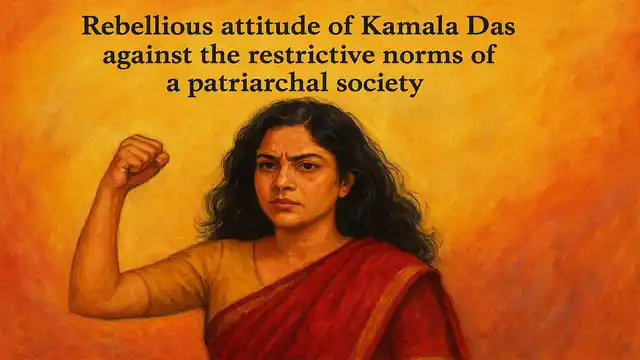
Her verses, marked by emotional intensity and honesty, challenge the hypocrisy of a male-dominated society and assert a woman’s right to autonomy—both physical and psychological. Through poems like “An Introduction,” “The Freaks,” “The Old Playhouse,” and “My Grandmother’s House,” Kamala Das transforms personal experience into a powerful protest against conformity. Her rebellious attitude is not rooted in mere defiance but in an earnest quest for identity, love, and self-realization, making her poetry both deeply personal and universally feminist in its resonance.
Kamala Das’ Rebelling against the Exploitation of Women:
Kamala Das’s confessional poetry can be seen as a form of protest, expressing her intense disapproval of the long-standing oppression and mistreatment of women in Indian society. Her marriage, as she portrays it, was a failure because her husband regarded her merely as an object for his own sexual satisfaction, withholding genuine love and emotional warmth.
In her poems, she vividly depicts his cold, mechanical approach to physical intimacy—an act that may have fulfilled her bodily desires but left her deprived of the affection and tenderness every woman seeks in a relationship. This lack of emotional connection, she suggests, leads not only to deep disappointment but also to profound suffering and anguish.
She rises in defiance against the subjugation of women in a patriarchal society. Deeply conscious of her femininity, she celebrates and reaffirms it in poem after poem. As a social rebel, she challenges the conventions, customs, and moral codes imposed by tradition. Her unfulfilled quest for love and emotional security, coupled with the exploitation she endured within the supposedly sacred bounds of marriage, bred disillusionment and frustration, transforming her into a voice of protest.
Both her life and poetry bear the mark of her nonconformity. In her personal struggles, she perceives the shared anguish of all women and transforms her individual pain into a universal experience. She becomes the embodiment of womanhood itself—she is every woman:
“It is I who laugh, It is I who make love
And then, feel shame, it is I who lie dying
With a rattle in my throat. I am sinner,
I am saint. I am the beloved and
the Betrayed.” (An Introduction)
Poems Presenting Her Extreme Protest:
The Poem “The Freaks” Is an Expression of Poetess’ Intense Emotions Poignancy:
The poetess conveys her emotions with deep intensity and heartfelt poignancy. In her vision, love appears as a mere illusion in a woman’s life. Her fervent longing for true affection remains forever unsatisfied. Even when the lover and beloved—or husband and wife—are together, they experience profound loneliness. The lover, who in Kamala Das’s poetry symbolizes betrayal and unrestrained desire, is depicted through stark images of ugliness and revulsion.
“The Freaks” is a confessional and autobiographical poem that genuinely portrays the absence of love, the emotional emptiness and collapse, and the sense of frustration and disillusionment in the poetess’ married life. It also exposes the hollow display of exaggerated passion that masks deeper despair. The poem stands as a sincere expression of a woman’s wounded sensibility—humiliated and suppressed within a patriarchal society.
“The Sunshine Cat”, a Pathetic Story of Her Life:
The poem portrays the deeply tragic experience of Kamala Das, who endured profound sexual humiliation throughout her life and was denied genuine emotional fulfilment in her relationships. Both her husband and the other men she grew close to treated her merely as an object of physical desire, offering her no real love or affection.
Even the man she truly loved viewed her only through the lens of lust, remaining indifferent to her emotional needs. Her husband, too, proved to be as insensitive and self-centered as the others. Overwhelmed by disillusionment and revulsion, she longed to erase every trace of them—their vulgar desires, their odours, and even the coarse hair on their chests—from her memory.
Kamala Das longed to withdraw from the prying eyes of the world. Trapped within the domestic cage her husband had built for her, she lived a life of quiet confinement. Her world was limited to a room filled with books, where her only companion was a ray of light that, to her weary eyes, appeared like a yellow cat. Bound by social expectations, she was compelled to perform the traditional duties of a wife within those four walls. Such is the fate of a woman in a patriarchal society.
The Poem “In Love” Dealing with the Tension between Love and Lust:
This poem deals with defilement of sex. It reveals the workings of feminine consciousness. True love is spiritual. But in this harsh, sterile and male-dominated world love is defiled in sex, and sex results in disgust, frustration and disillusionment. In Love, the poetess reveals her own futile yearning for love, her involvements in barren and sterile sex, her subsequent agonies, tortures, disillusionments and death-wish through the women persona.
The joyless repetition of the sex act bores her and she thinks of corpse bearers chanting “Bol, Hari Bol” which is prelude to getting consumed by fire. Since she cannot fulfil herself in love and sex irks and disgusts her, she wants to die and to be consumed in fire. Funeral fire alone can give her rest.
Her Complaining in the Poem “Glass”:
In the poem entitled “Glass”, Kamala Das complains that a man, wanting to perform the sexual act with her, had drawn her towards himself rudely and hastily, treating her as “an armful of splinters”. She says that man’s behaviour had hurt her and caused her much pain, so that she had felt like broken glass.
Her Protesting against Timidity of Indian Women in “An Introduction”:
Kamala Das has protested against the passivity and timidity of the Indian woman and against her subservience to her husband. In some of the most resentful lines in this poem, she writes that her husband surely did not beat her in the course of the sexual act but that her body yet felt badly beaten, and that the very weight of her breasts and womb crushed her.
Kamala Das’ Advocating the Liberty and Right of Women:
Kamala Das’ tone of resentment and indignation in these poems certainly shows her own sense of injustice against the social order but it also stresses the desirability and the need of the recognition of the claims and rights of the Indian women in general. Thus, Kamala Das may be described as a feminist, and a forceful and vehement feminist. She may be regarded as a champion of the rights of women and as a strong supporter of the movement for the liberation of women from the chains of slavery to men.
When Kamala Das wrote these poems, the movement for women’s liberation from male domination was in its initial and intermediate stages, though today the success of that movement has gone beyond the wildest dreams of women themselves. Today the Indian woman is as liberated as her counterpart in Britain and the U.S.A., but, at the time Kamala Das wrote her poetry, the Indian woman was subservient to her parents or her husband, while the question of having extra-marital relationships did not arise at all. Kamala Das was among the foremost Women to claim such freedom.
Her Treating Marriage as a Game of Cruelty:
Kamala Das is iconoclastic in her approach to marriage. She treats marriage as a game of cruelty on the part of a husband. Her female ego comes to the surface when she ruefully depicts her loss of liberty through marriage. In the poem entitled “Of Calcutta”, she exposes the intricacies of her inner pangs caused to her by her husband. Her husband, she says in this poem, treated her as a ‘walkie talkie’ to warm his bed at night. She felt that she had been reduced to a trained circus dog, and she asks:
“Where is my soul,
My spirit, where the muted tongue of my desire?”
Her Regarding Marriage as a Chastisement and a Punishment:
In the poem entitled “The Stone Age”, she laments the loss of her identity through marriage. Her female ego cannot tolerate male domination, and so she raises a voice of protest, sharply defining the gulf between the two worlds, one masculine and the other feminine. In The Stone Age, the note of rebellion and defiance is strongly expressed. The husband, devoid of love, is spoken of as:
“Fond husband, ancient settler in the mind,
Old fat spider, weaving webs of bewilderment.”
In the poem entitled “The Descendants”, she asks if it is any happiness for a woman to lie beneath a man for the sexual act, and points out that the world extends a lot beyond her lover’s six-foot frame. She intends to escape from this prison into a world of new love and infinite ecstasy. In the poem entitled “The Prisoner”, she says that she must someday find an escape from the snare of a husband’s or lover’s physical attractions.