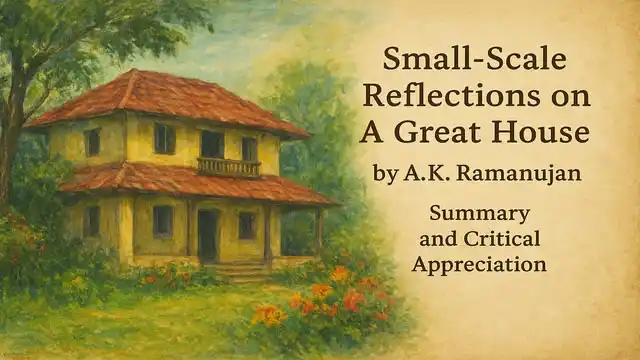
Introduction to the Poem “Small-Scale Reflections on A Great House”:
“Small-Scale Reflections on a Great House” by A.K. Ramanujan is a reflective and subtly ironic poem that explores the cultural, emotional, and symbolic significance of an ancestral Indian house. Written in free verse, the poem portrays the house as an enduring structure deeply rooted in tradition, constantly absorbing people, objects, customs, and memories—yet never letting anything truly leave its influence.
Through vivid images, gentle humour, and sharp observations, Ramanujan highlights how the house becomes a living metaphor for Indian family life, with its overwhelming sense of hospitality, emotional bonds, and the cyclical nature of relationships. The poem therefore serves as both a celebration and a critique of the complexities of Indian domestic culture, revealing how the past continually shapes the present.
The poem entitled Small Scale Reflections On A Great House is a nostalgic poem about a Great House that was the haunt of his childhood, as well as the people, things and events associated with it. It was first published in Ramanujan’s second volume of Poems, entitled Relations. In this poem, the poet shows his rare skill for bringing to life the smallest details of his subject. In it, the poet recalls the peculiar family house, where things that came into the house never went out.
The new things got completely lost into things that came earlier and, thus, the historic continuity was maintained. In the poem, the poet depicts the joint family system which was very popular in ancient days. It represents the feelings of love, brotherhood,neighbourhood and unity. In joint family system, true Indian culture is found. Social and moral values are given great importance. In the poem, the poet points out that Indian culture has forever accommodated whatever arrived at its threshold. It has incorporated all foreign elements into its internal structure.
Summary of the Poem “Small-Scale Reflections on A Great House”:
The Ancestral House as a Symbol of Tradition and Culture:
The poet recalls an ancestral house which had been a true embodiment of old culture and tradition. It preserved its old social and ethical values. The cruel blows of time could not affect its surroundings. It always remained unaffected from the activities of outside. It considerably signified the Great Indian Culture.
The house was said to possess an incorrigible property of letting anything into its confine without allowing it to go back. (The Indian Culture has forever accommodated whatever had arrived at its threshold. It has incorporated all foreign elements into its internal structure to form a homogeneous whole). He remembers the things and creatures that entered the Great House and got lost there and never went out.
Things came in daily, but they lost themselves among other things which had come previously long ago and which had been lost among other things which had come in even before that and had similarly been lost. (In fact, it projects the antiquity, rich heritage and innumerable elements the culture encompasses.) This house was a world where human beings were marginalised and the helpless creatures were accepted, given shelter and provided with identity (name); as with the intruding cow. Sometimes wandering cows came into the house and they became a part of it.
The mute, helpless and suffering cows were given shelter by the elders of this house. The elders and other members of this house showed the sympathetic and generous attitude for the stray cows. The cows were given name. They (cows) were mated with a bull to be made pregnant. The sexual act between the cow and bull was arranged by the elders of the house. The sexual act took place in broad daylight without any secrecy.
The elders did not want that their growing or grown – up daughters should see the bull performing the sexual act with a cow, but the young girls could not suppress their curiosity (which is natural and inevitable). They hid behind the windows which had holes in them, and through the holes they managed to look at what was going on.
Books, Sweets, Servants, Gramophones, and Diseases That Never Left the House:
The poet presents an unusual account of books in the library, which were brought in the house and were never read. The library books which were brought into the house , but were left to remain in the house instead of returning them ( the books ) to the library after two weeks , the period for which a borrower could keep them . If the library books are not read for more than two weeks , the silver fish would begin to lay a row of eggs in the ledgers for fines just like it does in the old man’s office room where it breed dynasties of its old kind in the succulence in the Victorian parchment .
The neighbours celebrated the wedding anniversary of some deity all night. Next day, they distributed oily sweets in the plates. The plates of sweets which were given to the inmates of the house, never returned to their real owners. The inmates of the house, even after consuming the sweet, never bothered to return the empty plates to their neighbours. The plates made the house their permanent residence.
They (plates) stayed in the house like the servants, gramophones and diseases like epilepsy. The servants, who were once given employment in the house, never left the house. The gramophones which were brought in, continued to remain there. Diseases like epilepsy which ran in the family never left the house because there was always some member of the family or the other who became a sufferer of the disease. Epilepsy had become family disease.
Sons-in-law and Women Who Remained Tied to the House:
Sons – in – law, who came to see their mothers – in – law or fathers – in – law, stayed in the house and never left the house. Even they forgot the affection of their own mothers. The atmosphere of this house fascinated them very much. They made this house their permanent abode. They were asked by their mothers – in – law to check the domestic accounts or by the fathers – in – law to check their office accounts.
In other words, they were employed to perform the domestic and official duties. They had no dare to reject the proposal of their mothers and fathers – in – law. Or they were asked to stay on to teach arithmetic to the daughters of their brothers – in – law. In this way they got the job to serve the family of this house.
Women, who came as wives of some of the male members of the family, never went back and remained in the house permanently. They were greatly absorbed in the atmosphere of this house. They never remembered their parents and the members of their family. They had become accustomed to witness the monsoons beating against the banana trees growing outside.
Things That Went Out and Returned: Cotton, Cloth, and Letters:
There was another category of things which went out but which always returned to the great house. For instance, the bales of cotton were shipped off to Manchester in the U.K. In the U.K. , there were cloth mills which were equipped with the modern machinery and where different types of cloth were manufactured . There, the cotton was converted into yarn and then it was woven into cloth.
The bales of cotton returned as packages of cloth. The manufacturers of the cloth mills of Manchester attached the long bills of expenses with the packages of cloth. The family of the great house had to pay the length bills in the form of manufacturing charges.
The male members of the family used the cloth in the packages as loin – cloth if it was coarse cloth and the fine and the smooth cloth was used by them as their night dresses. Letters which were posted by the members of the family found their way back to the house as they were not delivered or sent to their destination and were redirected to the house, with many red ink marks on them.
Ideas Turning into Rumours and Returning to the House:
Not only the things, but even ideas left the house and came back to house in the form of rumours. During the conversation and gossip between the members of the family of the house and visitors, many matters on different subjects were discussed and the opinions of the people were put to be implemented. But the visitors, who also participated in the conversation with the members of the family of the house, carried out the things and ideas and communicated them to others. In this way the ideas discussed in the house took the form of rumours.
The ideas of the family were revealed publicly. These rumours were then brought to the house by other visitors who did not that these rumours had got their existence in this house. What an uncle in the family living in this house might have said on a certain occasion, was repeated by some visitor. Perhaps the visitor had no idea that an uncle in this very family had made those remarks which he was now communicating to the family.
The uncle might have said that the contents of some book written by Plotinus pertained to what some conqueror like Alexander the Great had looted from the territory which lay between two rivers and which was a breeding – place for mosquitoes causing malaria . A beggar once came in with a violin to play a prostitute song which their cook sang all the time in the backyard in his harsh voice.
The song sung by the cook had no sweetness like that beggar. The cook was in the habit of reciting that song, but the beggar sang under the expectation of getting some money.
Daughters, Sons, and Grandchildren Who Returned to the House:
There was nothing which could remain far from this house for a long time. Whatever and whosoever left the house subsequently came back. The daughters of this house were married and sent to their husbands ‘ house but they could not live with their husbands for longer. Perhaps their marriage proved a compromise for them.
Their marriage was a short termed marriage. They thought their husbands to be idiots and it was difficult for them to pass their life with those idiots who could not make the daughters of this house happy. When their life with them was unbearable, they left them (their husbands) and returned to the house. It was thought that either their husbands turned them out and sent back to their house or they willingly left the house of their husbands.
Sons of the house who ran away, also subsequently came back with their own children because they married when they were away from their house and their wives gave birth to the boys. Their children (grandsons) performed various services for elders in the family. The little children made their elders happy by reciting the verses of Sanskrit. In this way they introduced the rich Indian culture.
The elders felt proud to see their little children as a true embodiment of culture and moral values. The elders, especially the old men of the house were highly pleased in the children’s company. They performed every duty whole heartedly whether it is religious or social. They showed the same reverence to the visiting uncles. They tried to please the family by bringing betel – nuts for the uncles.
The visiting uncles had many anecdotes to tell the children about their fathers and ancestors. They entertained the children by telling them anecdotes. Sometime the visitors came to see the old man who was at the edge of death or was taking his last breath. They brought a vessel full of water from the river of Ganga some of which could be sprinkled upon some old man who was about to die in the house.
The Tragic Return of the Son and the Nephew as Corpses:
The poet mentions a very heart rending incident related to one of the sons and nephew of this house. He very skilfully mingles the comic and pathetic. He describes a son of this house who had run away from this house, but when he returned, he was not a living person, but a corpse. The corpse had been half – eaten in the Sahara (or the Arabian Desert) by the foxes or other wild animals of the desert. This worst incident happened in the year 1943. Many years later, a nephew of the family who left this house to join army. He participated in many battles fought on the border.
Due to showing courage and bravery in war, he had won laurels. But on one occasion, he participated in a very fierceful battle fought on the border and during aggressive fight, he was killed while facing his enemies. He showed great courage, bravery and patriotism to defend his country and finally he sacrificed his life for the sake of country as a true patriot. He ultimately returned to the great house in the form of corpse.
His corpse was brought in plane, train and military truck. In this way his return to house was very tragic. When his dead body arrived to house, it was a good afternoon which encouraged a chat or a conversation or idle gossip, but this afternoon was converted into a sorrowful noon. Every member of the family, instead of enjoying the good noon, drowned in sorrow, though before the arrival of his dead body, telegram had reached to the house.
Critical Appreciation of the Poem “Small-Scale Reflections on A Great House”:
Introduction:
The poem Small-Scale Reflections on a Great House may seem, at first glance, to describe nothing more than an old ancestral home. Yet beneath this surface lies a deeper symbolism: the poem becomes a tribute to the vast and inclusive fabric of Indian culture. The house is depicted as having an almost impossible ability to absorb everything that enters it, while allowing nothing to leave. In much the same way, Indian culture has continuously welcomed whatever has come to its doors, blending outside influences into its own structure to create a unified whole.
The poem deliberately employs exaggeration to highlight this idea. Through recollections, reflections, and a series of events from the family’s past, the poet captures the long history of those who have lived within this emblematic house.
Thought – Content:
The poet mentions that some things that entered the house never went out. They lost themselves amongst other things that had similarly a history of being lost. Cows that entered were provided with shelter and gifted with a name. Their mating with bulls was carefully shielded from the young girls of the house. Nevertheless these girls managed to witness the sight of sex – making through the holes in the window. Library books once borrowed from the libraries never found their way back. They remained only to serve as breeding homes for insects and worms Eke silver – fish that multiplied in the office – room of the head of the family.
Dishes that belonged to the neighbours were never returned. Servants once employed never left the house. Gramophones continued to remain there. On a distressing note, the poet mentions that diseases like epilepsy that once entered the blood continued to haunt the generations to come. Sons – in – laws who came to see their mothers – in – law or fathers – in – law never left the house.
They were asked to check domestic accounts by the mothers – in – law or office accounts by the fathers – in – law. They were also asked to stay on to teach arithmetic to the nieces of the family, Women who came as wives of some male members never left the house. They were left to witness monsoons beating against the banana trees. The poet then goes on to say that some things that went out of the house did find their way back. Bales of cotton were carried out to Manchester in the U.K., these bales returned processed as packets of cloth with heavy bills attached to them.
Letters posted by members of the family found their way back as they were redirected by the post offices that failed to locate the precise address. Ideas that originated in the house conveyed to outsiders, returned to the house as gossip. Some things that went out of this house could never stay out for a longer period of time. They returned back right on time these included daughters that were married to idiots and were therefore found to be incompatible to live with. Sons of the house who had run away returned in the shape of their sons, because their wives had given birth to boys . A nephew once ran away returned as a corpse.
Failure of Hinduism:
In the poem; he also admires, or at least takes due note of, the great absorbing power of Hinduism in his poem . He gives us an elaborate account of life of a typical Hindu joint family. At the same time he does not ignore the inability of the orthodox Hindu religion to satisfy completely the modern mind. For instance, Hinduism fails to observe the elemental evil in human life. In one of his poems, he clearly brings out the failure of a Hindu to remain calm at all events though in theory and as a matter of belief he does remain calm because of his regular reading of the Gita.
Little or No Nostalgia in the Poem:
The poem has a large component of reminiscences in it. This poem is a mixture of the present and the past experiences; but there is little in it that can be called nostalgic. Here Ramanujan recalls the happenings in his ancestral house in a somewhat detached manner, without expressing any particular emotion about those happenings. There can be nothing nostalgic or wistful about a beggar coming with a violin and singing a prostitute song in a harsh voice; and there can be nothing nostalgic or wistful about the daughters of the house getting married to short lived idiots.
Element of Pathos:
The poem takes a pathetic turn. The poem narrates how epilepsy which rain in the family and passed on from generation to generation. On a poignant note, the poet ends the poem by mentioning that a nephew of this house once ran away and joined army. He participated in many battles on the borders. He had won laurels on the battle – field. He made occasional visits to this house, but finally returned to the great house in the form of corpse brought in aeroplane, train or military truck. Such a return was tragic, but it took place on a perfectly good chatty afternoon which heightened by contrast the grim tragedy referred to in military dispatches as merely an incident on the border.
“and lately from somewhere
in the north , a nephew with stripes
on his shoulder was called
an incident on the border
and was brought back in plane
and train and military truck
even before the telegrams reached,
on a perfectly good
chatty afternoon. “
All – Pervasive Irony in the Poem:
In the poem, there is irony in the very opening lines:
“Sometimes I think that nothing
that ever comes into this house goes out.”
The speaker, who is Ramanujan himself, then goes on to say, in an ironic tone:
“…….Things come in everyday
to lose themselves among other things lost long ago among other things lost long ago. “
Then the examples to illustrate this view have also been given in the same ironical manner. For instance, lame wandering cows coming to this house from nowhere have been known to be tethered , given a name , encouraged to get pregnant in the broad daylight of the street under the elders ‘ supervision , while the girls hide behind windows with holes in them .
“Lame wandering cows from nowhere
have been known to be tethered, given a name , encouraged to get pregnant in the broad daylight of the street under the elders ‘ supervision , the girls hiding behind windows with holes in them. “
Noteworthy in this connection is also the example of a beggar who once came with a violin to sing , in his jarring and harsh voice , ‘ a prostitute song ‘ which then the family cook picked up for his ‘ voiceless ‘ singing .
“A beggar once came with a violin
to coak out a prostitute song
that our voiceless cook sang
all the time in our backyard. ”
There is a marked irony in the speaker’s remark that the daughters of this family get married to short – lived idiots, and that the sons who ran away from home come back to it in the grand – children who recite Sanskrit to approving old men.
Style and Language:
The poem is remarkable for its condensation of the subject matter. Every six lines or so containing an event to illustrate the idea can be extended by us into a full page of ordinary prose writing. Of course even this poem reads like prose because of its complete absence of thyme and because not much of rhythm is felt by us in it .
The poetic quality is found mainly in the subject – matter, in the remarkable condensation of the material and in the presentation of the material through choice words and an ingenious combination of words into phrases: clauses and sentences.
The incidental details, inserted into the poem, here and there , enhance the interest of the poem as a whole , and also enhance its poetic quality . It is said the poem reads like prose. But it is prose packed with suggestions, and packed with them to the breaking – point or the bursting – point. How suggestive, for instance, are the lines in which the poet says:
“……. cloth for our days’
middle – class loins , and muslin for our richer nights. ”
Suggestive also are the lines in which we are told that ideas behave like rumours once casually mentioned somewhere. Here we can ourselves imagine what those rumours might be. Then what ingenuity is to be found in the sentence that the ideas come back to the door ‘ as prodigies born to prodigal fathers’!
Then, again the lines which follow are highly suggestive. What uncle said the other day and so on, may be interpreted by us in any way we like. Similarly a prostitute song sung by a beggar in his jarring voice may be imagined by us to be anything we like.
The poet deftly creates the past in the present. The use of the present tense bears witness to the presence of the past in his poetry. He communicates to the readers what he sees in mind’s eye. The repetition of the phrase “lost long ago” dramatically recreates the past in the present. The poet skilfully plays on words, which are used as in integral part of the context.