Introduction to the Poem “The Abandoned British Cemetery at Balasore “:
“The Abandoned British Cemetery at Balasore” is a reflective poem by Jayanta Mahapatra, one of India’s most acclaimed modern English poets. Set in Balasore, Odisha—Mahapatra’s home region—the poem uses the physical landscape of an old, neglected British cemetery as a powerful metaphor for history, memory, and the lingering traces of colonial presence.
Through vivid imagery and a contemplative tone, Mahapatra explores how time erases human ambitions, cultural conflicts, and even entire empires, leaving behind only fragments and silence. The cemetery becomes a symbolic space where past and present meet: the forgotten graves of colonial officers evoke questions about belonging, identity, and the impermanence of power. Ultimately, the poem invites readers to confront history not as a grand narrative, but as a collection of quiet, human stories slowly absorbed by the land.
Jayanta Mahapatra’s poem “The Abandoned British Cemetery at Balasore” serves as a somber elegy, contemplating the impermanence of human life and historical presence. Through the image of a neglected colonial graveyard, the poem dwells on time’s slow erasure, the inevitability of death that levels all distinctions, and the gradual slipping away of memory. What remains is an atmosphere of quiet ruin and lingering sorrow, underscoring how mortality ultimately prevails over every life and legacy.
In the poem entitled The Abandoned British Cemetery at Balasore, the poet depicts an old cemetery of British period in India. He mentions the historical importance of the cemetery. He presents the picture of the desolated and pathetic state of the graves and peaceful surroundings of the cemetery. He shows his individual concern for the dead young persons lying buried in their graves. In the poem, he expresses his extreme grief at the untimely death of the young persons. He shows sympathetic attitude for the young persons who die due to being victims of diseases or for another cause.
Summary of the Poem “The Abandoned British Cemetery at Balasore”:
Visit to an Old British Cemetery:
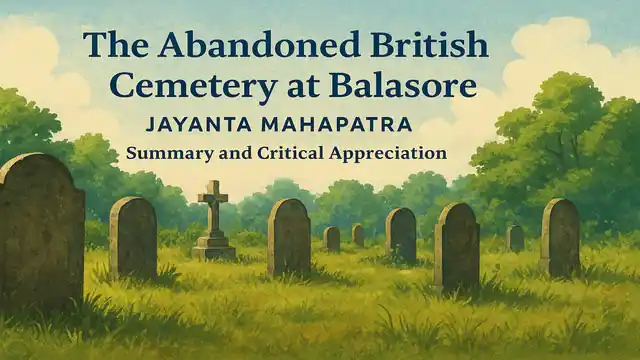
The poet visits an old cemetery dating back to the British era. It was established around a century and a half ago, when the British governed India. When they eventually departed from the country, they left behind the graves of their dead. Over the long span of nearly 150 years, the cemetery has fallen into neglect and now lies abandoned. The poet refers to it as a relic of history, suggesting that it carries historical significance because it belongs to a period and events that occurred about one hundred and fifty years in the past.
Wretched Condition of the Graves:
The poet arrives at the old cemetery and, seeing the pitiful state of the graves, is instantly reminded of the historical moment when numerous British individuals succumbed to cholera and were laid to rest here. Their bodies now lie apart in their own burial plots, all of which have fallen into a sorrowful state of neglect. The poet has no desire to break the quiet sanctity of the place by stepping inside. Instead, he prefers to observe it from a distance, fearing that entering the cemetery might somehow disturb the eternal rest of those sleeping in their cold, shadowed graves.
Ruined Tombs and Poet’s Reflection:
The graves in this burial ground have fallen into decay. The marble and stone that once shaped them have nearly disintegrated with age. Shattered fragments now scatter the earth around him. As he stands amid this historically significant resting place, the poet wonders how he ought to conduct himself in such a setting.
Historical Incident at Balasore and Neglected Graves:
The poet walks through an old cemetery established during the British era in India. As he moves among the silent grounds, he reflects on its historical weight, tied to a tragic outbreak in Balasore. When cholera swept through the region, it claimed many young lives, and those victims were laid to rest here.
What he finds now are crumbling graves—mute reminders of a time long past. With the British departure, the burial site gradually fell into neglect, leaving the tombs in ruins. The place is remembered only for the calamity that occurred a century and a half ago, and today it stands abandoned and forgotten.
Although the poet himself feels little personal connection to the cemetery, he cannot help feeling sorrow for the young souls buried there—lives cut short before their hopes and ambitions could ever take shape.
Indifference and Peaceful Atmosphere:
The poet reflects that had he lived in the era when the event occurred, he might have shared in the grief and compassion felt for the young lives lost. But standing in the present, he finds the old British graveyard—now abandoned and valued only for its history—incapable of stirring any deep emotion within him. All he sees is a stretch of overgrown grass, wild shrubs, thorns, and weeds. A quiet stillness fills the place. Whether or not he knew the people buried there is of no consequence to him; it makes little difference who once succumbed to cholera and who managed to survive.
Forgotten Dead and Fearful Atmosphere:
The poet stands beside the cholera victims’ graves in an old colonial-era cemetery, displaying a seemingly detached attitude toward both the dead and the survivors who once suffered from the disease. At first, he feels no compassion for those who perished or endured the outbreak. Yet, when he reflects on the terror and misery surrounding their final moments, a deep sense of fear rises within him. Time has erased their identities, and now they rest in a place where no one cares to remember their stories.
The Cemetery as a Historical Relic:
They now exist merely as fragments of an event that occurred almost a century and a half ago. Their resting ground is remembered only in connection with that tragedy. The cholera outbreak endowed this place with its historical weight. The poet’s arrival in the cemetery cannot restore life to those who have perished, nor can his presence unsettle their remains. No surge of emotion is powerful enough to rouse them from their deep, eternal slumber. Only the quiet, abandoned stillness of the place may momentarily be disturbed.
Desolate Surroundings and Reign of Insects:
The old British-era graveyard where the poet stands, reflecting on the young lives buried there, lies in utter abandonment. The area around it is bleak and unsettling. A haunting stillness hangs in the air, as though no one has cared to step into this relic of the distant past for many years. The graveyard’s desolation seems largely the result of people’s indifference toward those resting beneath the soil. In this lonely stretch where no trace of human presence remains, nature has claimed full dominion; various insects and creatures now rule the place, and many venomous species have made the forgotten cemetery their home.
Lizard and Scorpion Observed by the Poet:
The poet notices a gaunt, slender lizard intently observing the happenings around the cemetery, its neck lifted in alert curiosity. Nearby, a scorpion lies motionless on a gravestone bearing the name of a deceased British man. Its venomous tail droops over the edge of the stone, and its outstretched limbs give it a frightening appearance. The way the scorpion reclines on the tombstone adds an unsettling, eerie tension to the scene.
Unfulfilled Dreams of the Young Dead:
As the poet stands among the shattered graves of the British dead and takes in the bleak, forsaken atmosphere of the cemetery, his mind turns to the young men and women who were claimed by death before their hopes and ambitions could ever unfold. Their tender years earned them no compassion from death’s grasp. He notices the marble headstones rising at each grave, marking the identity of the one buried beneath. Upon these stone slabs are inscribed the details of the departed—their names, birth and death dates, origins, lineage, and other fragments of their lives now preserved only in stone.
Young Lives Lost: Florence and Others:
The poet is not concerned with the specific names or personal details carved into the epitaphs; what draws his attention is simply that these graves belong to young British men and women who lost their lives to cholera in a far-off land. What does interest him, however, is their age at the time of death.
On one marble slab, he notices the name Florence, described as the beloved wife of a military captain. The inscription reveals that she was only nineteen when cholera claimed her life.
On another gravestone, he comes across the memorial of a young girl, cherished daughter of a British couple, who died at just seventeen—struck down by the same deadly illness. These tragedies occurred during the period when the British ruled India, a time when cholera frequently swept through the population, sparing neither colonizer nor colonized.
Cholera During British Rule:
When cholera swept through the land and claimed the lives of countless young people, India was still under British rule—an era in which the country formed a part of the vast British Empire. The burial ground where the poet now stands was established during that colonial period, and it is here that the victims of the epidemic were laid to rest. As the poet moves among the graves, taking in the atmosphere of the place, he becomes particularly drawn to the inscriptions on the marble headstones, pausing to note the ages of the youths commemorated there.
Poet’s Indifference to Empire, Concern for Young Deaths:
His attention is solely fixed on the loss of young lives. The British Empire, its era, and its deeds hold no place in his thoughts. Since the British no longer rule in India, he sees no reason to dwell on an empire that has long vanished. Though he is aware that his distant ancestors once lived under British authority, it carries no significance for him. What truly matters to him are the young people who rest in these graves and those who continue to die in the present day.
Young Death and Its Emotional Impact:
The poet reflects on the idea that young people often leave this world before realising their dreams, ambitions, and desires. Their untimely passing profoundly stirs the human heart, awakening emotions and sentiments that have long remained hidden in its depths.
Cholera’s Unbroken Menace:
The poet stands by the graves of young people who fell victim to cholera a century and a half ago. He reflects that this lethal disease, which once cruelly cut short the lives of many promising British youths, remains largely unconquered even today. It continues to claim the lives of countless young individuals who might have lived full, productive lives, contributing their energy and talent to the progress of their nation. Tragically, the vitality, potential, and aspirations of these youths are stifled under the relentless grip of the deadly cholera.
Poet’s Sorrow and the Continuing Destruction by Cholera:
The poet is deeply saddened as he imagines the young British soldiers lying in their chill, shadowed graves. Their lives have been reduced to this lonely burial ground, forgotten and overlooked by the world outside. His sorrow is stirred by what he sees, and his gaze becomes the pathway through which his feelings rise. He grieves to think that this fatal illness still claims the lives of the young, conquering them one by one.
When the disease emerges, it spreads with alarming speed and force. It seizes the youth, draining their vitality little by little. Its reach is vast; it travels everywhere. It even sweeps over the graves in the cemetery—though it can no longer touch those already dead—and continues beyond, leaving devastation in its wake. The same tragedies recur endlessly, shaking and eroding the cherished ideals and convictions of humankind.
British Rule is Gone but Cholera Remains:
The poet observes that British rule has long since vanished from India. The colonizers departed nearly a century and a half ago, leaving the nation politically free. Yet one ruthless enemy still lingers—cholera. This deadly disease, unlike the British, continues to strike repeatedly, claiming countless young lives. It seizes its victims suddenly, drains their strength, and consigns them to eternal rest, silencing their hopes, dreams, and ambitions.
Whenever cholera resurfaces, it brings devastation in its wake. The nation suffers deeply, losing its youthful and valuable citizens. The disease is as harsh and unyielding as iron—sometimes lying dormant like metal left to rust, yet never truly losing its danger. Its threat persists, ever-present and unforgiving.
A Piece of Timber and Memory of Death:
Those who pass away leave behind the echo of their final moments. It is as if death itself watches with a quiet, knowing smile as each life ends. Observing a massive log resting near the graves, the poet reflects that the earth’s pull—its unceasing gravity—will forever act upon it. In time, he imagines, this solid block of wood lying beside the burial ground may come to be regarded with a kind of reverence by those who visit the place.
Timber as Symbol of History and Forbidding Power
Because of its great antiquity, this wooden fragment could eventually be revered like a god and turned into a sacred object. It would preserve the memory of events long past, continually recalling the deaths that occurred ages ago. At the same time, it would silence the voices of those who lived through those times, preventing them from telling others that they had once existed. In this sense, the timber would function not only as a vessel of history but also as a force of restraint and prohibition.
Critical Appreciation of the Poem “The Abandoned British Cemetery at Balasore”:
Introduction:
The poem The Abandoned British Cemetery at Balasore presents the poet’s meditative response as he steps into an old graveyard where several British individuals lie buried. With nearly a century and a half having passed, the place now stands silent and forsaken. The poem recalls a historical episode, and through it, the poet mourns the premature deaths of the young men resting there. He reflects on how they left the world before realising their hopes, dreams, or ambitions. For the poet, the death of the young strikes the deepest chords of human emotion, stirring feelings usually hidden within the heart. He is saddened by the thought that cholera—this merciless disease—still claims the lives of the young and continues to triumph over them.
Thought – Content:
The poet steps into a colonial-era graveyard and comes upon the resting places of many young Britons whose lives were cut short by cholera. He moves carefully, wishing not to disturb the silence in which the dead now sleep. Time has worn down the headstones—marble and stone have cracked, faded, and nearly dissolved. A quiet sense of awe settles over him as he thinks of those who were laid to rest here long ago.
As he wanders among the graves, he realises that nothing he does can rouse the remains beneath the earth. The presence of lizards and scorpions heightens the eerie atmosphere of the place. He pauses to read the names of the youths who succumbed to cholera in the bloom of their lives. His thoughts turn not only to these long-departed young souls but also to the many young people who continue to die in the present day, taken by different misfortunes yet linked by the same tragedy of lives ended too soon.
Theme of the Poem:
This finely shaped poem reflects Mahapatra’s contemplative outlook on life and the way he lifts starkly realistic images into the realm of lyrical beauty. A visit to an old British graveyard sets off in the poet a chain of reflections—on relentless diseases that once claimed the young and drew them silently into the forward-moving currents of history. His sorrow does not arise from seeing the weathered tombs of long-forgotten Britons, but from the haunting awareness of innumerable lives that, even today, are cut short before their time.
A Fine Blend of Poet’s Scientific Attitude and Orthodox Beliefs:
The poet notices a massive block of timber lying near the graves and reflects that the pull of the earth will never cease to act upon it. Over the years, this weighty timber—almost like an anchor—could gradually come to seem sacred to those who live nearby. Simply because it has endured for so long, people might eventually revere it as a divine presence, an object worthy of worship. In this way, the anchor would preserve the memory of the ancient deaths around it, serving both as a vessel of forgotten history and as a silent, imposing force.
Philosophical and Psychological Elements:
In a contemplative, almost philosophical tone, the poet reflects that cholera continues to erupt unexpectedly, claiming the lives of the young. Whenever it appears, it moves with terrifying speed and force, leaving devastation in its wake. Its nature is as cold, unforgiving, and unyielding as iron. Even when dormant—like a piece of iron left to rust in one place—its threat lingers, never truly disappearing.
Those who fall to the disease leave behind the imprint of their passing, and death itself seems to wear a grim smile as it gathers its victims. The poem delves into the psychology of loss, dwelling on the haunting presence of those who have died. The death of the young, in particular, strikes with a sharper pain, stirring deep and disquieting thoughts.
The poet even imagines that an ordinary anchor, lying half-buried in the cemetery’s mud, might one day be revered by future generations—transformed from a forgotten object into a sacred emblem.
Style and Language:
Mahapatra is original not only in his choice of themes and his treatment of them but also in his style of writing and his use of the English language. His command of the English language is exceptional. Besides, he can write in a scholarly style as well as in a simple, plain style. In this poem, we come across such expressions as ‘ the archaic dead’, ‘in a twilight of baleful littoral’, ‘a scrawny lizard’, ‘that plagues the sleepy shacks beyond this hump of earth’. Many also are the expressions and phrases which have an aesthetic appeal. We have surrealistic imagery in the lines in which the poet says that, awed by the forgotten dead, he walks around their graves: “thirty – nine graves, their legends floating in a twilight”. His presence in the cemetery, he says, cannot animate those legends. There is more such imagery in the lines in which the poet says that “this is the iron / rusting in the vanquished country; the blood’s unease / the tired triumphant smile left behind by the dead / on a discarded anchor.”