Introduction to “The Bus” by Arun Kolatkar:
“The Bus” is the opening poem of Jejuri (1976), the celebrated poetry collection by Arun Kolatkar, one of India’s most distinctive bilingual poets who wrote in both Marathi and English. The collection is based on the poet’s visit to Jejuri, a small temple town in Maharashtra dedicated to the local deity Khandoba.
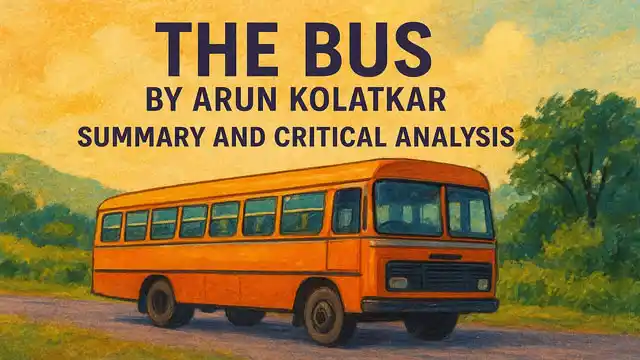
In this poem, Kolatkar begins the spiritual and physical journey that frames the entire collection. The bus ride to Jejuri becomes more than just a literal trip—it evolves into a metaphor for a quest, both personal and philosophical. Through his sparse, vivid imagery and conversational tone, Kolatkar captures the sensations of travel, the shifting landscapes, and the traveller’s quiet anticipation.
The poem’s strength lies in its minimalism and precision: Kolatkar transforms an ordinary bus journey into a scene charged with mystery and revelation. The darkness, the motion of the bus, and the fleeting glimpses of light all hint at the tension between the mundane and the spiritual—an interplay that continues throughout Jejuri.
Thus, “The Bus” serves as an entry point into Kolatkar’s world, where faith, scepticism, and beauty coexist. It sets the tone for the rest of the sequence, introducing the reader to the poet’s characteristic blend of irony, simplicity, and quiet wonder.
Summary of the Poem “The Bus”:
The Journey to Jejuri:
The Bus is the opening poem of the sequence of thirty – one sections of “Jejuri”. It describes the bumpy journey from the starting point to its destination which is the temple of Khandoba. It is a State Transport bus the windows of which are screened by the tarpaulin with which the bus has been covered to keep off the possible rainfall, and also to keep off the cold wind which keeps blowing throughout the journey.
A Night Ride Filled with Pilgrims:
It is a night journey which the bus has undertaken; and after several hours of the arduous journey the passengers start waiting eagerly for daybreak. The bus is full of the pilgrims who are bound for the temple of Khandoba where they want to offer worship; and the passengers might have included a few tourists who merely want to satisfy their curiosity about what kind of a temple it is and in what surroundings the temple stands.
The Old Man and the Passenger:
One of the passengers sits opposite an old man wearing glasses; and this passenger, while looking at the old man, sees his reflection in both the glasses of the spectacles which the old man is wearing. This passenger can feel the onward movement of the bus. The old man wears on his forehead a mark indicating his Hindu faith and even the high caste to which he belongs. Among the passengers is the protagonist or the persona who speaks in the poem, describing his experiences and his reactions to what he sees at Jejuri.
The Arrival at Dawn:
In due course, the sun appears on the horizon, and quietly moves upwards in the sky. The sun’s rays, filtering through the gaps in the tarpaulin, fall upon the old man’s glasses. Then a ray of the sun falls upon the bus driver’s right cheek. The bus seems to have changed its direction (on account of a turning in the road). It has been an uncomfortable journey; but, when the destination is reached, the passengers get down from the bus which had held them tightly in its grip.
Critical Analysis of the Poem “The Bus”:
Descriptive Nature of the Poem:
The Bus is a purely descriptive poem which does not give us much of information about the purpose of the journey, apart from telling us that it is going to Jejuri and that it is a night journey, with a cold wind blowing all the way.
Use of Humour and Imagery:
There are a few humorous touches in this poem as, for instance, the protagonist (probably the poet himself) finding two reflections of himself in the two glasses of the spectacles which the old man sitting opposite him is SIND wearing. This fact is thus described:
Your own divided face in a pair of glasses
on an old man’s nose
is all the countryside you get to see.
Humorous Conclusion of the Journey:
We also learn that it is a bumpy ride at the end of which the passengers get off the bus without anybody stepping inside the old man’s head; and this is another touch of humour.