Introduction of the Poem 8 “The Child Who Is Decked with Prince’s Robes”:
Poem 8 of Rabindranath Tagore’s Gitanjali, titled “The Child Who Is Decked with Prince’s Robes”, is a lyrical and symbolic meditation on spiritual humility and the limitations of material pride. In this short yet profound poem, Tagore uses the image of a child dressed in royal garments to expose the emptiness of superficial grandeur. The child, adorned like a prince, becomes a metaphor for the human soul burdened by ego, pretension, and outward display.
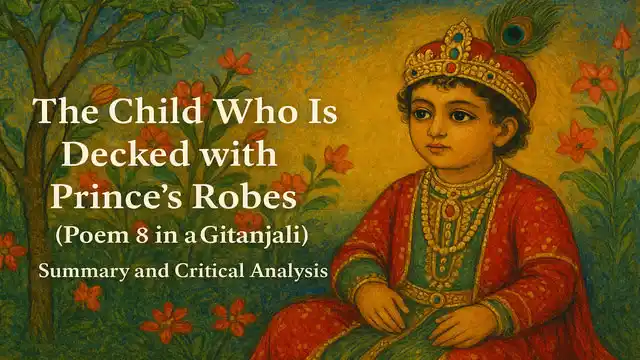
Tagore contrasts this artificial ornamentation with the simplicity and authenticity that the divine—or true spiritual realization—demands. Through gentle irony, he suggests that the child’s royal dress only restricts his freedom: it prevents him from playing, moving, and being his natural self. In the same way, our own self-imposed vanities and ambitions distance us from spiritual fulfilment.
This poem fits seamlessly into Gitanjali’s larger thematic framework, where Tagore repeatedly emphasizes surrender, purity, and the stripping away of illusion. The poem invites readers to return to the innocence of the inner child, unburdened by pride, and to seek a more genuine connection with the divine.
Poem No. 8, titled “The Child Who Is Decked with Prince’s Robes,” is a tender devotional piece that offers profound insight and practical guidance for parents and caregivers. It highlights how the display of costly clothing, often worn by children from affluent families, becomes a major barrier to the natural and balanced growth of a child’s personality. Such extravagant attire restricts their freedom of movement and robs them of the simple joy of carefree play. Constantly worried about damaging their fine garments, these children grow self-conscious rather than spontaneous.
As a result, they are unable to mingle freely with other children of their age. The burden of luxury also breeds a sense of vanity, creating an unhealthy psychological distance from others. These disadvantages prevent them from absorbing essential life lessons. Wrapped in comfort and display, they grow detached from the realities of practical living and the humble spirit that shapes true humanity.
The poet emphasizes that achieving noble aims does not require showiness or material wealth; in fact, such displays can be harmful. Instead, simplicity, sincerity, good behaviour, love for others, and a sense of equality are the virtues that guide one toward the divine.
Summary of Poem 8 “The Child Who Is Decked with Prince’s Robes”:
Stanza 1:
The child who is decked with princes robes and who has jewelled chains round his neck loses all pleasure in his play; his dress hampers him at every step.
In fear that it may be frayed, or stained with dust he keeps himself from the world , and is afraid even to move.
Explanatory Word – Meanings:
1. The child … his play= the child who puts an expensive dress and precious ornaments, misses the pleasure of game. 2. Decked = decorated, covered. 3. Robes = fine and costly clothes as 4. Jewelled chains = golden chains studded with jewels and diamonds. 5. His dress … step = he cannot mix and play with other children because his fine dress obstructs his free enjoyment of life. 6. Hamper = to impede, to hinder, to perplex. 7. In fear … world = due to wearing costly dress, he fears that it may be soiled and his expensive dress keeps him away from the children of other groups. His superiority also becomes a great hindrance in the way of mingling with children of lower groups of society. 8. Frayed = be ragged at edges, became worn, worn off by rubbing. 9. Stained = tarnished. 10. And is … to move = such child belonging to very rich family cannot move about because his precious ornaments may be robbed.
Paraphrase:
The poet suggests that a child dressed in luxurious clothes and adorned with costly ornaments—gold chains, pearl-studded rings, and diamond trinkets—cannot fully enjoy the simple joy of play. Such a child is deprived of the happiness that comes from freely joining games, for his attention is constantly fixed on protecting his fine attire and valuables.
These expensive garments become barriers, restricting his movements and distancing him from his companions. Living like a young prince, he is always anxious that his delicate clothes might tear or get soiled, or that his ornaments might be stolen. As a result, he stays away from the everyday experiences that could teach him much about the real world.
Stanza 2:
Mother, it is no gain , thy bondage of finery, if it keep one shut off from the healthful dust of the earth, if it rob one of the right of entrance to the great fair of common human life.
Explanatory Word – Meanings:
1. Mother, it … finery = the poet advises the mother of rich and prosperous family not to confine her child in such finery. 2. It is no gain = there is no benefit. 3. Thy bondage= the restrictions imposed by child’s mother to remain in a limited place. 4. Finery = expensive dress and precious ornaments. 5. If it keep … earth= because such finery keeps the child away from the healthful dust of the earth and the life – giving open air. 6. If it rob … human life = the precious clothes and jewellery make the child vain and deprive him of the vital things which can be got only through mingling with the common folk. In other words such finery keeps the child away from the common and humble humanity, which may be dirty but is health – giving. 7. Rob= deprive. 8. The right of entrance= when the child is born in the world, it is its right to experience everything of life and nature.
Paraphrase:
The poet counsels the mother of such a child that dressing the child in expensive garments and jewellery ultimately does the child no good. These burdens only distance the child from the free, natural play enjoyed by ordinary children—children who delight in their surroundings without concern, whether they are in dust, groves, gardens, fields, or by the riverbank.
Life in the open air brings them health instead of illness, self-reliance instead of frailty. It nurtures cooperation and fosters a spirit of daring. Growing up among other carefree children is vital for both moral and physical development.
Ordinary life resembles a bustling fair: it may contain dirt and disorder, but participating in it is necessary for inner vitality and spiritual well-being. Cutting oneself off from others because of pride in wealth or status is not only unwise but also damaging.
Critical Analysis of Poem 8 “The Child Who Is Decked with Prince’s Robes”:
Introduction:
The poem “The Child Is Decked with Prince’s Robes” is not merely an expression of devotion and love for God; it also carries deep insight and practical guidance for parents and guardians. Through this piece, the poet emphasizes that displaying wealth can isolate a child from his companions. Such separation deprives him of carefree pleasures that nurture joy and well-being, and it also prevents him from gaining essential life lessons.
Extravagant clothes and ornaments become burdens, diverting his attention and restricting his natural freedom of movement. Even more harmful is the sense of superiority these luxuries may instil in the child, distancing him from playmates who come from humbler backgrounds or lower social standing.
Thought – Content:
The poet notes that a child dressed in expensive clothes and adorned with costly ornaments cannot truly play or enjoy life, as he is constantly afraid of spoiling his finery. His luxurious attire becomes a barrier, restricting his freedom and diminishing his joy.
The poet urges the mother not to imprison her child in such showy splendour, for it separates him from ordinary, simple people—who, though perhaps dusty and rough, offer a wholesome and life-affirming environment. Real vitality comes from connecting with fellow human beings, while distancing oneself from them leads to inner emptiness and decline.
Life, the poet says, is like a vast fair where humble, inexpensive goods are displayed alongside precious items, and both have their own value. Extravagant clothing and jewellery can make the child arrogant and rob him of the essential experiences that only contact with common people can provide.
Similarly, those who isolate themselves in an ivory tower never discover the true pleasures found in ordinary life. The poet concludes that the grand celebration of life is meant to be lived among everyday people, not hidden away in solitary splendour.
Moral of the Poem:
To live a truly successful life, an individual must be given the freedom to grow up among others from early childhood. A childhood spent close to Nature and in the open air not only builds strength and energy, but also imparts essential values such as equality, cooperation, and warmth in human relationships.
Excessive burdens and showy comforts restrict natural movement and healthy growth, and they distance a person from their community. In time, these trappings can foster vanity, leaving the individual unable to fully enjoy life or accomplish their true aspirations.
Universal Appeal through the Image of Child:
The poet suggests that material riches not only stand in the way of spiritual awakening but can also hinder us in our ordinary, everyday affairs. He emphasizes the importance of engaging with people of modest means in order to gain a fuller, more genuine understanding of life.
To illustrate this idea, he uses the image of a child adorned in expensive clothes and ornaments, showing how such finery can distance one from the warmth and simplicity of common folk. The poet argues that if values like equality, cooperation, kindness, and mutual respect are nurtured from childhood, a person can accomplish anything. Most importantly, this path—rooted in love for humanity—leads one closest to the divine.
Language and Style:
Tagore’s poetry stands out for the graceful fusion of thought, emotion, and the musical charm of language. He selects words that are both precise and richly suggestive, drawing from an abundant vocabulary. Smoothness and musical rhythm mark his style above all. His diction is plain, rooted in everyday speech, yet it rises naturally to the sublime.
The short, simple words he uses carry weight not only in meaning but also in sound. Imagery permeates his verse, knitting it together with a sense of cohesion. At times, an image sharpens the central impression; at other moments, it gently releases the mind from dwelling too narrowly on a single idea.