Introduction of “The Ghaghra in Spate”:
Keki N. Daruwalla’s poem “The Ghaghra in Spate” vividly captures the fierce and devastating power of the Ghaghra River during its seasonal floods in northern India. The poet contrasts the river’s tranquil, almost gentle demeanour in ordinary times with its sudden transformation into a raging, destructive force that wreaks havoc across the land.
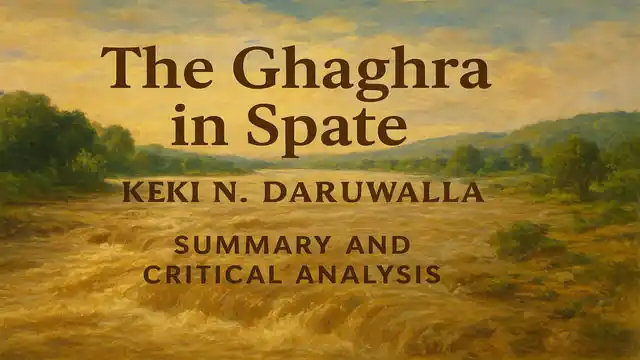
Through striking imagery and intense descriptions, Daruwalla presents the flood as a reminder of nature’s might and humanity’s vulnerability before it. The poem is often read as a reflection on ecological imbalance and a call for a more harmonious coexistence between humans and the natural world.
Summary of the Poem “The Ghaghra in Spate”:
The Ghaghra River and Its Dual Nature:
The poet depicts a river named Ghaghra flowing in northern India. This river, besides being a boon for the villagers, becomes a curse during flood and brings a widespread damage for the villagers and for those who live at the banks of the river. During flood this river presents its most fierceful form. Before keeping the fact of the flood, the poet tells us that the flood comes into the river Ghaghra every year and it comes suddenly without giving any hint.
The River’s Appearance During Dry Season:
When the river is dried up, it presents a very wretched sight. In the afternoon, when the sun shines at its peak, the sights of the river are clearly visible. Many muddy mounds are seen. They look like heaps of mud. When the sun sets in the western horizon overcast with clouds, evening approaches through the way of clouds. In the evening, the river looks black like over-boiled coffee. When the moon looks red, the river looks like a wound inflicted by the lash or a whip. When one goes the river-bank in the growing darkness of the evening, one would never think that a flood is about to come because the condition of the dried river does not point out the approach of the flood.
Calm Before the Storm:
Walking along the river bank in the growing darkness, no one can have any idea that nasty flood would come so soon. The poet describes the calm and balanced environment of the river very artistically. The landscape looks perfectly smooth and tranquil. A kind of serenity is found in the stretching land of the river. There is no commotion in the natural sights of the river (it may be said that this kind of peace and serenity is a certain indication of a sudden approach of a storm i.e., flood).
The Everyday Life Around the River:
Paddy crop is grown in the waster of the river. The plants of rice emerge piercing the water. The reflection of the ears of the corn is seen on the surface of water kingfishers and gulls may be seen on the river-bank as usual. They generally settle down on a river-bank to feed themselves upon the little fishes which are brought towards the bank by the force of the current of water. Seeing all these things taking place on the bank of the river and on the stretched land of the river, no one can imagine that there may be a sudden approach of the flood.
The Sudden Arrival of the Flood:
When the river becomes a narrow stream of water, no one can expect the approach of flood. Whosoever comes on the bank, can have no idea that the flood would come so soon. All the activities at the river bank and in the stretched field of the river remain as usual. The surroundings of the river remain very calm. The animals, birds, the villagers and the people living near the bank of river can never think of the unexpected danger which may bring great destruction. All of a sudden the river is over-flooded in night.
The Rising Waters and Panic:
The Ghaghra River which had become the narrow stream of water and was flowing calmly suddenly creates commotion. It is a devastating flood. It hardly takes twenty minutes for the water to rise to a dangerous level. It causes panic among the people living near the bank of the river. It does not give any chance to understand the situation and to take suitable steps. They seem to be very helpless against the fierceful form of the river.
The People’s Struggle for Survival:
The people want to flee away to the safe places to save their lives, but in utter darkness, when they have no lamps to show them way, they have a face great difficulty while moving to the places of safety. There are no boats, not even makeshift boat made of bamboo poles to carry them to the places of safety from the flooded river. The Ghaghra river keeps on rising above the level of danger and gives an open invitation to bring a great destruction. It brings loss of the lives of human beings and animals. The people try to save their lives, but many of them become victim of the violent and fierceful flow of the river.
The Devastation of the Flood
When, suddenly at night, the flood approaches, it takes no time to rise to a high level. Soon it begins to flow above the mark of danger. It creates fear and terror in the hearts of people living close to the rivers. It brings great disaster for the village situated near the river. Due to having no means, the villagers feel great difficulty in fleeing away to the places of safety. When the water crosses all the limits, it rushes into the village nearby. Its rapid, strong and violent flow brings down the mud-and-straw cottages and forces the cottagers to take shelter on the rooftops which are still intact. It carries with it the dung-cakes. The dung-cakes are soon converted into refuge which comes on the surface of water floating.
The Floating Carcass and Helplessness:
A buffalo which gets drowned in the water of the flood dies in the water due to great suffocation. After sometime the dead body of the buffalo comes or the surface of the water (the dead body of the buffalo floats on the surface of water because its stomach is filled with water). Now the dead body seems to be touching the rooftops of the cottages where the villagers take shelter.
The Misery of the Stranded Villagers:
The rooftops of the cottages which are made of straw and are erected on the poles of bamboo, cannot be uprooted easily, hence they remain intact or undamaged for longer. It takes three days for the flood to subside. During these three days the villagers on the rooftops have to remain hungry. Their condition becomes very pathetic and miserable. They spend a long time without sleeping in great fear and wait to subside the water of the flood. The cattle which are still alive, have not been milked during this time. In such state, the teats of the cattle are swollen. They (udders) become red with great swelling.
The Children’s Innocence Amid the Disaster:
Children are innocent, brave and fearless, so the sight of flood and the other activities happening during the flood do not frighten them. Even they remain unaffected of the most fierceful sights. They take all these horrible things in a great wantonness. The children derive joy and pleasure from the sights taking place during flood. They remain in cheerful spirits. It seems as if the impending danger were only a plaything for them. When the grownups worry of their lives, animals and property, the children show their excessive joy at the destruction made by the river. When the rescue boats arrive to take the people to safety and to provide them with food, they show their unbounded joy to see the boats.
The Villagers’ Resignation and Hopelessness:
The people who, even after, subsiding the flood water, look very dejected and sorrowful at the loss made by the river. They also think how they would survive their lives. The people do not indulge in curses or any crazy kind of talk because they are familiar with the behaviour of this river. They are very well aware of the language which the Ghaghra River speaks. Even the people do not raise their hands to pray to God for help because they know that in the moment of crisis, the prayers will prove meaningless. They do not give much importance to the prayers. They think that the human prayers do not reach the sky but come back, unheard by God.
The Aftermath and Outside Reaction:
The prayers made to God by the people come down on the earth like an object which falls in the water and produces a sound. Camps are set up to distribute food among the villagers, while ten miles away from the scene of destruction peasants go about catching fish from the flooded rice fields. The women in chauffeur-driven cars come from the city to take a look at what the flood had done to the village people, and to witness the stuff which the river- water had deposited on the land nearby.
The River’s Wicked Nature and Final Havoc:
Before retreating or subsiding, the Ghaghra River makes a great destruction. It shows its wicked and malicious nature. Its merciless behaviour is unendurable for the villagers living in nearby village situated at the bank of the Ghaghra River. When it is over-flooded, it flows with rapid and strong movement. Whatever falls in its way, it carries with its strong flow. It not only brings a huge destruction but also it swallows the lives of many cattle.
The Helpless Villagers and Their Loss:
The villagers succeed in securing their lives by taking shelter on the rooftops of the cottages which remain intact even in the strong blow of the water of the river. The rooftops of the cottages are erected on the bamboo poles, so they remain unaffected. But the villagers seem to be very helpless to carry their cattle at secured places. Thus many cattle become the victims of the Ghaghra River.
The River’s Bloodthirsty Imagery:
The river seems to be very thirsty of the hot blood of the cattle. It entraps the cattle in its rapid circular movements and makes them drown. Then like the frogmen it dives into the bottom and sucks the blood of cattle. After drinking hot blood of cattle, it grows excited and loses its mental control. Then it flees from the scene of its own havoc and leaves behind it great destruction.
The Final Aftermath and Desolation:
The real damage which the river does, becomes evident only after the flood has subsided and the water has retreated. The land, where the flood waters had stayed for a number of days, begins to sink. The houses in the village, which had withstood the fury of the flood, are now seen almost on the verge of collapse, and the rice-fields, into which the flood-water had brought plenty of fish, now begin to dry up and the fish begin to die. The fish are killed by mud and the scorching heat of the sun.
Critical Analysis of the Poem “The Ghaghra in Spate”:
Introduction:
The poem entitled The Ghaghra in Spate is one of Daruwalla’s best poems. This poem deals with a river in flood. It reminds us of Ramanujan’s poem A River which depicts a flood in the river Vaikai which passes through the city of Madurai in Tamil Nada in Southern India. The damage and destruction made by the northern river Ghaghra resemble to that of Vaikai, a southern river. So far as the poet’s approach to the subject is concerned, there is a big difference between these two poems. This poem is based on the poet’s minute observation. It shows how the villagers seem to be helpless before the natural disaster. The poet draws a realistic picture by making a close observation of the flood and destruction made by it.
Thought-Content:
The river Ghaghra is suddenly over-flooded every year and changes its course. Going along the river-bank in the growing darkness of the evening, one can never think that a flood is about to come. The landscape looks perfectly smooth and tranquil. All the activities in the surroundings of the river go on as usual. The sudden approach of water causes panic among the people living close-by. The water of the flooded river rushes into the village nearby, bringing down the mud-and-straw cottages, and forcing the cottagers to take shelter on the rooftops.
During these three days the men on the rooftops remain hungry and the cattle are not milked. The children are cheerful enough because they do not comprehend the dangers which they have been facing. The people do not indulge in curses or in any crazy kind of talk because they are familiar with the behaviour of this river. They do not even pray to God for help because they know that the prayers in this situation are futile. The real damage, which the river does, becomes evident only after the flood has subsided.
Realistic and Vivid Imagery:
Stark realism is the chief quality of much of the imagery in Daruwalla’s poetry. An outstanding example of this sort of thing is to be found in the poem. In the poem we have the picture of the Ghaghra looking like ‘overstewed coffee’, and looking at night like a red weal across the spine of land. And the moon is red because she is having menses! When the flood comes into this river suddenly at night, it is like a nightmare for the people who have to undergo days of hunger and have to find shelter on the rooftops though many of the mud-and-straw houses have already collapsed.
When the flood-waters recede, the Ghaghra turns actually “bitchy’. Behind the retreating flood-waters, the land sinks and houses bend down on their knees as if paying their farewell respects to the retreating waters. The paddy fields, which were filled with water and fish, would now begin to dry up, bringing an end to the life of the fish.
Social Concern and Compassion:
There can be no doubt that Daruwalla’s interests are varied and that his observation is very keen and minute. But the most pleasing aspect of his treatment of his themes is that his attitude to the various problems and issues of life is always original, and that his poems are therefore by no means state or stereotyped. In the present poem, the havoc worked by the flood in the Ghaghra is the main theme, though not the only one.
The poet does not become sentimental here. He shows a remarkable restraint and an attitude of detachment in depicting the horror of the flood as “half a street goes churning in the river-belly”, and the thatched cottages just melt away in the flood-waters. A buffalo floats over to the rooftop where men have taken shelter. Much has been left by the poet to our own imagination. He only throws hints to indicate the misery and the suffering, and can even write a word or two to lighten our sense of suffering by saying that children have enough spirit in them to cheer the rescued boats:
“Children have spirit enough in them
to cheer the rescue boats;
the men are still life-subjects
oozing wet looks. ”
Depiction of the Two Catastrophes in the Poem:
The poet depicts two catastrophes in this poem. First is the sudden approach of the flood in the river Ghaghra at night and the second is the damage which the river does after the flood has retreated. There is hardly any sign at that time that a flood is coming. Then landscape is “superbly equipoised”, and the kingfishers and the gulls are seen on the river-bank as usual. Then comes the flood, and the mud-and-straw cottages crumble because of the fury of the waters while the men have to take shelter on the roof-tops of those houses which still stand firm.
The rescue boats certainly do their job. But the service rendered by them is hardly enough. Then the second catastrophe takes place; the land near the river begins to sink; the houses, which still stood in their places, begin to bend downwards and the fish in the rice-fields begin to die with the water evaporating on account of the heat of the sun.
Style and Language of the Poem:
Daruwalla’s poetry abounds in figures of speech and, more particularly in metaphors which are most often strikingly original. In the poem the river is described as being in the afternoon a “grey smudge”, and at night as “overstewed coffee”. At night under a red moon in menses, the river looks like “a red weal across the spine of the land”. The idea of the futility of any prayers in that situation has metaphorically and felicitously been expressed in the following lines:
“No one sends prayers to a wasted sky
for prayers are parabolic.”
The manner, in which the fish begin to die as the paddy-fields begin to dry up, has also been described in a most satisfactory, metaphorical manner. Here the poet imagines that the mud has entered into a conspiracy with the sun to strangle the fish in the paddy fields which had been filled with the water from the flooded river. There is a tinge of satire in the following lines which that to the rich the sufferings of the victims of flood are a source of recreation or enjoyment:
“Women in chauffeur-driven cars
go looking for driftwood.”