Summary of the Poem “The Road Not Taken”:
Introduction
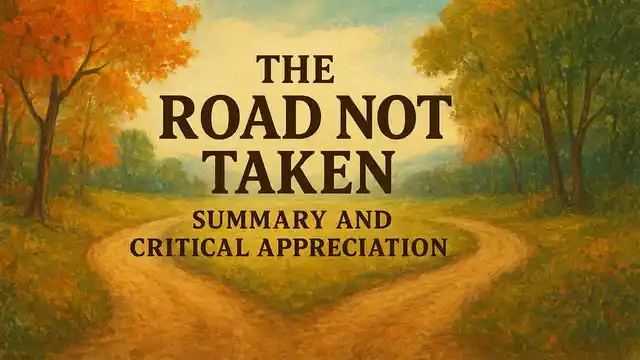
The poem The Road Not Taken is composed by Robert Frost. In this poem The Road Not Taken, the poet reflects on a crucial decision he had to make during his journey. While travelling alone, he reaches a point where the road divides into two separate paths that disappear into the forest filled with yellow autumn trees.
The Dilemma
The poet finds himself in a state of indecision as he cannot travel both roads at once. He stands there for a long time, carefully observing and thinking over which path to choose. Initially, he considers one road to be better than the other, but soon realises that both paths appear almost the same. One of them seemed slightly less worn, with grass still fresh, giving the impression that fewer people had walked on it. However, this was only a perception, as in reality, both roads were nearly identical.
The Choice
Both roads were covered with leaves that had not been darkened by the footsteps of travellers, showing that neither had been used much. Since he had to make a choice, the poet finally decided to take the second road, leaving the first one for another day. Yet, he knew deep within that one choice often leads to another, making it unlikely that he would ever return to the same point again.
Reflection and Regret
The poet narrates this experience with a tone of sadness, reflecting on the road he did not take. He feels that, in the future, he may regret not choosing the other path. He realises that the decision he made—choosing the road less travelled—has shaped the entire course of his life. The poem suggests that a single decision can have a lasting impact, and sometimes, it leaves us wondering about the possibilities of the road left behind.
Critical Appreciation of the Poem:
Introduction:
The poem “The Road Not Taken” was originally intended as an ironic ‘gentle joke’ on the wistful indecisiveness of Frost’s friend Edward Thomas who was killed in World War I quite early in his life time. But soon Frost recognised the poem’s unintended applicability to his situation as a Yankee poet and in setting up his collection “Mountain Interval” he placed it prominently in italics before the table of contents as a prologue. This is a poem of tantalising beauty and rich musicality and it seems to express the philosophy of the Yankee farmer poet. It has, therefore, received considerable attention and is one of the finest, most popular, much admired, much quoted as well as much misunderstood and criticized of Frost’s lyrics.
Evolution of Thought:
The poem presents the picture of a traveller (Frost himself) travelling alone. He reached a point where the road bifurcated into two different directions posing a problem in front of Frost. He now had to decide which road to take. He kept on pondering over the matter for long and then at length decided to take the “less travelled” path. He knew it fully well that both roads “equally lay / In leaves no stop had trodden black” and it was really difficult to decide which road was less frequented. Nevertheless he made the choice but now he does not evince any pride or satisfaction about his choice. Instead he sighs over his failure to take the ‘other ‘ road and laments his inability to travel both and be “one traveller.”
Problem of Making Choice— A Major Theme in Frost:
In his book, “Human Values in the Poetry of Robert Frost”, George W. Nitchie has drawn our attention to the fact that the problem of choice is a theme that occurs in the poetry of Frost again and again. “Frost”, he says, “has written a number of poems that have such acts of choice as their dynamic centre choices that have been made, choices that will be made or that must be made, choices that have not been made. It is of course true”, Nitchie goes on to say, “that such acts of choice are among the inescapable consequences of conscious life and hence of literature – and literature from Homer to contemporary magazine fiction, but I think their persistence in Frost’s work means more than the obvious fact that Frost is a writer. I think, in fact, that they are his themes, not simply a circumstance within which to develop his themes. For Frost, man can very nearly be defined as a choice – making animal; he fulfils himself in the act of choosing deliberately and at his best, with a sense of consequences.”
The Choice – Not A Result of Sound Critical Judgement:
The problem with the present poem, however, is that in it the choice made by the traveller is not the result of sound critical judgement but a matter of chance. Action determined and fearless in the living present is considered by Frost as essential for human salvation but such a determination is not visible in the poem under consideration. Neither self – interest or moral obligation nor even curiosity provides a real basis for preferring one road to the other. The speaker actually cannot distinguish which path is less travelled. Though the road taken had
“Perhaps the better claim,
Because it was grassy and wanted wear,
The literal truth was that
The passing there
Had worn them really about the same.”
The choice made was thus wholly arbitrary, whimsical and lacking in deliberate determination which is so often eulogized by Frost. This is the reason why this lyric has been severely criticized by Yvor Winters in strong derogatory terms. Winters feels that it is the work of a spiritual drifter who fails to make a definite choice. In “The Road Not Taken” and “The Sound of Trees” Frost is mistaking whimsical impulse for the moral choice and the blunder obscures his understanding and even leaves his mood uncertain with regard to the value of the whole business. He is vaguely afraid that he may be neither wrong nor right. Yvor Winters further writes, “The Road Not Taken” is the poem of a man whom one might call a spiritual drifter and a spiritual drifter is unlikely to have either the intelligence or the energy to become a major poet…… Had Frost been a more intelligent man, he might have seen that the plight of the spiritual drifter was not inevitable; he might have written a greater poem. But his poem is good as far as it goes: the trouble is that it does not go far enough, it is incomplete and it puts on the reader the burden of critical intelligence which ought to be borne by the poet.”
Based on his Personal Experiences:
The problem of making a choice was faced by Frost himself hence the poem may be said to be based on real life experiences. Frost, in his early life, tried to lead a settled life as a school teacher. For more than two years he helped his mother manage a small private school in Lawrence then spent two years as a student at Harvard College, hoping to prepare himself for college teaching. But again he decided that the academic atmosphere was not congenial to him and so he tried to make a successful business by raising hens and selling eggs. Occasionally he sold a poem or two. But when he could not make both ends meet financially either as a poet or farmer he turned to school teaching again at Pinkerton Academy in Derry. Subsequently he taught Psychology for one year at the New Hampshire State Normal School in Plymouth. It was in 1912 that he decided to make poetry his vocation in life. He sold his farm and with his wife and four children went to England where they settled in Beaconsfield Buckinghamshire. It was a major decision which brought instant fame and success to him. Robert Frost, as Kemp points out, decided that the right direction for him in the field of poetry “is toward the countryside, toward the rustic self-reliance and the Yankee shrewdness.” He decided to become a spokesman of the reality of New England and this Untermeyer says, “was the choice … which determined his destiny and made him a poet different from others.”
A Different Interpretation:
The poem “The Road Not Taken” is normally taken as a credo of the independent Yankee who takes the ‘ less travelled road because he knows that will make “all the difference.” But too much emphasis on this, will make us miss the ironical implications inherent in the lyric. We will misjudge the depth and complexity of the piece and the real meaning will be lost upon us. The reality is that the poem conveys a poignant sadness, haunting sense of limited capacities of human – life. “This is”, says Kemp, “not so much an exhortatory poem about choice take the less travelled road” as it is a wistful meditation on the consequences of choice for a creature whose vision runs beyond the realm of possibility.” The speaker has a really imaginative mind which yearns to take the untravelled paths but finds it difficult to decide which path is actually “less travelled”. He wants to understand life in its totality wants to go on the frequented as well as unfrequented roads but knows it lies beyond his capabilities. This brings about a sense of frustration and yearning which is implicit in the poem’s many images— “I could not travel both”, “long I stood”, “as far as I could”. “I doubted if I should ever come back” etc. He keeps the frequented road for another day but knows in his heart it will not be possible for him to come back to the starting point again.
Craftsmanship:
The lyric “The Road Not Taken” is a personal poem hence the conventions of the dramatic lyric – parentheses, dashes and pauses etc. are not to be found here. The language used is conversational characterized by simplicity, clarity, lucidity, terseness and precision. The poem is divided into five line stanzas. Each line comprises eight syllables with slight variations here and there to impart informality and casualness of tone. Speaking about the stanza form in this and some other poems Thompson says, “An entirely different modification occurs when the four stress lines are used in certain forms which are related to the ballad; the five lines’ stanza, the six lines’ stanza or the combined five and three stress lines. One pattern of rhyme is established in the single stanza of the five lines’ epigram in ‘In Neglect’ thus ‘a b a a b’: it is used again in ‘My November Guest’, ‘In a Vale’, ‘All Revelation’ and ‘The Road Not Taken’.”
Thus, ‘The Road Not Taken’ is a remarkable poem for its artistic specialities, thought content and most significantly for its psycho – analysis of a sensitive intellectual. The speaker very unselfconsciously reveals himself. to us as possessing a Hamlet – like psyche. He is an intelligent person who can work only after pondering seriously over the matter; after weighing pros and cons of the situation. But he does not have the strength of will that the Shakespearean hero possessed so even after making a choice he keeps on yearning for the path which he himself had put away for another day knowing fully well that he would never be able to start all over again. To his frustration and depression he comes to realise the limited capacities of human beings. Man’s vision may make him aspire for the stars but he has to keep his feet firmly planted on earth. His aspiration may be infinite but his capacities and abilities are finite and he has to be contented to live within his own limited sphere