Introduction:
Theme of Love in the Poetry of Sarojini Naidu occupies a central and significant place. She is often hailed as the “Nightingale of India.” Her treatment of love is remarkable for its depth of emotion, lyrical beauty, and spiritual refinement. Naidu’s concept of love transcends mere romantic passion; it embraces a wide spectrum of human experiences — from youthful affection and conjugal devotion to divine love and patriotic fervour.
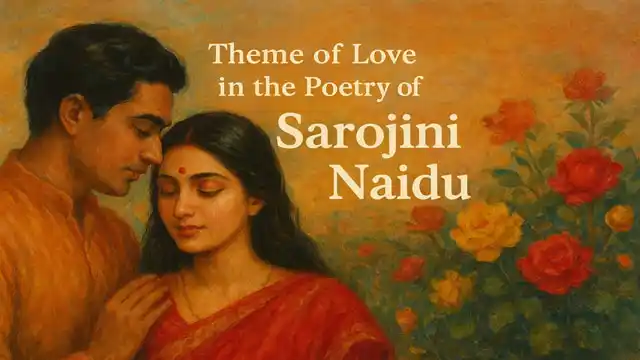
Her poems celebrate love as a unifying and ennobling force that binds human hearts and elevates the soul. Whether she writes of the tenderness between lovers, the sanctity of marriage, or the yearning of the soul for the eternal, Naidu’s expression of love is always suffused with purity, idealism, and melody. Through her delicate imagery and musical diction, she transforms personal emotion into universal experience, making love not just a personal sentiment but a profound spiritual and aesthetic ideal in her poetry.
The Dominant Theme of Love in Sarojini Naidu’s Poetry:
The theme of love predominates in Sarojini’s poetry. It breaks even into poems that are primarily in praise of Nature or Spring. It is, indeed, ever present in her work, and almost every one poem out of three among her poems is a love poem of one kind or another. Every kind of love-experience and every possible mood of love finds its place in her poetry.
Her love lyrics show that “Prayer, not praise” is the proper tribute to love that love is the partial in search of the complete. In her love poetry there is a constant progression from devotion to the ecstasy of fulfilment or a union with the object of love. In the process there is much suffering and purgation of self through suffering.
The Range and Richness of Love Expressions:
Sarojini Naidu plays all possible notes on the orchestra of love. The longing of lovers for each other is expressed with truly oriental splendour in, A Rajput Love Song:
“Haste, O wild-deer hours, to the meadows of the sunset!
Fly, wild stallion day, to the pastures of the west!
Come, O tranquil night, with your soft, consenting darkness,
And bear me to the fragrance of my Beloved’s breast!”
The world of Rajput chivalry and royal splendour has been successfully evoked in this lyric.
Serenity and Oneness in ‘A Persian Love Song’:
A Persian Love Song, which comes immediately after, exhibits the serener mood of lovers who are conscious of their oneness through love. The lover does not know why, when his beloved is glad, or sad, or at rest, or in pain, he feels exactly what she feels; but he has an inkling of the possible explanation. But the ecstasy of loving and being loved can be so over-powering as to be almost unbearable, Witness the early poem called Ecstasy:
“Cover mine eyes, O my Love,
Mine eyes that are weary of bliss
As of light that is poignant and strong,
O silence my lips with a kiss,
My lips that are weary of song.
Shelter my soul, O my Love,
My soul is bent low with the pain
And the burden of love like the grace
Of a flower that is smitten with rain:
O shelter my soul from thy face.”
The Pain of Separation and the Pathos of Solitude:
Another aspect of love is revealed in the Poet’s Love-Song. The poet, far away from her lover, is rapt in dreams all day; but not so at night. But in Alone the sense of loneliness is constant; neither the “accustomed alleys of delight” nor the “orchards of the night” bring any relief; nor the maiden breasts of the “tides of life’s familiar streams”:
“But no compassionate wind or comforting star
Brings me sweet word of thine abiding place….
In what predestined hour of joy or tears
Shall I attain the sanctuary of thy face?”
Love in Absence and Forsaken Hearts:
In The Garden Vigil, the woman, separated from her lover, finds comfort in apostrophizing the morning star. In other poems something more than the pathos of separation is expressed. In a Love Song from the North the forsaken one cannot bear to hear the papeeha’s call or similar joyous sights and sounds, for they only recall dreams of delights that are gone.
In Caprice and in Destiny, we are shown how maidens’ hearts are broken by those unworthy of their love. But in Longing the heart, though broken, still hopes for the return of the wayward lover. Amid the gleaming pageant of life that crowds round the sadness of the maiden’s days and nights,
“Glides my cold heart like a spectre
In a rose-encircled shroud.”
“But she still harbours a hope and cries:
Love, beyond these lonely years
Lies there still a shrine of tears,
A dim sanctuary of sorrow
Where my grieving heart may rest
And on some deep tide of slumber
Reach the comfort of your breast?”
Love as Memory and Spiritual Fulfilment:
And yet it is better to have loved and lost than never to have loved at all; for the memory of a love, however transient, is a dear memory. This is so beautifully expressed in The Festival of Memory that nothing short of a reproduction of the whole of it is called for:
“DOTH rapture hold a feast,
Doth sorrow keep a fast
For Love’s dear memory
Whose sweetness shall outlast
The changing winds of Time,
Secret and unsurpassed?
Shall I array my heart
In Love’s vermeil attire?
O shall I fling my life
Like incense in Love’s fire?
Weep unto sorrow’s lute?
Dance unto rapture’s lyre?
What know the world’s triune
Of gifts so strange as this
Twin-nurtured boon of Love,
Deep agony and bliss,
Fulfilment and farewell
Concentrated in a kiss?
No worship dost thou need;
O miracle divine.
Silence and song and tears
Delight and dreams are thine,
Who mak’st my burning soul
Thy sacrament and shrine.”
The poem shows that love for the poetess is not so much an object of desire as of memory. Love as memory is a “twin-natural” born of agony and bliss.
‘The Temple’: The Mystic Pilgrimage of Love:
But all these are scattered poems. There is a group of love poems at the end of her last volume, and the twenty-four poems that form the group are significantly given the collective title, The Temple. The deep mystic fervour that inspires them is stressed with the sub- title “A Pilgrimage of Love”. And the pilgrimage towards the temple is carefully worked out in three stages of eight poems each.
The First Stage: Love’s Bondage and Devotion:
The pilgrimage begins with The Gate of Delight and the Poems of this stage are calculated to demonstrate that in Love’s bondage is true freedom, and true bliss in the sacrifices it demands. In the opening poem, The Offering, the woman unable to bring beauty or greatness to Love’s shrine, can yet bring a devotion that asks for no recompense.
Similarly, the devote of The Feast is content to smear her head and eyelids with the “entranced and flowering dust” that Love has honoured with his tread, happy to bear Love’s foot prints on her breast, and eager to have as a priceless boon.
“All the sorrow of your years,
All the secret of your tears.”
The Ecstasy and Spiritual Vision of Love:
In Ecstasy the woman cares not at all for the glories that spring brings, for, as she exclaims :
“But I have plucked you, O miraculous Flower of desire, And crushed between my lips the burning petals of your mouth I have drunk the deep, delicious nectar of your breath.”
In The Lute-Song the beloved tells her lover that he needs no mirror, no lute, and no silks. Her eyes, her voice, and her heart will serve instead. “If you call me I will come”, says the maiden in the next poem. She will come swiftly and fearlessly. For the sins of looking at the face of her lover, touching his flesh, assailing him with her silence or her song, the poetess-beloved asks for forgiveness in The Sins of Love. The supreme sin is mentioned last,
“Forgive me the sin of my heart,
It trespassed against you and strove
To lure or to conquer your love.”
The Vision of Love: The Final Realisation:
The Desire of Love is a short, simple song, but intense and packed with passion. The last of the eight poems in this section is The Vision of Love. The woman has lost all knowledge except that of her beloved. To her enraptured sight he is the sovereign and sweet reality, the splendour of the morning star, the might and magic of the sea, the subtle fragrance of the spring, the fruit of all time’s harvesting; he is the sacred fount from which her spirit draws all sustenance; he is the temple of her woe and bliss.