Introduction of the Poem No. 1—Thou Hast Made Me Endless:
“Poem No. 1—Thou Hast Made Me Endless” serves as the opening work of Rabindranath Tagore’s celebrated collection Gitanjali (Song Offerings). Originally published in Bengali in 1910 and later rendered into English prose in 1912—a translation that played a major role in earning Tagore the 1913 Nobel Prize in Literature—the collection is revered for its deep spiritual resonance and its roots in the Indian Bhakti devotional tradition.
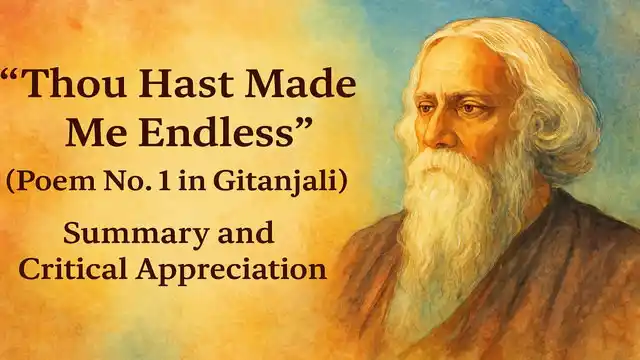
As the first poem, it sets the spiritual tone for the entire work. Here, Tagore expresses profound gratitude for the gift of life and the boundless presence of God within it. The poet marvels at the way the divine spirit flows through his mortal body, renewing him again and again despite human limitations.
The poem blends humility with wonder, presenting life as a sacred vessel through which the infinite expresses itself. Through rich metaphors—such as the flute, the reed, and the overflowing cup—Tagore introduces a central theme of Gitanjali: the eternal within the transient, the infinite within the finite, and the intimate connection between the human being and the Divine.
Summary of the Poem No. 1—Thou Hast Made Me Endless:
Stanza-1
“Thou hast made me endless, such is thy pleasure. This frail vessel thou emptiest again and again, and fillest it ever with fresh life.”
Word-Meanings:
1. Thou hast…endless = the poet addresses God and says that He (God) has made him infinite immortal. Paying his obeisance to God in a spirit of humbleness, the poet says that soul is eternal and immortal. 2. Endless = infinite. 3. Such is thy pleasure = it is the will of God that it should be so. 4. Thy pleasure = God’s will. 5. This frail vessel…again = this implies the theory of reincarnation of souls after death. 5. This frail vessel = this human body which is mortal. It is a metaphorical expression. 7. And fillest…life = Tagore tells us that the matter of which human beings are made, destroys and rebuilds in an order ordained by nature. It also hints the theory of Transmigration of Soul in the Hindu scriptures. 8. Fillest = gives life. 9. Fresh life = God gives a fresh life to the human soul every time a man dies.
Paraphrase:
The poet offers his reverence to God with deep humility, acknowledging that it is through God’s compassion and divine grace that a perishable human being attains immortality. Such is the will of the Almighty. To illustrate the fragility of human life—or more precisely, the human soul—the poet likens himself to a delicate, easily shattered vessel, like a clay pot. Yet, this vessel is repeatedly refilled by God’s grace each time it is emptied. In this way, life is continually renewed.
A person dies only to be reborn in another form. Through this imagery, the poet affirms his belief in the Hindu doctrine of the Transmigration of the Soul, which teaches that while the physical body decays and returns to dust, the soul itself is eternal and takes on a new body with every new birth.
Stanza-2
This little flute of a reed thou hast carried over hills and dales, and hast breathed through it melodies eternally new.
Word-Meanings:
1. This little flute of a reed = human body which is weak by nature. The poet compares himself to a flute made of reeds and God to a flute player, a skilled musician. 2. Thou…new = God plays upon it everywhere, over the hills as well as in the valley and he always plays new and fresh melodies. 3. Hills and dales = mountains and valleys. 4. Breathed = played on. 5. It = flute. 6. Melodies = music. 7. Eternally = forever.
The poet likens himself to a simple reed flute, while God is the one who plays it. He expresses humble gratitude for being chosen by the divine to spread melodies that remain ever-fresh. Calling himself God’s flute, he suggests that God plays through him at all times and in all places. The poet conveys that his creative works arise from divine inspiration, emphasising that his poetic gift is not his own doing but a blessing bestowed by God, who empowers him to sing endlessly new and vibrant songs.
Stanza-3
At the immortal touch of thy hands my little loses its limits in joy and gives birth to utterance ineffable.
Word-Meanings:
1. At the immortal touch = When God inspires the poet. 2. Loses its limits = under the inspiration of God, the poet forgets his personal identity and physical limitations. 3. Gives birth to utterance ineffable = the mystic union of man and God takes place.
Paraphrase:
When the divine presence stirs the poet’s soul—when God breathes inspiration into him—he sings with a joy too deep for words. In that instant, he rises above his earthly bounds and dissolves his sense of self in communion with the infinite. The poet becomes like a living flute, trembling with delight at the touch of its Lord. His small heart overflows, breaking into song with an ecstasy that defies expression. God’s generosity knows no limit, and it fills the poet with such profound happiness that no language can fully convey his gratitude or the depth of his joy.
Stanza-4
Thy infinite gifts come to me only on these very small hands of mine. Ages pass, and still thou pourest, and still there is room to fill.
Word-Meanings:
1. Thy…of mine = God’s gifts are infinite, but the poet can accept them only in his small hands. 2. Ages pass…to fill = these gifts have come to him through ages and yet they remain inexhaustible. 3. Infinite = limitless. 4. Pourest = pours, bestows.
Paraphrase:
According to the poet, the generosity of God is so vast that it defies expression. No language is sufficient to capture the fullness of His grace, which stretches far beyond the limits of human description. His blessings are countless, scattered lavishly throughout the whole of creation. Yet the human soul is too small to receive or relish the boundless joy He offers.
Many people are endowed by God with remarkable gifts and abilities, but these remain buried and unused, as though they were of no value, simply because they are not put to proper use—or not used at all. The human soul can be compared to a child whose tiny hands cannot hold all the presents its parents wish to give. God continues to pour out His infinite blessings, but man lacks the greatness of spirit and the wisdom needed to receive and use them, and this is what brings about his misery and want.
Critical Appreciation of the Poem No. 1—Thou Hast Made Me Endless:
Introduction:
Rabindranath Tagore’s Gitanjali, a collection of devotional lyrics, stands as an extraordinary work, and “Thou Hast Made Me Endless” appears as the opening poem of this distinguished anthology. The verses are marked above all by humility and deep reverence. From the very beginning, the poet acknowledges God’s grace in granting the human soul a kind of immortality—making it “endless.” Immediately after, he hints at the Hindu concept of the soul’s rebirth and its journey through many lives.
“This frail vessel thou emptiest again and again, and fillest it ever with fresh life.”
Further he depicts God’s generosity in giving him the gift of poetic talent so that he may write devotional song in His appreciation and spread divine ideas all over universe. He also expresses his gratitude to God.
Thought-Content:
The poet suggests that the human soul has no end. Just as a cup can be drained and refilled with juice again and again, the body too perishes repeatedly only to rise anew each time with fresh life.
He goes on to liken himself to a small flute, and God to the master musician who plays it. God draws music from this flute everywhere—on the hilltops and in the low valleys—creating melodies that are always new. The poet implies that his own ability to sing or write comes only when divine inspiration flows through him; whatever he creates is born from God’s touch.
When God’s eternal hand brushes against him, the poet’s tiny heart overflows with joy and gives voice to feelings beyond expression. Filled with divine inspiration, he sings in rapture, forgetting the boundaries of his physical existence, and in that moment experiences a mystical union between human and divine. God’s generosity, he says, is immeasurable—far too great for human words to capture. His blessings are countless and everlasting, and even after ages of giving, they still remain inexhaustible.
The Use of Imagery:
Tagore repeatedly turns to tangible, everyday images to express ideas that are otherwise deeply abstract. He likens the human body to a “delicate vessel” and the soul to the water that fills it. Later, he portrays God as a flute-player and the soul as a simple “reed flute” through which divine music flows. This interplay between the concrete and the symbolic is a defining feature of Gitanjali.
The Theme of Devotion:
The body is the sacred dwelling place of the soul, and the soul itself is the dwelling place of the Divine. The soul gains its true worth only when it is infused with the presence of the Supreme. What we call birth and death are simply moments when the Supreme enters or withdraws from the soul. It is in this spirit that Tagore proclaims:
“This little flute of a reed thou hast carried over hills and dales, and hast breathed through it melodies eternally new.”
The silent flute awakens only when the Lord of Brindavan lifts it to His lips, filling it with ever-fresh melodies. Likewise, the human soul is not merely a shrine of the Divine—it is also the flute through which Krishna pours His music. The shifting experiences of life become the varied tunes He chooses to play. Thus, the poet concludes:
“At the immortal touch of thy hands my little loses its limits in joy and gives birth to utterance ineffable.
Thy infinite gifts come to me only on these very small hands of mine. Ages pass, and still thou pourest, and still there is room to fill.”
His Belief in the Doctrine of the Transmigration of Soul:
In the first stanza, the poet compares the human body—or the soul—to a fragile vessel that God repeatedly refills and restores. In doing so, he acknowledges the idea of the soul’s transmigration while praising the boundless generosity of the Divine.
Diction, Language and Style:
The poem’s language is plain, direct, and richly evocative. Tagore’s style draws heavily on everyday speech, using clear and fitting words to express profound spiritual emotion. His inclusion of archaic forms such as “thee” and “thou” lends an old-world charm to the diction and highlights the soul’s intense longing for complete union with the Divine.
“Thou hast made me endless, such is thy pleasure. This frail vessel thou emptiest again and again, and fillest it ever with fresh life.”
His diction is plain and closely resembles ordinary human speech. Rarely does he employ a word that feels strange or obscure. In his writing, simplicity walks hand in hand with grandeur. He prefers brief, unadorned words that carry weight through both meaning and music. His manner of expression is distinguished by an elegant clarity and a restrained, almost classical purity, which together enhance its beauty and dignity.