Introduction:
Sir Richard Steele As An Essayist and Social Critic occupies a distinguished place in the history of eighteenth-century English literature as a pioneering essayist and an insightful social critic. Living during a time of political change and social transformation in England, Steele used his pen not merely for entertainment but as a powerful instrument for moral reform and social improvement. Through his essays, he sought to refine public taste, promote virtue, and correct the follies and vices of contemporary society.
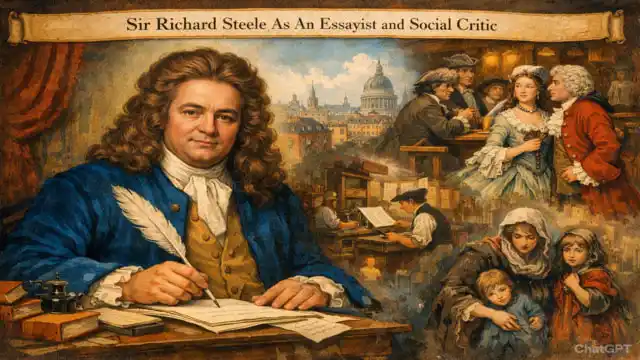
Steele is best remembered for founding influential periodicals such as The Tatler and co-founding The Spectator with his close friend Joseph Addison. These journals became vehicles for shaping public opinion and cultivating moral sensibility among the emerging middle class. Through lively characters, engaging anecdotes, and conversational prose, Steele addressed issues such as social manners, women’s education, hypocrisy, duelling, gambling, and the importance of family life. His essays reflect both sympathy for human weakness and a sincere desire to elevate the moral standards of society.
As an essayist, Steele’s style is marked by simplicity, warmth, and emotional appeal. Unlike the more restrained and polished tone of Addison, Steele’s writing often reveals personal feeling and moral earnestness. His ability to blend humor with seriousness made his essays accessible and appealing to a wide readership. As a social critic, he was progressive in outlook, advocating kindness, charity, and social responsibility. He criticized superficiality and moral corruption while encouraging civility, politeness, and compassion.
Thus, Sir Richard Steele stands as a significant figure who helped to establish the periodical essay as a literary form and as a medium of social reform. His work not only entertained readers but also contributed meaningfully to the moral and cultural development of eighteenth-century England.
Sir Richard Steele as a Social Critic of 18th Century England:
Sir Richard Steele was one of the greatest social critics in the history of English literature. Like Addison, Steele was a moralist of heart. He possessed the talent to satirise the vices of the society in which he lived. In his writings, he aimed at the presentation of the foibles and follies of the society of 18th century. He not only observed the vices of the society but also presented the causes of these shortcomings and later on he gave the solution to these problems. He had a great experience of the in town and he saw the latent vices which city life developed. He became aware of the vanity, ignorance and selfishness and disillusionment that reigned in the town.
His Reformative Aim and Moral Purpose:
His main object was to expose the false arts of life, to pull off the disguise of cunning, vanity and affectation, and to recommend a great simplicity in dress, discourse, and behaviour. He wanted to reform the tastes of the readers. He did not want them to continue in the contemporary fashions which were perverted tastes – drinking, gambling and all kinds of vice. He also deals with the sensitive studies of home life.
Use of Humour as a Moral Instrument:
Sir Richard Steele was highly impacted with his contemporary writers such as Pope, Addison and others who laid stress on the value of humour. He knew the value of humour in convincing the reader and converting him to one’s point of view: He was free of the values moralising of the Puritan. He realised that lightness of touch, a humorous gaiety was needed to give moralising an acceptable flavour. He said, “Touching upon the malady tenderly is half way to the cure, and there are some faults which need only to be observed, to be amended.” He used his lively sense of humour of effective ends. He is friendly and not as ironic as Addison and not in the least bit savage like Swift.
Steele and the Coffee-House Culture:
Steele was a great frequenter of coffee – houses. He knew very well how confused and misguided were the political discussions which took place there. He also realised that many other topics were also wrongly or superficially discussed. So, he set himself the task of enlightening as well as entertaining his fellow talkers in these centre of social life. Financial reasons also determined his future career. Since the censorship had been removed from the press, journalism had become profitable, and Steele’s chief motive in starting The Tatler in 1769, was, undoubtedly, the fear of bankruptcy. The general purpose of this paper, Steele wrote in the dedication of the first collected volume, was to expose the false arts of life, to pull off the disguise of cunning vanity and affectation.
Originality and Creative Genius in The Tatler and The Spectator Club:
Richard Steele was capable to create originality in his essays. The Tatler was the result of his idea. The work was original and easy and friendly in style. It was the individual work of Steele. As Gazetteer, he had already acquired valuable experience in journalism, and The Tatler illustrated his inventive genius, and his courage in taking risks. He borrowed the popular name of Bickerstaff from Swift and it was under this pseudonym that he edited and contributed to the journal. As the paper advanced, it was proved that Steele’s work was original and could not be called imitation. It was Steele’s creative imagination which led to the original establishment of the Spectator Club. It was he who made the first sketches of the members of the club. All the members of the Spectator Club were the product of his creative imagination. The members of the Spectator Club were drawn from different stages of life, society and profession. Each of them had own individual qualities. It is true that Addison developed these characters fully but the original conception was of Steele.
Variety of Subjects and Social Criticism in The Tatler
The Tatler was published thrice a week, and each issue contained several, essays, dated, according to their subjects, from particular coffee houses. Richard Steele perceived that different coffee – houses had widely different interests and tastes and he created to them all. He tried earnestly to instruct or amuse people of every taste, till the essays in The Tatler became almost as varied as the opinions of readers. He tried to make his writings as light and interesting as possible. He began by giving foreign, political and theatrical news and fully expressed middle class disgust at frivolity and immorality. He criticised prominent social and political personalities. He gave expression to the public dislike of gambling. Affectation in dress and manner, such as the use of the snuff boxes or the right use of care or fan, was mercilessly ridiculed.
Discontinuation of The Tatler and Political Complications:
The paper, The Tatler was published till the 2nd of January, 1711, when it was discontinued suddenly. There were many reasons for its discontinuation. According to Steele’s own account the public had seen through his disguise, and so he was no longer able to censure with effect under the Pseudonym of Bickerstaff. There is no doubt that partly this was his motive for abandoning the paper, but a weightier motive, which led him to discontinue its publication, was the realisation that the political element which the paper contained was a source of embarrassment to Addison as his sympathies were with the Whigs. The Spectator was then started.
Style, Prose Qualities and Personal Approach:
Richard Steele was free from the professional author’s obsession with correctness and cultivated quality of expression. He establishes a friendly relationship with the reader. His essays have an effusiveness of conversation about them. He is often not too careful about the construction of his sentences. He is free from any kind of pedantry. His style has the ease and freedom of everyday conversation. He is always polite and humble yet full of confidence. His prose has the ease and flow of the spoken phrase, and the urbanity of middle – class man of the world who has read in an university. It is dignified, but never pompous. It shows warmth, sincerity of conviction, naturalness and spontaneity which makes up for any lack of correctness of writing, any lack of elegance or purity in writing. Sometimes, he is capable of writing pithy and compact epigrammatic sentences.
He is also capable of a subtle and gentle irony as is evident in the essays, Of Club and Sir Roger’s Ancestors as well as the essays dealing with his disappointment in love. But his approach is slightly sentimental and romantic and more soft than Addison’s. To Steele women are distressed heroines and he shows a great sympathy for the down – trodden. In the portrayal of the members of the Spectator Club, Steele first showed the general tendencies of each character and it was left to Addison to develop them. His prose admirably carries out the one great general rule to be observed in all conversation, which, as he himself remarks in The Tatler No. 264, is “That should not talk to please themselves, but those that hear them.”
Insight into Human Nature and Social Institutions:
Steele had by nature a surer gift of reading the human heart, and by experience a keener insight into the ways of the town and into the latent vices which city life develops. He saw how vanity and self – consciousness produced much of the love – making in London with its jilts and fribblers, and ignorance and selfishness, most of the disillusionments and humiliations of married life. He went deeper when he discussed education, and pointed out how frequently the school system of that age sacrificed the character and temperament of children through their mental training. While advocating a fellow – feeling between all classes and both sexes, he did not forget to heap scorn on the vileness and futility of the courtship of patrons.
