Introduction:
Nissim Ezekiel’s poem “Marriage” offers a grounded, often ironic depiction of the institution, stripping away romanticised notions to reveal a frank—even at times sceptical—view of married life. Blending humour with exasperation, Ezekiel draws on personal experience and keen wit to delve into the tangled realities and less-spoken struggles of marriage, portraying it as a relationship shaped equally by companionship and tension.
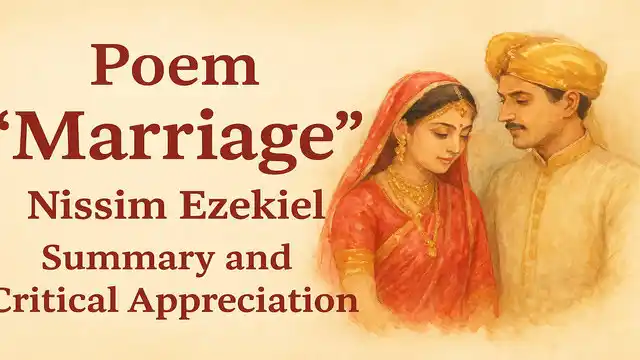
“Marriage” by Nissim Ezekiel is one of his best-known autobiographical poems, reflecting his characteristic blend of honesty, humour, and self-awareness. Written in a conversational and ironic tone, the poem explores the poet’s personal experiences and anxieties surrounding marriage—before, during, and after the event.
Ezekiel, known as the father of modern Indian English poetry, uses simple language and understated wit to present marriage not as an idealised romantic union but as a complex, often challenging, and deeply human relationship.
The poem moves through various stages of the poet’s life: his early confusion about the purpose of marriage, the pressure of societal expectations, his interactions with potential partners, and the realities of his married life.
Through this journey, Ezekiel offers sharp observations about middle-class Indian culture, arranged marriages, personal dilemmas, and the search for companionship. In doing so, he highlights themes of identity, commitment, cultural norms, and the struggle to balance personal desires with social obligations.
“Marriage” is therefore both personal and universal—capturing the humour, frustration, and emotional complexity of one of life’s most significant relationships.
Summary of the Poem “Marriage”:
Stanza.1:
Lovers when they marry face
Eternity with touching grace
Complacent at being fated
Never to be separated.
Explanatory Word-Meanings:
Eternity = being eternal, infinite time, future life. Touching = pathetic, moving, over sensitive. Grace = charm, honour. Complacent = self satisfied
Paraphrase:
When two lovers marry, they are filled with immense joy. They believe their happiness, excitement, and sense of pride will last for all time. Content with their union, they feel certain that nothing will ever part them now.
Stanza.2:
The bride is always pretty, the groom
A lucky man. The darkened room
Roars out the joy of flesh and blood.
The use of nakedness is good.
Explanatory Word-Meanings:
Pretty = beautiful. Groom = bridegroom. Roars = loud sounds. Flesh and blood = sexual pleasure.
Paraphrase:
After the wedding, a bride often appears especially radiant, and the groom is thought fortunate to have married someone so lovely. In the privacy of their room, the happiness they share may at times be audible to others outside. Their intimacy and vulnerability do not trouble them; instead, it feels natural and beautiful.
Stanza.3:
I went through this believing all, Our love denied the Primal fall Wordless, we walked among the trees And felt immortal as the breeze.
Explanatory Word-Meanings:
Primal = primeval, fundamental. Breeze = slow and gentle air.
Paraphrase:
The poet accepted everything people say about marriage and experienced it himself. His love for his beloved was so deep that he refused to believe Adam was cast out of heaven because of his devotion to Eve. He and his beloved wandered silently among the trees, feeling as timeless as the passing breeze. They believed that their love and desire for one another would never change.
Stanza.4:
However many times we come Apart, we come together. The same Thing over and over again Then suddenly the mark of Cain Begin to show on her and me. Why should I ruin the mystery By harping on the suffering rest, Myself a frequent wedding guest.
Explanatory Word-Meanings:
The mark of Cain = the sign of dispute. Harp on = dwell tediously on a subject.
Paraphrase:
Their relationship slowly began to fall apart. At times they appeared together, at other times they drifted separately. Arguments grew frequent, and an uneasy tension lingered between them. The poet chooses not to elaborate on the hardships that marriage often brings. Instead, he now often attends weddings simply to observe how long the couple’s affection and enthusiasm for one another will stay alive.
A Critical Appreciation of the Poem ‘Marriage’:
Introduction:
The poem “Marriage”, included in the third volume of Ezekiel’s poetry published in 1959, highlights his keen interest in exploring human relationships. Like many pieces in this collection, it reflects Nissim Ezekiel’s fascination with the intricate tensions of modern life.
In Marriage, he captures the emotions of a newly married couple—overjoyed by their union and convinced that nothing will ever part them. To them, the bride seems endlessly radiant, and the groom appears exceptionally fortunate. They long to remain wrapped in each other’s arms, believing such closeness to be the purest form of happiness.
The poet himself once shared these ideals, feeling almost ageless and free, like a breeze, whenever he was with the woman he loved. Yet, as time passes, differences inevitably surface. This pattern, familiar to many married couples, leads to strained bonds and fading affection. As a result, the poet distances himself from the idea of marriage, choosing instead to attend weddings simply as a frequent observer rather than a participant.
Importance of Marriage in Social Concept:
In our society, marriage is viewed as an important and even necessary institution. Those who are married are often seen as respectable, and married life itself is imagined as a source of happiness. Newly married couples typically begin their journey with joy, believing that their love will stay strong and unwavering, and that their affection for each other will never fade.
Brides are praised for their beauty, and grooms are thought to be fortunate for finding such lovely partners. For a time, the couple remains deeply absorbed in each other’s company. They find their greatest delight in physical intimacy, where nudity is not seen as improper but rather as something natural and positive.
However, this state of happiness is short-lived. Before long, their intense feelings for each other begin to fade. Affection slowly disappears, and conflicts start to arise. The couple grows anxious and eventually starts blaming their destiny. This pattern is common in everyday life. Many marriages ultimately break apart, even though at the start the partners seem convinced they will stay together forever.
A Realistic Picture of Married Life:
Since Ezekiel focuses deeply on human relationships, he observes nearly every facet of human experience. In this poem, he offers a truthful and realistic portrayal of the situations commonly found in many families. The thoughts he presents may not be lofty, but they ring true to everyday life.
Autobiographical Elements:
The poet fully accepted the traditional claims about the joys of marriage and thus chose to wed. So devoted was he to his beloved that he rejected the old belief that Adam was expelled from paradise because of Eve. For a while, their life together was harmonious and sweet. Gradually, however, small disagreements surfaced—nothing severe at first. But as time went on, their bond weakened. Quarrels became frequent, and their days grew increasingly unhappy. Although the poet never states directly how the marriage concluded, the tone suggests that it ultimately fell apart.
The Language of the Poem:
The poem is written in clear, straightforward language. Its rhyme scheme pairs the first line with the second, and the third with the fourth. The poem conveys that love is not always steady or permanent; human relationships naturally shift and may even fade over time. Therefore, we must learn to adapt to life’s changing circumstances. We should avoid placing excessive expectations on our partners, or we risk facing disappointment.
