Introduction:
The Family Reunion by T. S. Eliot is a powerful modern verse drama that blends psychological realism with classical myth to explore the themes of guilt, sin, crime, and spiritual redemption. First performed in 1939, the play marks an important stage in Eliot’s development as a dramatist, revealing his deep interest in religious philosophy and moral responsibility. Though set in a modern English country house, the play echoes the structure and spirit of Greek tragedy, particularly the myth of Orestes from Aeschylus’ Oresteia.
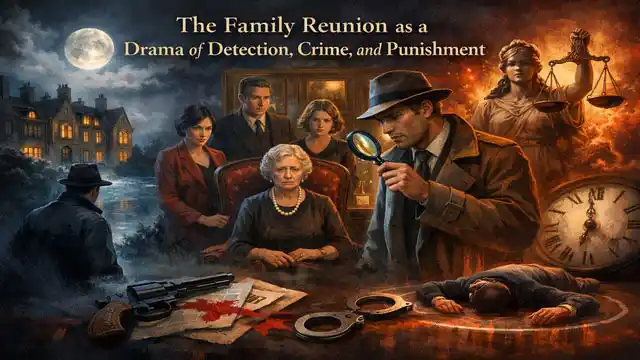
Viewed as a drama of detection, crime, and punishment, The Family Reunion centers on the mysterious death of Harry’s wife and his overwhelming sense of guilt. Harry, the protagonist, believes himself responsible for her death, though the circumstances remain ambiguous. The dramatic tension of the play arises not from external investigation, but from the internal process of psychological and spiritual detection. The crime in question is not merely a physical act but a deeper moral and spiritual transgression. Eliot shifts the focus from legal punishment to inner torment, presenting guilt as a force that isolates the individual from family and society.
The presence of the Furies—modern representations of the avenging spirits from Greek mythology—intensifies the atmosphere of moral pursuit and spiritual reckoning. These figures symbolise Harry’s conscience and the inescapable consequences of sin. Unlike a conventional detective drama, the play does not seek to solve a mystery through evidence and logic; rather, it uncovers the hidden layers of the human soul. Punishment in the play is not imprisonment or death, but spiritual suffering and the painful journey toward redemption.
Thus, The Family Reunion can be interpreted as a modern tragic drama in which detection is psychological, crime is both literal and symbolic, and punishment becomes a means of purification. Through this structure, Eliot transforms a domestic family gathering into a profound exploration of guilt, destiny, and spiritual awakening.
Poetic Play and the Duality of Action:
According to T. S. Eliot, a verse drama possesses a greater range of expression than a prose drama because it operates simultaneously on two distinct planes: the visible, external world of events and the inner, spiritual dimension of human life. This dual structure gives poetic drama a depth that prose drama generally lacks.
In The Family Reunion, this twofold movement of action is clearly evident. On the surface level, the play can be interpreted as a subtle comedy of manners marked by irony, or even as a conventional suspense narrative involving crime, investigation, and retribution. Beneath this outward framework, however, lies a profound spiritual narrative concerned with guilt, moral transgression, and the quest for redemption.
These parallel planes of meaning are skilfully interwoven, particularly through the character of Downing. Although he cannot be described as overtly spiritual, he demonstrates a keen psychological awareness that helps bridge the material and spiritual dimensions of the drama.
The Setting at Wishwood and Family Atmosphere:
The action takes place at Wishwood. A group of relatives—Aunt Ivy, Aunt Violet, Aunt Agatha, Mary, Charles, and Gerald—have gathered there to mark the birthday of Amy, the Dowager Lady Monchensey, and to receive her eldest son, Harry, who is coming back home after being away for eight years. Their talk reflects the commonplace, shallow drawing-room chatter typical of refined modern society. They are preoccupied with material ease and bodily comforts, and apart from Agatha, they display little sensitivity to deeper spiritual or moral concerns. Although the occasion is meant to be a joyful family reunion, it is ironically marked by a noticeable lack of warmth, sympathy, and genuine affection among its members.
The Higher Spiritual Action: Sin and Expiation:
Yet the play’s suspenseful, almost thriller-like quality is not its true centre of attraction. At a deeper, spiritual level, it unfolds a profound narrative of sin, anguish, purification, and redemption; it is this higher dimension that constitutes its real significance. The drama traces Harry’s movement from a personal sense of guilt to the realization that his torment springs not merely from individual wrongdoing but from an inherited, ancestral sin. This awakening comes through Agatha’s disclosures about his own history and that of the Monchensey lineage. Discovering that his family is burdened by a longstanding curse, Harry consciously chooses to endure suffering, seeking through his sacrifice to atone for the past and liberate his house from its doom.
Melodramatic and Sensational Elements:
Downing is summoned and interrogated without Harry’s knowledge in order to uncover the real circumstances surrounding his wife’s death. In the same way, Dr. Warburton holds a private conversation with Harry, aiming not only to discover the truth about the tragedy but also to awaken his sympathy and anxiety for his mother’s fragile condition. The entrance of Sergeant Winchell, Harry’s peculiar conduct, and the deliberate concealment of the mishaps involving Arthur and John further contribute to the play’s atmosphere of melodrama and heightened sensation.
Psychological Link Between the Two Levels:
The two planes of action—the outward, material level and the inward, spiritual level—are connected through the exposure of the hero’s troubled psyche. Haunted by an intense feeling of guilt, the hero’s inner conflict comes to light primarily through Downing. Though Downing possesses no spiritual perception, he is deeply perceptive in psychological matters. His limitations arise from his attachment to the practical world, for he understands only the anxieties and pressures of everyday life. Having served Harry for many years, he is well acquainted with his master’s temperament and difficulties. Through this long association, Downing has gained a clear awareness of the kinds of struggles and sufferings that burden a human being.
Downing as the Bridge Between Spiritual and Physical:
Downing comes to understand that Harry possesses psychic sensitivity, and through his profound psychological insight, he connects the material and spiritual planes of action. As D. E. Jones points out, although a considerable distance exists between the physical and the spiritual dimensions, the playwright effectively narrows this divide by means of Downing’s character. His perceptive understanding of the human mind serves as the crucial bond that fuses the two strands of action into an integrated unity. In doing so, Eliot demonstrates remarkable craftsmanship in shaping and structuring the plot of the drama.
The Christian Myth and the Poetic Under-Pattern:
The true importance of the drama lies in its underlying poetic structure. At this profound level, The Family Reunion presents the Christian myth of sin, the suffering that follows it, and the eventual renewal and salvation achieved through that suffering. Harry is burdened with the guilt of having killed his wife—or at least of having desired her death. As a result, he endures severe spiritual torment and finds no peace, either day or night, during the eight years that have passed since her drowning.
The central appeal of the play rests in the depiction of his intense inner agony. The playwright illustrates how, through deep suffering, Harry gradually becomes conscious of the true nature of his wrongdoing. Consequently, rather than remaining at Wishwood to lead a life of comfort and worldly ease, he chooses to leave in order to atone for his sin and ultimately attain spiritual freedom.
