Introduction of the Poem “The Journey of the Magi”:
“The Journey of the Magi” is one of T.S. Eliot’s Ariel Poems—a series of works composed for an annual Christmas publication between 1927 and 1929. The poem draws its narrative core from the Gospel of St. Matthew, recounting the Magi’s long pilgrimage to witness the birth of Christ.
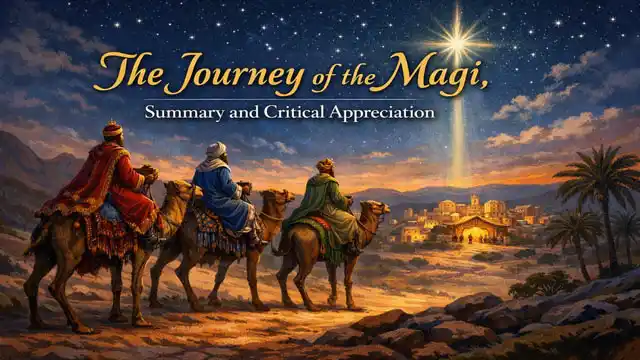
Guided by a mysterious new star, the wise men initially approached Herod, the ruler of the Jews, seeking assistance. Although he appeared willing to help, Herod’s true motive was sinister: he feared the rise of a rival king and planned to destroy the child. After the Magi found and worshipped the infant Jesus, they were warned not to reveal his whereabouts to Herod.
In Eliot’s poetic retelling, the journey becomes symbolic. The speaker suggests that the old spiritual order has faded, and although the search for a new faith has reached its fulfilment, it brings neither comfort nor satisfaction.
The Magi return with a profound sense of disquiet—changed by what they have witnessed, yet unable to find peace within their former world. Their restlessness leads them to long for death itself, hoping it will affirm the new truth they have encountered.
Summary of the Poem “The Journey of the Magi”:
The Magi Decide to Honour Christ:
The Magi learned of Christ’s birth and felt compelled to honour the newborn child. With this devotion in their hearts, they resolved to travel to the place where He had been born. Their departure took place at the end of December—a season hardly suitable for such a distant expedition, for winter’s harshest cold grips the land at that time, and people of the warm Eastern regions were unaccustomed to such bitter weather.
Harsh Winter Struggles of the Journey:
The journey from their hot homeland to a freezing country was extremely difficult. They knew they might face numerous obstacles and hardships along the way, yet they pressed on undeterred. As they travelled, they encountered rough, jagged rocks riddled with deep holes, and icy winds cut at their bodies. This was the worst stretch of winter.
Their camels, unable to bear the biting cold, soon fell ill. Exhausted and weakened, the animals—used to walking on hot desert sands—found their feet wounded and raw. At times, they seemed reluctant to move and collapsed upon the snow-covered ground.
Regret and Thoughts of Abandoning the Journey:
Moments of regret often clouded the minds of the travellers. They thought themselves foolish for beginning such a journey during this season. They wondered whether, instead of venturing into such hardship, they should have pursued a more comfortable trip to the luxurious palaces in the hills and valleys, where pleasure and comfort awaited. There, they could have enjoyed the company of beautifully dressed young women and sipped sweet chilled drinks offered by them.
Complaints and Difficulties Faced by the Camel Drivers:
Their camel drivers—fond of wine and women—also grumbled at the hardships of the road. With no source of entertainment, they grew unwilling to continue and even wished to abandon the journey midway. Another challenge was the absence of firewood to keep themselves warm through the freezing nights. When fatigue overcame them, they could find no safe refuge to rest and recover, for shelters were rare in such desolate places.
Hostility from Cities and Villages:
Though they passed through several cities, the people there rose violently against them, mistaking them for dangerous strangers. In the villages, too, the locals treated them harshly and demanded exorbitant prices for shelter and food.
Determination Despite Weariness and Doubt:
Weary and worn, the travellers longed to reach their destination as soon as possible. They resolved not to halt again, taking brief rests in turns as they moved. The Magi’s unwavering determination and inner spiritual drive urged them forward despite every hindrance. Yet, at times, doubts crept into their minds. They feared that their journey might end in vain—that all their effort and devotion would prove nothing more than a fruitless chase.
Symbolic Valley and Signs of Christ:
At last, when dawn broke, they arrived in a valley blessed with a delightful climate. Lush vegetation surrounded them, and the soft melody of a flowing stream blended with the rhythmic sound of a water mill. In a nearby meadow an old, white horse raced freely. They noticed three trees marking the spot of Christ’s crucifixion, where three crosses once stood.
A tavern with vine leaves draped over its doorway symbolized the Holy Communion. Six hands casting dice for silver brought to mind Judas’s betrayal of Christ and the soldiers gambling for His garments. They saw the drunken men’s feet nudging empty wine bottles along the ground.
Arrival at the Birthplace of Jesus:
Uncertain of the true birthplace of Christ, the travellers decided not to halt there and instead continued their journey. At last, they reached their destination—the birthplace of Jesus. However, the poet did not dwell on their joy upon finding the infant Christ. He simply ended the account with quiet satisfaction.
The Magus Reflects on Life, Death, and Faith:
The aged Magus reflects on the long-completed journey and tries to recall its essential moments. He questions the true aim of their travel—whether they went forth to witness the collapse of an old world or the emergence of a new one. For them, the experience felt like a kind of death, for it demanded a complete break from their former life and beliefs, yet it also resembled the beginning of a new existence.
Inner Conflict About Accepting Christianity:
The wise men had not been fully ready to accept the new Christian faith; it unsettled them deeply. They felt estranged from their own people, who continued to honour the gods of the pre-Christian era. They found no happiness in embracing this new religion. Because of this lack of inner peace, they longed for another kind of death—a final release from their old traditions and convictions, one that could lead them wholly into Christianity and allow them to live entirely within a new spiritual world.
Critical Appreciation of the Poem “The Journey of the Magi”:
Introduction:
The poem The Journey of the Magi is part of a collection known as the Ariel Poems. These pieces were composed as contributions to a yearly poetry volume released during Christmas, and trace back to the years 1927–1929.
Eliot’s poem draws upon an episode from the second chapter of the Gospel according to St. Matthew. According to the account, the Magi—also called the wise men—were guided to the infant Jesus by a mysterious star that led them to his dwelling and then vanished. Upon arriving, they honoured the newborn Christ. They were then divinely instructed not to reveal what they had learned to King Herod. Historically, the Magi formed a priestly caste among the Babylonians and the ancient Persians.”
Thought – Content:
One of the three wise men recalls their long and difficult journey to the birthplace of Jesus. They travelled during the harshest part of the year—late December—when winter was severe. Throughout the expedition, the Magi encountered numerous hardships. The roads were rugged, full of pits and uneven ground, and the biting cold had weakened their camels.
The camel drivers, addicted to wine and tempted by the company of prostitutes, constantly longed to return to those pleasures. Their desires were so overpowering that they even considered abandoning the journey halfway.
Nights offered no comfort; there were neither warm fires nor proper places to rest. Battling the bitter weather, the travellers often recalled the luxuries and ease they had left behind. Moreover, the city dwellers they met were unfriendly and offered no hospitality. In the villages, shelter and food were available only at unfairly high prices. Yet the Magi, driven by strong resolve and inner spiritual conviction, continued on despite every obstacle. At times, they wondered whether their mission was meaningless—nothing more than a futile chase.
Eventually, they entered a pleasant valley rich in vegetation. There they heard the soothing sound of a flowing stream and a water mill turning. Around them stood trees that reminded them of Calvary, the place of Christ’s crucifixion, where three crosses were raised—one for Jesus and two for the thieves crucified beside him.
They also saw a white horse running across a meadow, symbolising the dawn of a new beginning. A tavern covered with vine leaves suggested the idea of holy communion, while the sight of six hands gambling for silver recalled Judas’s betrayal and the soldiers casting lots for Christ’s clothing.
Although the Magi discovered nothing directly about Christ’s birth in that valley, the signs revived their spirit and urged them to continue. Their search ultimately reached its goal. However, the narrator’s closing remark reveals an ending marked not by triumph in the usual sense, but by a quiet, understated fulfilment—a journey completed, yet tinged with anti-climax and a sense of insufficiency.
The message of the poem:
The Magi sensed that their old belief system had faded, and their journey symbolized a search for a new spiritual truth. Their path was difficult, and even when they reached their goal, they felt a lingering pull toward their former faith. The new belief attracted them, yet it did not bring them peace or contentment.
Restless and uncertain, the wise men began to look toward death as the moment that might finally confirm their new faith. They longed for a death that would sever every connection with their past and allow them to be reborn as complete followers of Christ.
The aged Magus wished for a “second death” that would free him entirely from old customs and traditions, enabling him to embrace fully the new life offered through Christ’s birth. Only through such a final inner transformation could the Magi attain a fully realized spiritual state.
Suggested Title of the Poem:
The term Magi refers to the three wise men who travelled from the East to pay homage to the newborn Jesus. Historically, “Magi” denoted a priestly caste of magicians in ancient Persia. Over time, these wise men came to be regarded as three kings—Balthazar, the ruler of Chaldea; Gaspar, the Ethiopian king of Garshish; and Melchior, the king of Nubia. In the poem, one of the Magi narrates the hardships they faced as they journeyed through a harsh and unwelcoming landscape. Their physical voyage becomes a symbolic search for spiritual awakening—a movement from the death of the old order to the birth of a new era. The Magi’s inner transformation and their adopted way of life reflect the fulfilment of their spiritual quest.
Style and Language:
The poet has used a remarkable use of symbols. The main symbols are traditional. Smelling of vegetation symbolises sign of life – birth and growth. The running stream of water symbolises vital force of driving life, denying the voices that this was all folly. Three trees are symbol of Calvary where Christ was crucified and three crosses refer for Christ and the male factors crucified with him.
A white horse refers Christ, the conqueror. The horse’s galloping away in the meadow symbolises the dawn of progress. A tavern with vine leaves over the lintel is symbol of communion sharing in common.
The poet has also enriched the story with his personal memory as mentioned in his critical essay entitled The Use of Poetry and Use of Criticism. Another peculiarity of the poem is that while in style and phrasing, it bordered on prose. It is free from earthiness of prose. The poem has the greatest dignity and power. The process of conversation is portrayed in the images of the Magi’s journey.
