Introduction:
Robert Frost’s poem “Mending Wall” was first published in his collection “North of Boston” (1914), though it was composed in 1913. W. G. O’Donnell remarks that the poem explores “the theme of man’s isolation from his fellow men.” Set in the rural landscape of New England, the poem “Mending Wall” reflects the traditions, customs, and ways of life of its people. Written as a kind of dramatic monologue, it centres around the repairing of a boundary wall between two farms. The two farmers—one young and modern-minded, the other old and tradition-bound—hold conflicting opinions about the necessity of the wall. The younger farmer questions its purpose, while the older one insists, “Good fences make good neighbours.”
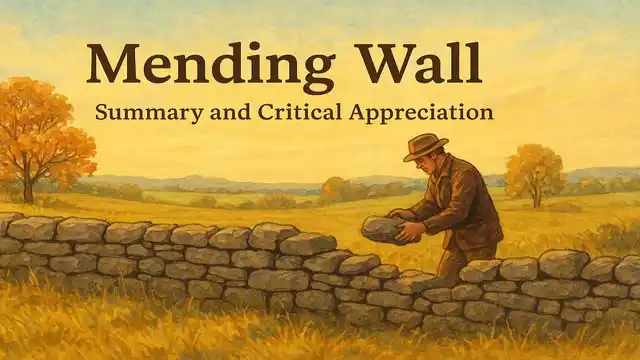
Summary of the Poem:
The Neighbours and Their Wall:
This poem ‘Mending Wall’ has been composed by Robert Frost. As we start to study the poem we find two farmers, one young and the other is old. They are neighbours but they have opposite views about the common wall. The young farmer does not agree to the views of the old farmer who is in favour of building a fence (wall) between their fields. The young farmer says that some supernatural power is at work to remove such a common wall between them. That power sends frost which brings down all the stones of all the walls on the ground which is covered with snow. As the sun rises, the snow melts and the stones of the wall become disbalanced. Both the farmers pass through the big gaps created by both of them. The young man asserts that the fall of that wall is truly not the work of hunters.
The Act of Repair:
Both the farmers dismantle the wall when they go on hunting to bring the rabbits out of their hidden places so that their hungry dogs should attack them. The young man says that he himself had repaired the wall after the hunters had gone. In fact, it is really the work of some mysterious power.
The poet further says that every year the spring season sets in and the holes again appear in the walls. He also tells this fact to his neighbour. Both the old farmer and the young start mending the wall on their respective sides. They set the stones of different sizes and the wall is built. The stones of different sizes make it difficult for both of them to repair the wall well because it needs special skill. The young farmer, out of fun, asks the stones that they should remain at their places for some time till they depart from that place. Their fingers become rough with the long handling of those stones. Their work is like some outdoor game in which both of them stand on their own opposite sides.
The Futility of the Wall:
The young farmer says forcefully that these dividing walls are not to be built at all. Their fields are already divided by Nature. For example, there are apple trees in his fields and pine trees are growing in the land of his neighbour. It is the Natural division because his apple trees cannot go to his part of the land to cat the cones of his pine trees. The old man does not pay attention to him and he remains adamant by saying, “Good fences make good neighbours.” The young farmer asks him why such fences are needed for good neighbours. According to him, such separation is necessary when cows, or other animals are harmful to others.
The young farmer asked the old one why the building of such a barrier is needed and for whose protection. He further says that he is not giving any harm to any person. He will also not harm him in any way if the common wall is dismantled. He gives the example that there is some natural power which pulls down such walls time and again. According to the young farmer, the old one could give his argument that perhaps it is the work of some fairies to pull down these walls. He himself cannot give such an argument because he does not believe in it. After saying this he became lost in some conflicting thoughts of his own.
The Old Farmer’s Belief and the Clash of Views:
When the young farmer was lost in his own thoughts, he saw the old farmer bringing two stones, one in each hand respectively by holding them firmly. The young man thought that the old man had turned into the wild beast of the Stone Age. Its reason was that he was fully prepared and armed to attack him. He also said that the old farmer was uncivilised, so he was living in the darkness of his foolish orthodoxy. This is the reason that he would not give up the teaching of his ancestors who had taught him that good neighbourly feelings could not be developed without keeping strong walls, or barriers. He called him an orthodox fellow believing in old ideas. He also called him a slave to old social ideas which are against the progressive ideas of the modern times.
The Closing Note:
Hearing these words of the young farmer, the old farmer again repeated his saying with firmness, “Good fences are good neighbours.” Hearing his repeated and traditional answer, the young farmer did not say anything more.
Critical Appreciation of the Poem:
Introduction:
“Mending Wall” reflects Frost’s deep understanding of New England life, traditions, and human relationships. The poem, though simple in setting, raises timeless questions about human separation and connection. While the young farmer dismisses walls as futile, the old neighbour values them as essential for harmony. This tension between tradition and modernity gives the poem its depth.
The Theme of the Poem:
As we study the poem ‘Mending Wall’ the title is not only attractive but it is also very suggestive. It shows the practice of repairing the wall, or the fence between the two farms which had been damaged by the winter frost. The main theme of this poem shows a debate on the subject related to the need of having a wall, or not because the two farmers have their opposite views. It was a custom in New England to repair such walls, or fences every year. For such repair the common consent of the partners was necessary. Thus the theme of the poem is very simple because it is the sign of common partnership. The indirect meaning of the title shows a feeling of separation from one another. Some persons or some nations are in favour of such a common boundary. On the other hand, there are some other persons, or nations who like to have no boundary between them. This poem shows a very good remark about the need of such walls, or fences. The significant words are, “Good fences make good neighbours.” The poet leaves the decision on the readers in the end of the poem.
The Development of Thought:
The underlying idea of the poem “Mending Wall” is the sign of the instinct of separation or alienation found among all human beings. The wall was damaged by the winter frost, so it became necessary to make the necessary repair of the common wall by the mutual consent of the two farmers. Each of them started the work of repair from his own side like the two players. They reset those stones which had fallen down. Thus their fingers were also injured. The old farmer, in the course of their conversation showed the need of a common wall by saying, “Good fences make good neighbours.” The young farmer opposed his idea by saying that there is no need of a wall between them. He also gives the example of apple and pine trees on each side respectively.
Even in the concluding part of the poem, the old farmer asserts the need of the common wall by saying, “Good fences make good neighbours.” It shows a clash between old ideas and progressive conception of the modern age. The poet asserts the need of fellow – feelings.
The Modern Issue:
As we study this poem ‘Mending Wall’ by Robert Frost we find, that it deals with a modern issue because it is highly interesting and important for all the readers of the progressive modern age. This poem is regarded of much relevance in the modern times. Its reason is that the present age is regarded as an age of internationalism where narrow divisions or barriers are regarded useless and unnecessary among different nations of the world.
Today we are living in the age of science and progress when old ideas and narrow divisions have become totally out – of – date. On the other hand, there is the need of love and universal brotherhood. With this reason, divisions between human beings and nations are regarded out of time and out of place. Robert Frost, through this poem, clearly shows that human beings may erect temporary walls, or barriers but Nature, or atomic wars will bring them down. With this reason the poet does not give a clear cut answer even at the end of this poem but he leaves the decision with the readers of this poem. He does not give any message from his own side. He leaves it as a problem of the modern times.
Conflicting Views:
As we go on studying the present poem, “Mending Wall” seriously and attentively we find that it shows the mixture of opposite, or conflicting views. Such conflicting views are expressed both by the old farmer and the young farmer. Their conflicting views are related to the building, or dismantling the common wall between their farms.
The old farmer asserts “Good fences make good neighbours” because some persons cannot live without walls, or boundaries because they have their faith in isolation, or separation. On the other hand, the young farmer expresses his firm faith in having no such wall or boundary. His views, which are apparently more progressive and reasonable support free and common life without having any fence or boundary.
The views of the two farmers show the clash of the conflicting views. The old farmer is in favour of ‘Good fences’ but the young farmer shows his revolt against the traditional view of the old farmer because he does not believe in any kind of wall, or fence. It seems that the poet is in favour of a broad – minded human outlook against narrow ideas.
The Poet’s Style:
As we study the ideas included in the poem ‘Mending Wall’ attentively we find highly interesting, effective and unique style of Robert Frost. It is true to find out here that the ideas in this poem have been expressed in simple language. The poet has made use of blank verse and iambic metre. Both the language in the poem, as well its rhythm shows the poet’s usual conversational style. The poet also makes use of symbols and imagery to increase the effect of his poetic expression.
As we go on making the study of the poem more and more we find the image of Robert Frost as a true and great artist. His skill is clearly seen from the beginning of the poem upto its end. The example of rabbits, apple trees and pine trees not only show the use of beautiful images but his symbolism is very clear. After reading this poem, we find the show of several artistic qualities of the poet in this poem. The poet has also used chosen words to make his expression realistic and highly effective. The symbolism in the poem is excellent. In short, there is artistic quality as well as deep meaning in the poem.