Introduction to Milton’s Sonnet “On the Massacre”
John Milton’s sonnet “On the Massacre in Piedmont” is inspired by a tragic historical event. In April 1655, the Duke of Savoy ordered the brutal massacre of around 400 people in Piedmont, who were persecuted for rejecting the traditional Roman Catholic faith. His armies carried out the command with ruthless cruelty, killing even women and children.
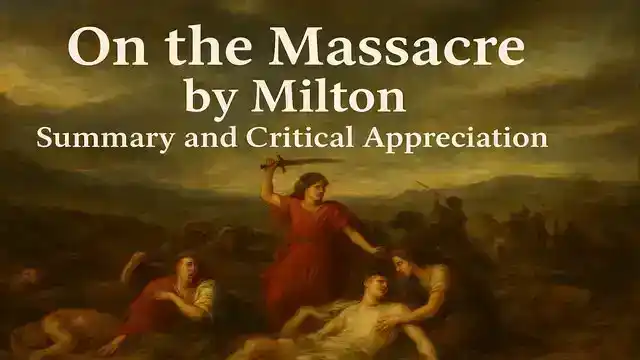
Through this sonnet “On the Massacre”, Milton raises his voice against such injustice and appeals to God to avenge the murder of these innocent believers, whom he refers to as saints. Their bones lay scattered across the Alpine mountains, bearing witness to their faith in the pure and true religion, in contrast to the idolatrous practices of worshipping “stocks and stones.” Milton insists that their sacrifice must never be forgotten.
He vividly describes the horrors: women with infants hurled down rocky cliffs, their cries echoing through valleys and rising to Heaven. Yet Milton transforms this grief into hope, declaring that the martyrs’ blood and ashes will one day inspire revolt, bringing freedom to Italy from papal tyranny. He envisions a future where people embrace the true word of God and overcome oppression.
Summary of the Sonnet “On the Massacre”:
Shock at the Merciless Massacre:
Milton is deeply shocked at merciless massacre of innocent Protestants by the armies of Duke of Savoy. Only because these people refused to follow the Roman Catholicism. The bones of the dead saints lie scattered on the Alpine mountain. These people had faith in true and pure religion and opposed blind faith in idols of wood and stone. Superstitions, narrow – minded Catholics could not bear it and massacred the Protestants. Milton prays to God to punish the merciless murderers who killed the true followers of God.
Record of Sacrifice and Satanic Cruelty:
According to Milton, the great sacrifice of Protestants must not be forgotten. The book of judgement keeps record of all good and evil actions. The barbaric massacre must dominated by Satanic instincts, massacred the helpless Protestants mercilessly. The soldiers did not feel pity even for woman and children. They rolled down a mother with her child down the rocks. It is great irony that the satanic action happened in the name of religion.
Cries of the Innocent and True Faith:
The armies had no pity even for women and children. Milton imagines that their cries echoed for hills and the souls rose up to Heaven. For these Protestants were the true followers of God. They had progressive reformatory views. The narrow minded Catholic could not bear them and killed them mercilessly.
Hope in the Martyrs’ Sacrifice:
Milton believes that the sacrifice of these people will not prove fruitless. It will provoke the whole country against the tyranny of the Pope and his followers. These people died for their true faith. The blood of these martyrs will spread far and wide and create a larger number of Protestants. These Protestants will revolt against the corrupt rule of the Pope whose three – crowned head dress symbolises that he rules over the earth, heaven and hell. But his tyranny will force all people to accept the true religion of Protestants. Their revolt will succeed in removing the corrupt rule of the Pope. The corruption of the Roman Catholic Church is compared to that of ancient Babylon. The Bible condemns Babylon for sin and corruption.
Critical Appreciation of the Sonnet “On the Massacre”:
Introduction to the Sonnet:
The sonnet “On The Massacre” is provoked by the merciless killing of protestants known as the Vandois or Waldenses, in Piedmont (in Italy) by the Duke of Savoy in April 1655. The Turin Government wanted these people to be Catholics. But they refused and were massacred.
Form and Structure of the Sonnet:
Milton’s “On the Massacre” is an ideal sonnet in Italian pattern. It differs from the English sonnet in structure. It has an octave of eight lines and sestet of six lines. The octave is divided in two stanzas of four lines each. The sestet is divided in two tercets of three lines each. It observes the following rhyme: abba, abba, cdc, ded.
Thematic Development:
In the octave, Milton presents a pathetic description of the merciless killing and prays God to punish the murderers. In the sestet, he becomes hopeful and believes that the sacrifice of innocent protestant will provoke the whole country to stand against the tyranny of God. Their number will increase day by day and they will be able to end the corrupt rule of the Pope, the head of the Roman Catholic Church.
Power of Imagination:
The poem presents a remarkable example of Milton’s high imagination. On the base of imagination he draws a lively word picture of the dead Protestants and their bones scattered on the snow – covered Alps. He imagines that the blood of these people is wide spread and creates a larger number of Protestants.
Pictorial Quality:
Milton’s sensuous pictorial art is well expressed in the sonnet. He presents the pathetic word pictures of the dead Protestants:
“Thy slaughter’d Saints, whose bones
Lie scattered on the Alpine mountains cold.”
Use of Figurative Devices:
Milton uses his grand style in this sonnet. He uses metaphor and hyperbole. He uses symbolism. For example ‘thy sheep’ symbolises ‘followers of God’.