Introduction of the Poem:
Walt Whitman’s “Animals” is a celebrated poem from his landmark collection Leaves of Grass. In this poem, Whitman expresses his deep admiration for animals and contrasts their simple, peaceful, and contented existence with the restless, artificial, and dissatisfied life of human beings. The poet observes that animals live naturally, without greed, hypocrisy, jealousy, or the endless desire for material possessions. He therefore wishes to live among them and learn from their uncomplicated way of life. Through this comparison, Whitman presents animals as symbols of simplicity, innocence, equality, self-contentment, and harmony with nature. The poem also contains a gentle criticism of modern human civilization, suggesting that human beings have lost some of the natural virtues that animals still possess. Thus, “Animals” is both a celebration of the animal world and a thoughtful reflection on the weaknesses of human society.
Historical Context:
Walt Whitman’s “Animals” is a short poem from his celebrated collection Leaves of Grass. It was first published in the 1860 edition of the collection and later appeared in revised editions. The poem reflects Whitman’s characteristic belief in nature, democracy, equality, and the spiritual unity of all living beings.
The poem belongs to the literary and cultural atmosphere of nineteenth-century America, a period marked by rapid industrialisation, urban growth, social change, and material ambition. Whitman witnessed a society increasingly concerned with wealth, status, competition, and social advancement.
Against this background, he looks at animals as creatures that seem free from many of the anxieties that trouble human beings.
Whitman wrote “Animals” during the broader period of intense political and social transformation that culminated in the American Civil War (1861–1865). Although the poem is not directly about the war, its emphasis on equality and freedom resonates with Whitman’s larger democratic vision.
Whitman was influenced by the ideas associated with American Transcendentalism, particularly the belief that nature provides a source of spiritual truth. Thinkers such as Ralph Waldo Emerson encouraged Whitman’s conviction that ordinary life and the natural world possess profound spiritual significance.
In “Animals,” animals become almost philosophical teachers because they live naturally and simply, without the artificial concerns of civilisation.
The poem contrasts the apparent simplicity of animals with the dissatisfaction of human beings. Humans are shown as troubled by complaints, guilt, material possessions, social distinctions, and the pursuit of success. Animals, by contrast, appear content with their existence.
This contrast reflects Whitman’s criticism of the artificiality and materialism of modern civilisation.
Whitman was deeply committed to the ideals of democracy and equality. His poetry frequently challenges conventional social hierarchies. In “Animals,” the poet imaginatively approaches animals as beings from whom humans might learn.
The poem therefore extends Whitman’s democratic sympathy beyond humanity and toward the whole natural world.
The poem also reflects Whitman’s characteristic idea that the body, nature, and spirit are interconnected. Rather than presenting animals merely as lower creatures, he treats them as beings possessing a kind of wisdom and harmony that human beings have lost.
Thus, the historical context of “Animals” lies in nineteenth-century America, particularly its democratic ideals, rapid social and economic change, growing materialism, and the influence of Transcendentalist thought. Whitman uses the apparently contented lives of animals to question human dissatisfaction and civilisation’s artificial values, while expressing his broader faith in nature, equality, freedom, and spiritual unity.
Summary of the Poem:
The poem “Animals” has been extracted from the poet’s popular poem “Song of Myself” from its section 32. The poet shows his better liking for the company of the animals who are far superior for him to human beings who have a number of evils with them.
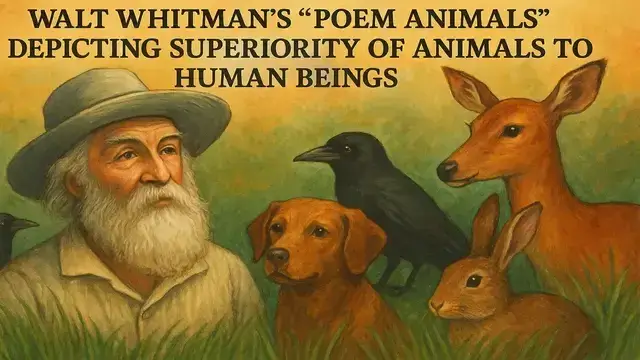
In the opening lines of this poem the poet shows his desire to live in the company of the animals who are peaceful by their nature with the quality of self – contentment. Like human beings they do not complain about their conditions, nor, they keep awake in the dark night to weep for their sins which men and women often do. They also do not complain of their duty to God. On account of their such virtues, the poet wishes to live and move in their company. He gets much satisfaction in such a way.
The poet again says that animals do not suffer from the lust of wealth and power which are the faults of human beings. All human beings complain of the differences of rich and poor, high and low, etc. In the last lines, the poet says that he can run faster than a horse.
Critical Appreciation of the Poem:
Introduction:
This short poem under the title “Animals” is an extract from Walt Whitman’s famous poem “Song of Myself”. In the opening lines of this poem the poet says that the animals possess the great virtues of innocence, peace and contentment. In this respect they are superior to human beings. The poet has described these virtues in the first eight lines. As a believer in democracy, the poet asks to keep equality with the animals. He describes his own desire to live with animals because they are calm and self-contained. They do not make any complaint about their conditions. The following opening lines show the poet’s liking for the animals. The first five lines of this poem are given here:
“I think I could turn and live with animals,
they are so placid and self – contain’d,
I stand and look at them long and long.
They do not sweat and whine about their conditions,
They do not live awake in the dark and weep for their sins,
They do not make me sick discussing their duty to God.”
Poet’s Longing for Animals’ Company:
The poet loves all these animals so much that he wants some time of his life in their company. Its reason is that they are of calm, peaceful and satisfied nature. In short, they are happy and highly self – satisfied. The poet prefers their company because they are always more happy and carefree than human beings. He is so much impressed by their virtues that he likes to look at them for a long period of time. In fact he is much delighted at their simplicity. Neither they sweat for any work, nor, they make any complaint for anything. Its main reason is that they are always satisfied. They do not pass sleepless nights under the care of their sins as a large number of human beings remain under tension and they cannot sleep peacefully at night. Neither they commit any sin, nor, they have any such knowledge. They are not a prey of hatred or jealousy. They do not complain to the poet regarding their duties to God. Like a common man, they are not mad with the lust for wealth and power.
A Comparison between Carefree and Worried Life:
The poet contrasts the carefree life of the animals against the worried life of a large number of men and women. It is a conception according to the Bible that the animals and the birds are carefree unlike human beings. Again the poet says that the curse of Adam is not on the heads of the animals, so they do not whim about their problems. A large number of persons often complain that they have not been able to do their duty towards Got but there is no such complaint from the side of animals. They are always innocent in such matters.
Close Affinity between Animals’ and Poet’s Personal Life:
The poet further asserts that there is much similarity between the animals and his own personal life. This is the reason that he loves them and wants to pass a major part of his time in their company. The poet does not know how these living creatures have got the qualities of peace, contentment and carefree life which he himself wants to share with them and enjoy like them. He is happy at such a common affinity. He further says that he had received these wonderful virtues some time back when he had passed by them at the time of his journey from there. He is in the habit of moving about and receiving experience from different parts of the earth. In this way, he regards these animals like his brothers, so he also wants to live with them. In short he is influenced by their magnetic touch and it is also the cause of his own fascination with them.
“So they show their relations to me and I accept them,
They bring me tokens of myself, they evince them plainly in their possession. ”
Poet’s Admiring A Male Horse:
The poet further describes in the closing lines of this poem about the beauty, strong body and impressiveness of a male horse. He has high head in the wide forehead between his ears. His parts of the body are glossy, delicate and his tail is so long, that it is touching the ground clearly in his movement. His eyes are sparkling, showing a touch of wickedness. His ears which are nicely cut show flexible movement. His nostril dilates when the poet touches him with love. The following lines from the text of the poem indicate the impressive personality of the horse along with the detailed description of its different parts of the body.
“A gigantic beauty of a stallion,
Fresh and responsive to my caresses,
Head high in the forehead, wide between the ears,
Limbs glossy and supple, tail dusting the ground,
Eyes, full of sparkling wickedness, ears finely cut, flexibly moving.
His nostrils dilate as my heels embrace him.”
Poet’s Showing His Divinity:
In the last three lines of this poem the poet makes it clear that he does not need to concentrate only to the house only because he has something more in the Vast Universe. If he is sitting or standing at one particular place, his soul can fly higher and faster than any horse. It is because of the presence of the divine within his heart – of – hearts. Only with this reason he is “Infinite and omnigenous”.
Moral of the Poem:
The great poet likes to show “oneness” with animals, etc. He does not see any cause of human superiority to animals. On the other hand, a man should learn the virtues of peace and contentment from animals. This is also his message to his readers. The following last three lines are worth – quoting here:
“I but use you a minute, then I resign you, stallion,
Why do I need your paces when I myself out – gallop them?
Even as I stand or sit passing faster than you. ”
Mystical Idea:
The great poet, in this poem, “Song of Myself” has expressed his mystical idea of his journey to the kingdom of God. We also find his simple language, fine expression and easy style in this poem. Here he is not only unconventional as well as revolutionary in his ideas.
Form:
We find an improvement from the traditional form. He has shown the use of free metrical laws included in his poetic style without the use of rhyme and metre.
Fast Facts:
| Aspect | Fast Fact |
| Poem | Animals |
| Poet | Walt Whitman (1819–1892) |
| Nationality | American |
| Collection | Leaves of Grass |
| Literary Period | American Renaissance |
| Genre | Philosophical and reflective poetry |
| Form | Free verse |
| Central Theme | Contrast between animals and human beings |
| Major Ideas | Simplicity, contentment, equality, and harmony with nature |
| Attitude towards Animals | Admiration and respect |
| Attitude towards Humans | Critical of greed, hypocrisy, discontent, and materialism |
| Speaker’s Wish | To live with the animals |
| Literary Devices | Repetition, imagery, contrast, and symbolism |
| Tone | Reflective, admiring, and critical |
| Animals Symbolize | Naturalness, contentment, and simplicity |
| Humans Symbolize | Artificial desires and social corruption |
| Poetic Movement | Transcendentalist-influenced thought; Whitman is also associated with American Romanticism |
| Message | Human beings can learn contentment and simplicity from animals. |
