Chaucer’s Humour: The Prologue
Introduction:
The Prologue to The Canterbury Tales is one of the finest achievements of medieval English literature, in which Geoffrey Chaucer presents a vivid and realistic picture of fourteenth-century English society.
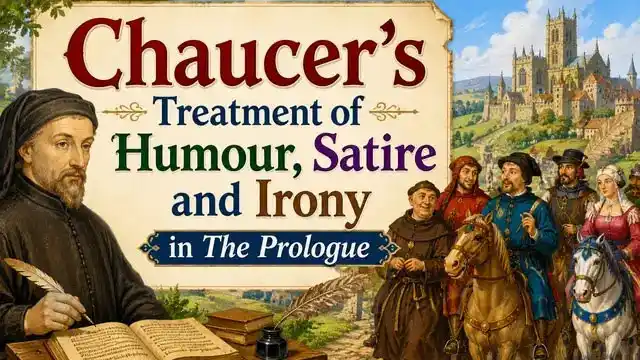
Through his gallery of pilgrims drawn from different social classes, Chaucer skillfully combines humour, satire and irony to expose human weaknesses, social corruption, and moral hypocrisy. His humour is gentle, entertaining, and humane, making his characters lively and memorable. At the same time, his satire is subtle rather than harsh, allowing him to criticize the shortcomings of individuals and institutions, particularly the Church and the social order.
Chaucer’s use of irony further enriches the narrative by creating a contrast between appearance and reality, often revealing the true nature of his characters beneath their outward respectability. Thus, humour, satire, and irony work together in the Prologue to provide both amusement and social criticism, making it a timeless masterpiece of literary art and human observation.
Humour is the excitement created by amusement. Therefore, all the elements of a poem may become sources of humour. Chaucer is expert in this art and creates humour of character, speech, action and thought. Humour has two more aspects that are called satire and irony. Satire is a direct comment on a short coming while irony is an indirect comment. Irony is created by difference in appearance and reality. All the sources of humour become the sources of satire and irony also.
Purpose of Humour, Satire and Irony: Criticism of Life:
Chaucer’s poetry is not for Art’s sake. It is for Life’s sake. It is therefore, Chaucer points out throughout the ‘Prologue’ what is wrong and what right. He criticises the growing worldliness among the churchmen. He points out imperfections of the Nun, the Monk and the Friar. He admires the Poor Parson for his truthfulness. According to him the priest should be ideal enough to present an example before others to show how his followers should live without being corrupted. He never ran after earning money leaving his followers sunk in corruption. He did not go to St. Paul’s in London to collect fees for singing mass or to join another guild for earnings. He lived in his town taking care of his parishioners so that corrupt people might not mislead them. In fact, he was a priest and not a businessman. Though he was holy and virtuous he was not merciless to sinners. He was never scornful or rude in his speech. He always taught quietly and kindly. His only ambition was to lead his followers to heaven by inspiring them to lead an honest life. But if anybody was obstinate, he would rebuke him then and there without caring if he was rich or poor. While dealing with the character of the Knight he points out how he believed in chivalry, truth, honour, freedom and politeness. Besides, he was not only brave but he was not only brave but wise and polite also. He had never abused anybody in his life. In short, he was a perfect gentle knight. Chaucer’s criticism of life is so apt that it becomes universal. For example, he points out that the Summoner’s face was pimpled for he loved garlic, onion and leafy vegetables and drank strong red wine of blood colour. Under intoxication he spoke only Latin and cried like a mad man. He knew only a few Latin words that he had learnt from some law. It was not surprising for he heard these words all the time in the court. Like a bird he could speak the word ‘Walter’ in the manner of the Pope. But if a man examined him further, he forgot whatever, he knew. Then he began to cry ‘The question is what portion of the law (applies)’. The poet tells about the Wife of Bath also that she was not attractive at all. Her face was bold and dark. Her mouth was gap-toothed. She was hard of hearing and her hips were heavy yet so many people were mad after her. It is so for she is an earning lady and her frank behaviour wins their hearts. It is true that she was gap- toothed. She sat comfortably upon a slow-moving horse. She wore a fair wimple or veil and a wide hat shaped like a shield. Her outer skirt covered her large hips. She wore a pair of light shoes. In company she talked freely and cut jokes. She knew all the remedies of love for she had gone through that game so often and so long. Her charms are hidden in her being a lady of self-earning and frank nature. These qualities are rare to be found in a lady in a traditional society.
Humour:
Chaucer’s humour is innocent, pleasing and full of universality. For example, he tells about the Squire’s hair and gown. The squire was a loving enthusiastic young man. His hair was curly as if it were kept under pressure. The poet guesses the squire was twenty years old. His height was moderate. He was very strong and active. He had been in cavalry force at Flanders, Artois and Picardy. He had become an expert rider in a short period just to impress his beloved. There were embroidered white and red flowers on his gown that looked like a meadow of fresh flowers. He tells about the Monk’s gown that was decorated with fine fur at the cuff. His hat was bound with a pin of solid gold under his chin in a butterfly knot. His bald head shone like glass. His face shined as if it were oiled. He was a bulky man. His eyes were sinking and rolling in his head. They looked burning like the furnace of lead. Likewise, when the Friar played on a harp his eyes glittered like stars in a foggy night. The shipman had drunk wine secretly without payment when the merchant was asleep. Humour of character is well represented by the Monk who has no time to study holy books and wastes his time in riding and hunting. Humour of speech is created by the Nun by speaking such French that is not spoken in Paris. Besides she sings in a nasal tone. Humour of action is present in the Friar’s polite behaviour with those from whom he earns money. Humour of description can be marked in the gown of the Squire. There were embroidered white and red flowers on his gown that looked like a meadow of fresh flowers.
Embrouded was he as it were a meede,
Al ful of fresshe floures whyte and reede.
Satire:
‘Prologue’ is a remarkable poem of satiric nature. The poet passes mild satires without even a bit of bitterness for he knows that no man is perfect. It is the quality of his satires that they are neither bitter nor biting. But they are perfect in serving their purpose. For example, Chaucer passes satire on the corrupt practice of the Summoner. He was a kind rascal. It was difficult to find out a more wicked man. If a man could give him wine, he allowed him to enjoy himself with a mistress. If he lent his mistress to the Summoner the man could enjoy himself with her for the whole year for the summoner was ready to excuse him. Privately he could cheat an ignorant person. He asked to be bold against the fear of the arch deacon’s excommunication and taking no risk to his soul the person should suffer a loss of money. Besides, purse is hell i.e., a noble person should not love money and get rid of it. But in reality, he told a lie by saying it for he loved money. Chaucer passes satire of imperfection of his characters. For example, Chaucer passes satire on growing worldliness among monks of that time by pointing out that the Monk was interested in leading a worldly life. According to holy books a monk should never be a hunter, but this monk had a number of hunting dogs. His hunting dogs were as fast as a bird. He took deep interest in catching and hunting a hare. He was not ready to leave it in any condition. The Monks physical appearance exposed his worldly nature. His gown was decorated with fine fur at the cuff. His hat was bound with a pin of solid gold under his chin in a butterfly knot. In this way he looked more like a romantic landlord than a monk. His dress was costly enough to be worn by a highly prosperous man. Chaucer brings to light the prevailing corruption of contemporary church. He passes satire on the Friar’s easy way of granting pardon to the sinners. Chaucer passes satire on growing imperfection among friars of that time by pointing out the Friar’s interest in leading a worldly life. In an satiric tone the poet comments that the Friar was a worthy officer in his church. All the landlords and rich people loved him. He knew all the worthy i.e. corrupt women of the town. He had power to hear confession of sin and grant pardon to the sinner. He took interest in listening to the tale of sin. He claimed that he was more than a priest. He was a licence-holder. His way of pardoning the sinner after confession was easy. It is not the proper way of granting pardon but the Friar had made religion a source of corrupt earnings. It is the mockery of confession that pardon is granted only by taking gifts.
Irony:
Irony is a literary device in which an imperfection is pointed out indirectly. Chaucer is expert in this art and hits imperfections of his contemporary society without creating any sense of bitterness. For example, Chaucer comments ironically on the Monk:
What sholde he studie and make hymselven wood,
Upon a book in cloystre alwey to poure,
Or swynken with his handes and laboure,
As Austyn bit? How shal the world be served?
In a way the monk was justified for he had no faith in those books. In this condition if he is forced some how to read those books his wits will be confused. The poet remarks that the Monk did not give any importance to those books that claim that hunters are not holy. According to them a monk becomes careless if he spends his time out of cell. He is like a fish out of water that means his sacredness is lost. He did not like to study those bulky books. The poet passes satire on the monk saying that the monk’s opinion was right for such books would make him mad. He did not like the life of a scholar who spends his whole time in reading those meaningless books. He did not care for St. Augustine and his suggestions. The monk wanted to serve the world and therefore he had become a rider. He was a worldly man whose sole interest was hidden in worldly activities. It is an example of remarkable use of irony. The character of the Nun Prioress is the best example of irony. Chaucer admires the Nun’s table manners on the one hand and on the other exposes her worldly nature. In fact, a nun ought to concentrate her mind in religious matters. It is a matter of surprise that she cares so much for such worldly things. She showed stately manners to be respected in society. The poet tells about her inner nature. It was helping and kind enough to make her weep on seeing a dead or bleeding mouse. She had pet puppies whom she fed with roasted flesh and high-class bread with milk. If any one of them was dead she wept bitterly. She could not bear if anybody beat or frightened them. A nun ought to be merciful towards orphan children, the sick and the old. She ought to look after them and feed them by borrowing money and food from the well to do people of society. But such things were below her dignity. She had no time for them. She fed her dogs with milk and bread of high-quality wheat. It exposes her vanity. It is an example of Chaucer’s use of irony.
Conclusion:
Chaucer’s Great Humanity-Chaucer’s humour is dominated by his great humanity. It is therefore he is bitter towards none. In this respect he leads Shakespeare and Dickens who point out imperfections of society with a positive attitude of providing an opportunity to make improvement. Therefore, he is regarded as the greatest humorist. He knows mankind is imperfect. Attempts should be made to make it as perfect as possible. With this view in mind, he exposed the imperfection without being bitter to the character. He seems to be defending the Monk’s imperfection by making statements like:
i. A manly man, to been an abbot able.
ii. What sholde he studie and make hymselven wood.
iii. Therfore he was a prikasour aright.
iv. Now certeinly he was a fair prelaat.
For the Doctor also he makes such remarks:
i. In al this world ne was ther noon hym lik.
ii. For gold in phisik is a cordial,
Therfore he loved gold in special.
