Introduction:
In Alexander Pope’s The Rape of the Lock, Lord Baron is one of the central male characters whose actions set the entire plot in motion. He represents the fashionable, pleasure-seeking young aristocrats of eighteenth-century English society. Driven by vanity and romantic ambition, Baron becomes determined to possess a lock of Belinda’s beautiful hair, which he regards as a symbol of her charm and beauty. His seemingly trivial act of cutting the lock creates a major conflict and serves as the basis of Pope’s mock-epic treatment of a minor social incident.
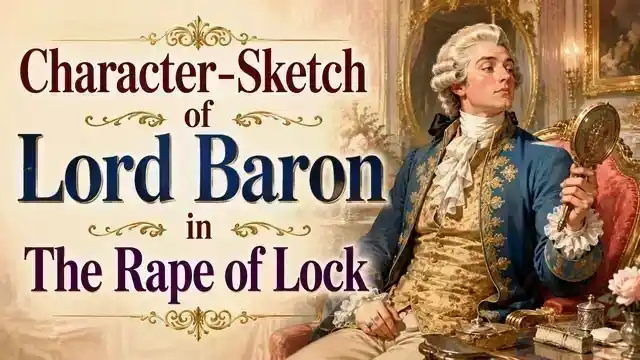
Through the character of Baron, Pope satirises the superficial values, pride, and frivolous concerns of the upper-class society of his age. Although Baron appears confident, charming, and gallant, his actions reveal selfishness, vanity, and a lack of genuine respect for women. Thus, Lord Baron plays a crucial role in the poem and helps Pope expose the absurdities of fashionable society through wit, irony, and humour.
Lord Baron is the hero in this mock-heroic epic. A classical epic consists of inspiring characters as we see in Paradise Lost that even Satan’s character is highly inspiring. But in this mock-heroic epic the characters are lacking in nobility. They are comic characters. For example, the hero is hardly heroic in his action he wants to get possession of the beautiful bright locks hanging behind ivory white neck of fair Belinda. He wants to get it done by fair or foul means. He knows success is important. Nobody thinks if it is got by honest or dishonest means. First of all, he attempts at pleasing the gods. For it he gets up before the sun-rise and begins to worship all gods and goddesses. The lord worships all gods yet he prays chiefly the god of love. For that purpose, he builds an altar of love. There he places twelve huge volumes of French Romances for they narrate love stories. Besides, he sets there all those things that his former beloveds left with him from time to time. Among these tokens of his former loves were three garters, one glove and a number of love letters. The lord heaves three long passionate sighs to raise fire.
A Romantic Youth:
Baron is a romantic youth who is greatly attracted by Belinda’s beauty. He remains looking at Belinda attentively. He is a daring lord who praises her locks very much. He decides to possess them. He begins to think about the way how to get success in it. He wants to get possession of the beautiful bright locks hanging behind ivory white neck of fair Belinda. He wants to get it done by fair or foul means. He knows success is important. Nobody thinks if it is got by honest or dishonest means. First of all, he attempts at pleasing the gods. For it he gets up before the sun-rise and begins to worship all gods and goddesses.
His Comic Worship:
The lord worships all gods yet he prays chiefly the god of love. For that purpose, he builds an altar of love. There he places twelve huge volumes of French Romances for they narrate love stories. Besides, he sets there all those things that his former beloveds left with him from time to time. Among these tokens of his former loves were three garters, one glove and a number of love letters. The lord heaves three long passionate sighs to raise the fire. To get blessings of the god of love, the lord falls flat and prays with eager eyes to get the locks immediately and possess them permanently. The god of love granted only half of his prayer and the rest of it disappeared in the stormy wind.
His Defeat:
He plays cards with Belinda. She defeats him. In the game, the Baron moves the cards of Diamonds. He has united force of the King and the Queen of Diamonds. Belinda’s cards are found in an utterly confused state. They fall on the ground in utter confusion. The cards being played there act like soldiers. When they are defeated, they are confused and run to other countries. There have been battles between armies of Asia and those of Africa. Like them here, a battle can be seen between cards of red and those of black colour. There is a great difference in their dresses and colours. The soldiers are wounded and defeated in want of unity. They are in a large number and have the same sad fate. The Jack of Diamonds tries his cunning and gets success in winning the favour of the Queen of Hearts. Seeing it Belinda becomes hopeless and a paleness spreads over her face. She sees that her misfortune is not very far. She is in the middle of destruction. She is losing the game though she had full hope of winning in it. A confused army suffering from disorder may change its fate only with a successful trick. The Ace of Hearts is moved. The King of Hearts comes in a momentary rage from Belinda’s hand to avenge for his imprisoned Queen. He falls down like thunder on the Ace of Hearts and defeats it. Now Belinda gets an upper hand. She shouts in joy. Her shouts echo far and wide. Baron feels insulted.
His Foul Act:
Baron wishes to teach a lesson to Belinda. The poet warns the Baron not to act like a thoughtless hasty youth. He should check his foul action before it is too late. He should not think of cutting off Belinda’s lock for it is a very serious matter. Before doing the act, he should think about the Eternal Justice of God. He should think about Sculla’s fate. She had cut a hair from her father Nisus’s head and for that crime she was punished heavily. She was turned into a sea bird and sent to fly in air. The poet points out a deep irony that a man determined to do an evil act finds the means of doing it without difficulty. The Baron marks that Clarissa, one of Belinda’s friends has a pair of scissors which she picks out from a shining box in an attractive manner. It is the way in which ladies offer weapons to warriors in romantic stories when the warriors decide to go to take part in a battle. The Baron takes a pair of scissors respectfully from Clarissa. He opens the scissors on the tips of his fingers. He takes it just behind Belinda’s neck when she bends her head over the river. Seeing it a number of sylphs run to attend her. They try to blow back the lock to save it from the scissors. Sylphs try their best to save Belinda’s lock from being cut off. They try to warn her by moving three times the diamond of her ear ring. Three times she turns back and three times the Baron comes near her. Ariel tries to know if she is virgin by thought and feeling. When the bunch of flowers at her breast falls down, he gets an opportunity of knowing her feelings. Belinda tries her best to hide her inward feelings but Ariel succeeds in seeing the image of an earthly lover present there. He is utterly surprised and confused with this discovery. He decides to withdraw his army of sylphs leaving Belinda at her own fate. He leaves her with a deep sigh expressing his sorrow. The Baron opens the scissors to cut off the lock. He opens it wide. Just then an unfortunate sylph tries to obstruct the foul action by coming between the sharp edges of the scissors. Fate directed the scissors and the sylph was divided into two pieces. With it Belinda’s fair lock also gets separated from her head for ever. Seeing it Belinda becomes very angry. Her eyes produce flames of fire. She shouts horribly. The whole sky echoes with horror. None has ever shouted louder than this to melt the heart of Divine Powers. A woman does not lament louder than this when she loses her husband or the lap-dog or her costly pot of China clay falls down from a high place. It is broken. Its painted pieces shine bright in dust and cause her great sorrow.
His Pride:
The Baron takes pride in his possession of Belinda’s lock. He claims that he should be crowned with the garlands of victory for he has done a glorious act. He hopes that his name shall be remembered with great admiration and honour till the streams are full of fish, sky of singing birds, beautiful ladies travel in coaches driven by six horses, people read ‘The New Atlantic’, ladies beds have small pillows, people visit Church on holy days and illumine the place with wax-candles, beautiful girls accept invitations and give appointments for meeting. The poet claims that durability of a thing depends on the mercy of steel that has power to destroy everything. Monuments are made to make the name of a mortal man immortal but the hammer of steel breaks it. It destroys even those things of the world that are made by God. The grand buildings like the city of Troy are ruined. Glorious gates of victory are destroyed by it. When steel is so powerful the soft hair of Belinda’s head had no power to resist the scissors made of steel. Sir Plume pleads what the Baron has done is not a decent act; it has been uncivil; and now the Baron should forget the lock in the name of God. He should take it as an ugly joke of mean nature. Now he should give the lock back to Belinda. Saying these words Sir Plume closes the snuff- box. The Baron tells Sir Plume that his speech has disappointed him greatly for in place of talking sensibly, Sir Plume has spoken all non-sense. The Baron swears by that lock that the lock can never join the hair after once being cut off. Now it, in no way, can save Belinda’s honour. It grew on her head but now it has been separated. He declares that till he is breathing he shall wear it round his hand. While speaking in pride of victory the Baron spreads the lock that he has cut off Belinda’s head after great efforts. Umbriel being a hateful gnome cannot bear it. Umbriel breaks the bottle given by the goddess of spleen to spread sorrow. What a change is there for Belinda appears lamenting. Her tearful eyes are half shut and half open. Her depressed head is hung on her sighing breast and she speaks with a sigh.
His Downfall:
Baron is defeated when angry Belinda attacks him. Her eyes are filled with uncommon fire. But it does not frighten the Baron who was ready for it. His only wish is to die in the hands of beautiful Belinda. He does not, therefore, use his physical strength. She defeats him with a finger and a thumb. Immediately when the Baron takes breath, a pinch of tobacco the cunning Belinda throws before his nose and gnomes take all particles of tobacco powder inside the Baron’s nose. Immediately his eyes overflow with tears. The Baron sneezes so heavily that the high dome of Hampton Court echoes with its horrible sound. Angry Belinda asks the Baron to face his tragic fate. She draws out a horrible hair pin from one side of her head. The pin has been a piece of decoration since ancient times. Her great grandfather used to wear it round his neck. It was turned into three seal rings. After his death, it was melted. There was made a buckle with it for his widow. It was turned into a whistle when Belinda’s grandmother was a child. It was her beloved toy to play. It was turned into a hairpin for Belinda’s mother. Belinda’s mother wore it for a long time and now it is worn by Belinda. The Baron asks Belinda not to be proud of his fall. According to the Baron Belinda is his insulting enemy. He curses that she too shall be defeated by someone. He claims that the thought of death does not frighten his sublime mind. He fears that he is leaving behind Belinda. He wishes to live and burn in the fire of her love. Belinda cries that he should give back her lock and these words echo the dome of Hampton Court. Even Othello had not shouted louder when he asked his wife about his handkerchief that was the source of his grief.
Conclusion:
Baron acts most unheroicly in the epic. Many scholars plead that he does not deserve to be called the hero in the poem. Still, he is the most important male character in this epic.
