Introduction to the Poem “Our Casuarina Tree”:
Our Casuarina Tree is one of Toru Dutt’s most admired and enduring poems. It appears in Ancient Ballads and Legends of Hindustan, Part II, accompanied by six other poems in the same collection. The casuarina, a distinctive species of tree, holds special significance for Christian communities. It is often regarded as sacred and is commonly identified with the Christmas tree.
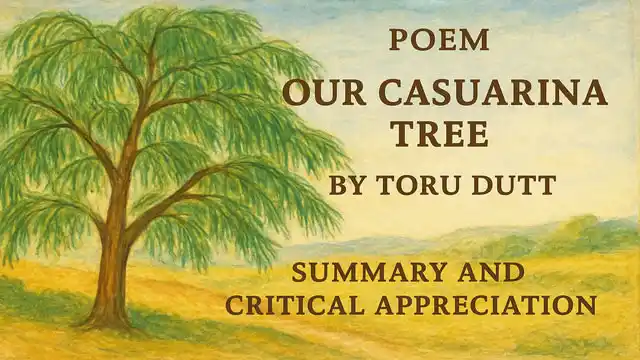
During the celebration of Christ’s birth, casuarina trees are beautifully decorated with lights and ornaments. Adorning the Christmas tree has become a simple yet beloved tradition among Christians to mark the occasion.
The tree is also linked with the figure of Santa Claus, who is believed to visit homes on Christmas Eve, bringing gifts and toys for children. According to popular belief, Santa especially calls on homes where a decorated casuarina—or Christmas tree—stands illuminated in honour of the festival.
Santa Claus is believed to be fond of the casuarina tree, and a beautifully adorned casuarina is often thought to invite his visit to a home. The casuarina, native to regions of Australia and India, is known for its interwoven branches and impressive height. When viewed from a distance, its long, drooping limbs give it the appearance of a massive serpent.
Toru Dutt’s memories revolve around a particular casuarina tree beneath which she spent many joyful moments with her siblings, Abju and Aru. It was under this tree that the three of them played together, creating memories that have remained vivid in her heart. Sadly, both Aru and Abju passed away, leaving the poetess without the beloved companions who once shared those happy hours.
Despite their absence, her bond with the casuarina tree endures. To her, the tree revives the warmth of her siblings’ company. She even imagines the tree itself grieving the untimely loss of Aru and Abju, as though it mourns with her and understands her sorrow. Thus, the tree holds a profound and irreplaceable place in her life.
“Our Casuarina Tree” stands as one of Toru Dutt’s finest poems, rich in emotion, sensory imagery, and artistic craftsmanship, supported by a careful structure and harmonious rhyme scheme. Comprising five stanzas, the poem beautifully captures her deep feelings and cherished memories of the days spent beneath the beloved casuarina with her brother and sister.
Summary of the Poem “Our Casuarina Tree”:
Stanza 1:
Like a huge python, winding round and round
The rugged trunk, indented deep with scars
Upto its very summit near the stars.
A creeper climbs in whose embraces bound
No other tree could live. But gallantly
The giant wears the scarf, and flowers are hung
In crimson clusters all the boughs among.
Whereon all day are gathered bird and bee:
And off at nights the garden overflows
With one sweet song that seems to have no close,
Sunk darkling from our tree, while men repose.
Explanatory Word – Meanings:
Huge = vast, large in size and structure. Python= a large snake. Winding = curving, spiraling. Rugged = coarse, rough. Trunk = stem of the tree, the base of a tree. Deep = profound. Scars = marks or signs of wound, injury. Summit = peak, top. Near the stars = very high. Gallantly= boldly, courageously. Giant = colossus, huge body. Scarf = muffler. Crimson = scarlet. Clusters= in a large amount, bunches. No close = without an end, perpetual. Gathered = garnered. Darkling = in darkness. Repose = take rest.
Paraphrase:
Toru Dutt offers a rich, sensuous portrayal of the casuarina tree. She likens the towering tree to a massive python, its immense trunk appearing as though a great serpent has coiled itself around it. The bark bears deep marks, almost like ancient scars. Rising majestically, the tree seems tall enough to brush the sky or touch the distant stars.
A creeper winds itself around the trunk as well, clinging so closely that it seems to choke the tree’s breath. Its grip is so firm that no other tree could have survived such an embrace—yet the casuarina endures, untroubled. It appears almost to welcome the creeper, wearing it like a warm, oversized scarf.
Clusters of dark red blossoms brighten its branches, making the tree irresistibly beautiful. Covered in these scarlet flowers, it becomes a striking centre of attraction. The broad branches offer refuge to birds and bees, who are drawn to the vivid blossoms. At night, the birds often fill the darkness with their sweet songs, turning the surroundings melodious. In this way, the casuarina tree inspires music and spreads beauty throughout its environment.
Stanza 2:
When first my casement is wide open thrown
At dawn, my eyes delighted on it rest;
Sometimes, and most in winter on its crest
A gray baboon sits statue like alone
Watching the sunrise, while on lower boughs
His puny offspring leap about and play;
And far and near kokilas hail the day.
And to their pastures wend our sleepy cows,
And in the shadow on the broad tank cast
By that hoar tree, so beautiful and vast,
The water-lilies spring, like snow enmassed.
Explanatory Word – Meanings:
First = the poetess means the first work in the morning. Dawn = the early time of the day, day – break. Delighted = pleased, happy, joyous. Crest = top, peak, summit. A gray baboon= an old monkey. Statue = idol. Statue like = static, without any movement like an idol or statue. Alone= without anyone’s company. Boughs= large branches of a tree. Puny=little, tiny. Offspring= issues, children of someone. Leap =jump with joy. Kokilas= black colour birds famous for sweet singing. Hail = welcome. Pastures= grassland, land for grazing purposes. Wend=move, go ahead. Cows= cattle in normal sense. Shadow = the shade cast by an object. Broad = wide. Broad tank = big pond. Hoar=old, outdated. Vast = huge, large. Spring = bloom. Enmassed = collected, gathered.
Paraphrase:
In these lines, Toru Dutt expresses her profound emotional bond with the casuarina tree. She describes how, each morning, she opens her window specifically to gaze at the tree. It has become her daily ritual—upon waking, the very first thing she looks at is the casuarina tree. To her, it is the object that marks the start of the day.
The poetess finds the tree irresistibly beautiful. Its charm is so compelling that she feels no desire to look at anything else; her eyes remain fixed upon it. During winter, she often notices a monkey perched at the very top of the tree, with the rest of its family scattered along the lower branches. Watching them leap from branch to branch is a delightful sight for her. Their playful movements bring the tree to life.
The casuarina tree also serves as a home for numerous melodious birds. Many sweet-voiced birds nest there, filling the surroundings with their enchanting music. Their morning songs seem to greet the arrival of the new day, and the poetess takes great pleasure in listening to them. These lively notes awaken the world around—cows rise and begin their walk toward the fields as the birds’ melodies echo through the air. In this way, the songs signal the dawn of another day. Nearby, the wide pond appears covered in white water lilies, giving it the look of a surface dusted with snow.
Stanza 3:
But not because of its magnificence
Dear is the Casuarina to my soul:
Beneath it we have played, though years may roll,
O sweet companions, loved with love intense,
For your sakes shall the tree be ever dear!
Blent with your images, it shall arise
In memory, till the hot tears blind mine eyes!
What is that dirge-like murmur that I hear
Like the see breaking on the shingle – beach?
Is the tree’s lament, an eerie speech,
That hoply to the unknown land may reach,
Unknown, yet well – known to the eye of faith!
Explanatory Word – Meanings:
Magnificence = splendid, glorious, elegant. Companions= friends. Beneath = under the tree. Intense = extreme. Roll = pass by. Images = statues. Blind=unable to see. Dirge = funeral song, elegy. Murmur = to speak slowly, to whisper. Lament = mourn, to express sorrow. Hoply= to leap, jump in a joy. Faith = trust, believe.
Paraphrase:
The casuarina tree holds a deeply significant place in the poetess’s life. Her bond with it is not rooted in its physical grandeur or beauty, but in the emotional closeness she feels toward it. Many cherished moments of her childhood were spent beneath its branches, and it is these memories that make the tree so dear to her heart. Whenever she looks at it, she is reminded of the joyful days she shared with her siblings, Abju and Aru.
She recalls playing with them under the tree while birds sang overhead and monkeys leapt from branch to branch. Those days of innocence and happiness have long since slipped away, and both Abju and Aru are no more. Yet the casuarina tree continues to preserve their memory, keeping them alive in her thoughts. It becomes a source of bittersweet comfort, helping her smile through her grief even as it stirs her deepest emotions.
As she gazes at the tree, scenes from the past return vividly, contrasting sharply with her present sorrow. Even the rhythmic sound of sea waves crashing against the pebbles—usually soothing—fails to capture her attention. Her heart is too heavy with the loss of her beloved brother and sister. She feels overwhelmed by sadness, longing to mourn their untimely deaths.
At times, she imagines that the tree itself shares in her grief, as though it too laments the absence of Abju and Aru. But she knows that mourning cannot bring them back; they now belong to a distant, unseen world that one reaches only through faith. Still, the casuarina tree stands as a living reminder of the love and warmth she once shared with them, making it an irreplaceable part of her emotional world.
Stanza 4:
Ah, I have heard that wail far, far away
In distant lands, by many a sheltered bay,
When slumbered in his cave the water wraith
And the waves gently kissed the classic shore
Of France or Italy, beneath the Moon;
When earth lay tranced in dreamless swoon;
And every time the time rose, -before
Mine inner vision rose a form sublime;
Thy form, O tree, as in my happy prime
I saw thee, in my loved native clime.
Explanatory Word – Meanings:
Wail = lament, mourn, express grief openly. Distant= far away in space or time. Sheltered = hidden, cut off, isolated. Bay= a West Indian tree, casuarina tree. Cave = cavern. Slumbered = asleep. Classic= ancient. Wraith= apparition. Gently= softly. Beneath= under, below. Tranced= without consciousness, in sound sleep. Swoon= faint, lose consciousness. Inner vision=imagination. Form = image. Sublime= great, noble, dignified, glorious. Prime= youth. Native clime= the native place, homeland, motherland, the poetess’ homeland i.e. Kolkata.
Paraphrase:
In this stanza, Toru Dutt reflects on the vibrancy of her inner and outer life. Though she lives far from her homeland, Kolkata, she feels as if the casuarina tree still calls out to her. Its cries and whispers reach her even in deep sleep. The tree appears vividly in her dreams—so clear and lifelike that it seems to stand right before her. The sight of her beloved tree in these dreams brings her joy.
These dream-visions strengthen her belief in a mysterious realm beyond the mortal world, a place where the spirits of the departed continue to exist and visit their loved ones through dreams. The recurring presence of the casuarina tree in her sleep convinces her that such a hidden world does indeed exist—a world where souls remain connected to those they love. In this way, the tree’s appearance in her dreams turns the unimaginable into something she can believe.
Stanza 5:
Therefore I fain would consecrate a lay.
Unto the honour, Tree beloved of those
Who now in blessed sleep for aye repose,
Dearer than life to me, alas! Where they!
Mayst thou be numbered when my days and done
With deathless trees – like those in Borrow dale,
Under whose awful branches lingered pale
‘Fear Trembling Hope, and Death, the skeleton,
And Time and Shadow ‘, and though week the verse
That would they beauty fain, oh fain rehearse,
May love defend thee from oblivion’s curse.
Explanatory Word – Meanings:
Fain = glad, pleased. Consecrate= to make or collect for holy and pious purposes. Lay = song, hymn. Unto thy honour= in honour and esteem of the casuarina tree. Repose= rest. Alas= word used for expressing grief and dejection. Numbered = counted. Done = finished, end, over. Death – less= immortal, everlasting. Awful= dreadful, fearful. Awful branches = big branches that appear dreadful. Lingered = hang. Pale = yellow in look, colourless. Trembling = wavering, shuddering. Defend= save, guard, protect. Oblivion’s curse= after sometime all is forgotten.
Paraphrase:
The poet has already hinted at her deep emotional bond with the casuarina tree in the earlier stanzas. She emphasizes that the tree holds a special and personal significance in her life. In this stanza, she speaks more openly and expansively about her feelings, expressing a desire to create a song in the tree’s honour. The casuarina tree was especially cherished by her siblings, Aru and Abju, who are no longer alive. They once played beneath its branches, and their presence has become inseparable from her memories of the tree.
Because of this, her love for the tree is woven with the tender moments she shared with them. Whenever she looks at it, she is reminded of those joyful days spent together. Although she does not know where her departed brother and sister might be now, she hopes that when her own life ends, her memories will continue to bind her spirit to the beloved casuarina tree. She believes that these cherished recollections will keep her connected to it even after she leaves this earthly world.
The poet is unsure about the merit of the song she wishes to compose—she fears it may not be strong or impressive. Yet she trusts that the sincerity of her devotion will preserve it. In this way, she hopes to be remembered, just as her siblings are, through the depth of her affection.
Ultimately, the poem reveals the poet’s profound love for the casuarina tree. It is a vivid, heartfelt portrayal of the intimate relationship between the poet and the tree that symbolizes her past, her memories, and her enduring emotional ties.
Critical Appreciation of the Poem “Our Casuarina Tree”:
Introduction:
“Our Casuarina Tree” is one of Toru Dutt’s most celebrated poems—known for its lyrical beauty, emotional depth, and lasting appeal. It appears in Ancient Ballads and Legends of Hindustan, Part II, a distinguished collection of her poetic works.
In Christian tradition, the casuarina tree holds a special significance. During Christmas, these trees are often decorated with lights and ornaments, much like the customary Christmas tree. Many associate the casuarina with Santa Claus, who is believed to visit homes on Christmas Eve, leaving gifts and toys for children. It is commonly thought that Santa especially visits homes where the casuarina tree is festively adorned, quietly placing presents for the little ones during the night.
Santa is fond of the casuarina tree, and a decorated casuarina is believed to draw him toward a home. The tree itself traces its origins to Australia and India. With its interwoven branches and towering height, it can resemble a giant python when seen from a distance.
Toru Dutt fondly remembers a casuarina tree that stood outside her house in Kolkata. She spent many delightful and unforgettable moments beneath its shade with her siblings, Abju and Aru. The three of them often played around the tree, and those cherished memories remain vivid in her heart.
Tragically, both Aru and Abju passed away, leaving the poetess without anyone to share those precious recollections. Despite this sorrow, her affection for the casuarina tree has only deepened. To her, the tree brings back the warmth of her siblings’ companionship. She even imagines that the tree mourns the untimely loss of Aru and Abju, sharing in her grief.
In essence, the casuarina tree holds a special, irreplaceable place in the poetess’s life.
Development of Thoughts:
The casuarina tree stands at the very heart of the poem, forming the focal point around which the entire composition unfolds. For the poet Toru Dutt, this tree holds deep personal significance. It was under its shade that she spent cherished moments with her siblings, Abju and Aru, both of whom passed away early. The tree thus becomes a silent witness to their shared joy and innocent laughter.
Dutt portrays the casuarina tree with vivid imagery and tender emotion. Every detail is remembered with affection, and she describes its features with enthusiasm and reverence. To convey its massive presence, she likens the tree’s enormous trunk to a great python, with the creeper wrapped tightly around it like a coiling serpent. Its towering height seems to reach upward toward the sky. The creeper clings closely to the tree, almost like a warm muffler draped around its form.
Clusters of bright red blossoms make the tree especially enchanting, adding to its charm. Generous and life-giving, the casuarina tree welcomes birds and bees into the shelter of its thick branches. At night, these birds often fill the darkness with their sweet songs, creating an atmosphere rich with melody. The tree seems to inspire their music, transforming the surroundings into a world of harmony.
In the opening lines, the poet lovingly reveals the tree’s physical grandeur and beauty, setting the tone for the emotional depth that follows.
Toru Dutt shares a deep emotional bond with the casuarina tree, a bond strengthened by the many cherished memories of her early life connected to it. She says that every morning, her first act is to open her bedroom window to gaze at the tree. This simple ritual—greeting the day by looking at its familiar form—has become an essential part of her daily routine.
At times in winter, she notices a monkey perched on the tree’s highest branch, while the rest of its family occupies the lower ones. Watching them leap playfully from one branch to another fills her with delight. The casuarina tree also serves as a shelter for numerous melodious birds. Many such songbirds rest among its branches, filling the morning air with sweet music that transforms the entire surroundings into a harmonious world. Their songs are so enchanting that they awaken all of nature: even the cows rise and begin their walk to the pastures.
Nearby, a wide pond adds to the beauty of the scene. Covered with blooming water lilies, it appears almost white, as though dusted with snow. Through these vivid observations, the poetess paints a serene and captivating picture of the casuarina tree at daybreak.
The poetess holds the casuarina tree in deep affection. Her love for it is not merely due to its grandeur or beauty, but because it is bound to her heart and her emotions. The tree is precious to her as it witnessed some of the happiest and most cherished moments of her childhood, spent beneath its shade with her siblings, Abju and Aru—both of whom are no longer alive. For her, the tree keeps their memories alive, acting as a tender link between her and her departed brother and sister.
The casuarina tree becomes a source of emotional strength, bringing a faint smile to her face even as it reminds her of the time she once shared with Aru and Abju. She recalls the vibrant scenes of those days: birds singing joyfully, monkeys leaping from branch to branch, and herself playing freely with her siblings under the tree. But those golden days have slipped away, and remembering them now fills her eyes with tears and her heart with sorrow.
While she listens to the dull, repetitive sound of the sea waves crashing against the pebbles—a sound that creates its own kind of music—she finds no comfort in it. Her grief over the untimely loss of her siblings overwhelms any desire to appreciate nature’s melody. At times, she even imagines the tree grieving with her, as if it too mourns the absence of Abju and Aru. Yet she knows that lamenting their death can change nothing; they have passed into that mysterious realm beyond life, a place we believe in only through faith.
In the following section of the poem, Toru Dutt brings attention to the vibrancy of her inner and outer life. She explains that, although she is far from her homeland in Kolkata, she still senses the sorrowful call of the casuarina tree. Its cries reach her even in deep sleep, and its image rises before her vividly in her dreams. The vision is so clear and lifelike that it seems as though the tree stands right before her. Seeing this beloved tree in her dreams fills her with joy.
The sharp, vivid presence of the tree in her dream world strengthens her belief that beyond the physical world lies a mysterious, unseen realm where the spirits of the departed dwell. These spirits, she feels, can reach out to their loved ones through dreams. Thus, the recurring appearance of the casuarina tree in her dreams convinces her of the existence of this hidden world, where the souls of the dead maintain a quiet connection with those they have left behind. Through these dream-visits, the tree leads her to accept what once seemed impossible.
In the opening stanzas, the poet has already revealed her deep emotional bond with the casuarina tree. She makes it clear that this tree holds a special place in her life. As the poem unfolds, she expresses her affection for the tree more fully and openly, even wishing to dedicate a song to it. The casuarina tree was especially cherished by Aru and her brother Abju, both of whom have passed away. They once played beneath its branches, and because of this, the poet’s memories of them are inseparably linked to the tree.
The tree brings back the tender moments she shared with her siblings, filling her mind with scenes from a happier past. Although she no longer knows where her departed brother and sister may be, she hopes that when her own life ends, her memory will continue to cling to the beloved casuarina tree. She believes that these cherished recollections will maintain her connection to the tree even after she leaves this earthly world.
The poet is unsure about the merit of the song she wishes to compose, considering it perhaps imperfect or feeble. Yet she trusts in the sincerity of her devotion. Her pure love for the tree, she feels, will preserve her memory just as the tree preserves the memory of those she has already lost.
In this way, the poem becomes a heartfelt portrayal of the poet’s profound affection for the casuarina tree—a tender and vivid exploration of the emotional bond between the poet and this cherished symbol of her past.
Aptness of Title:
The title “Our Casuarina Tree” is perfectly suited to the poem, as it aligns closely with its central theme and subject. In the poem, Toru Dutt reflects on her deep emotional bond with the casuarina tree, portraying its immense significance in her life. The poem unfolds around the tree’s beauty and the memories it evokes, making the chosen title highly fitting, meaningful, and impactful. Its brevity and clarity give it a smooth, appealing quality that naturally piques a reader’s interest. In this sense, “Our Casuarina Tree” stands out as an excellent and evocative title for Toru Dutt’s celebrated poem.
A Poem full of Emotions:
Toru Dutt’s Our Casuarina Tree is celebrated for the depth of its emotions and heartfelt sentiment. At its core, the poem portrays a profound yet tender bond between the poet and the tree. Her affection for the casuarina does not arise from its physical beauty or grandeur, but from the personal memories it holds.
The tree becomes a living reminder of the joyful moments she once shared with her siblings, Abju and Aru, beneath its branches. Though both Aru and Abju have passed away, the casuarina continues to keep their memories alive in the poet’s heart. It stands as the sole link that ties her to those cherished days of companionship.
The poem is shaped by this emotional connection. The poet even imagines that the tree itself grieves the premature deaths of her beloved brother and sister, as though it silently shares in her sorrow. She heightens the emotional tone further by describing the tree’s gentle relationship with the creeper entwined around it. The casuarina, offering refuge to birds and bees, seems benevolent and nurturing to all forms of life.
The sentiment reaches its peak when the poet recalls her childhood moments spent playing around the tree with Aru and Abju. The entire poem is suffused with deep, heartfelt emotion, beautifully captured in the stanza that follows.
“But not because of its magnificence
Dear is the Casuarina to my soul:
Beneath it we have played, though years may roll,
O sweet companions, loved with love intense,
For your sakes shall the tree be ever dear!
Blent with your images, it shall arise
In memory, till the hot tears blind mine eyes!
What is that dirge – like murmur that I hear
Like the see breaking on the shingle – beach?
Is the tree’s lament, an eerie speech,
That hoply to the unknown land may reach,
Unknown, yet well – known to the eye of faith!”
Sensuousness:
Sensuous imagery forms one of the most striking qualities of Our Casuarina Tree. Toru Dutt brings the tree vividly to life, capturing its shape, presence, and surroundings with rich descriptive detail. To convey its grandeur, she opens the poem by likening the tree to a giant python coiling around the earth.
She observes how it becomes a haven for birds and bees, and how, in the winter months, playful monkeys swing from its branches. The nearby pond, dotted with white lilies, further enhances the scene’s charm.
At dawn, the tree turns into a focal point of life as birds greet the morning with their melodious calls. Dutt records each of these impressions carefully and recreates them with remarkable artistic skill. The poem’s exceptional sensuous appeal is one of the reasons it stands out so powerfully.
To sum up, Our Casuarina Tree remains one of Toru Dutt’s finest and most celebrated lyrics. Its emotional depth is profoundly moving, and its sensual richness adds another layer of beauty. The poem also reveals Dutt’s imaginative power, confirming her stature as a distinguished Anglo-Indian poet of the early 20th century.