Tagore’s Play Chandalika— Critical Appreciation
“Chandalika” is one of the important plays of Tagore. It is a psychological drama of intense spiritual conflict. The play beautifully analyzes the thoughts and feelings experienced by Prakriti, the outcast girl, her mother and the Buddhist Monk Ananda.
Read moreThe Emperor of Ice-Cream, Summary and Critical Appreciation
"The Emperor of Ice-Cream" is a brief yet striking poem written by Wallace Stevens. Despite its short length, it is quite challenging to grasp because it contains complex and lofty language.
Read more“Break, Break, Break” by Tennyson | Summary and Critical Analysis
The poem entitled Break, Break, Break is an elegy which is inspired by the death of Tennyson's dear friend, Arthur Hallam in 1833. This poem was first published in 1842, nine years after the death of Arthur Henry Hallam, Tennyson's dearest friend.
Read more“The Lake Isle of Innisfree”— Summary and Critical Analysis

The poem entitled The Lake Isle of Innisfree is remarkable for the purity of heart. It has autobiographical essence. It was published in the volume entitled The Rose. When Yeats wrote this poem, he was staying in London.
Read more“Prospice” by Robert Browning—Summary and Critical Analysis
“Prospice” is an optimistic poem of Robert Browning. It is a dramatic monologue expressing the poet's courage, hope and determination. It was composed after the death of Mrs. Browning and was first published in 1864 in Dramatic Personae.
Read more“Dover Beach”— Summary and critical appreciation

"Dover Beach" is a representative poem of Arnold. It was published in 1887. This poem is a sad musing on the life of the Victorian Age marked throughout by the prominence of the spirit of inquiry and criticism, by scepticism and religious uncertainty, and by spiritual struggle and unrest.
Read more“An Elegy Written in a Country Churchyard”— Summary and Critical Analysis
‘An Elegy Written in a Country Churchyard' was published in 1751. It brought Gray into lime light and his genius was recognized. Its success was instantaneous and overwhelming. A dignified elegy in classical diction celebrating the graves of humble and unknown villagers was, in itself, such a novelty that all paid attention to it.
Read moreOde on A Grecian Urn— Keats’ Philosophy and Medievalism
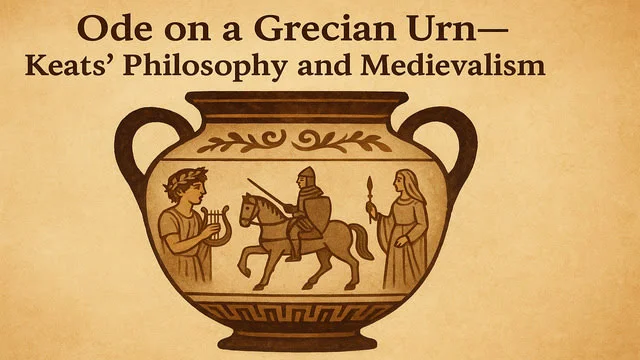
In this great ode, Keats presents an ideal philosophy of beauty based on truth. The urn represents it. The urn has a Grecian shape. It attracts the poet very much. It presents two lively pictures engraved on the urn. The pictures have the blessing of eternity.
Read moreNovel Pride and Prejudice— Jane Austen’s Limited Range or World
Jane Austen's view of life is not extensive. She paints pictures of that life which she sees at close range. The secret of her power lies in the complete mastery she has, as an artist, over her material.
Read moreLove, Marriage and Woman in Tennyson’s Poetry

Tennyson is also a great love-poet, and his treatment of love is unique in many ways. He is primarily and mainly a poet of conjugal love.
Read more