Poem “Of Mothers Among Other Things” by A.K. Ramanujan, Summary and Critical Appreciation
Poem "Of Mothers, Among Other Things" by A.K. Ramanujan revolves around the poet’s recollections of his mother and was first published in Relations.
Read morePortrayal of Indian Peasant Life in Nectar in A Sieve
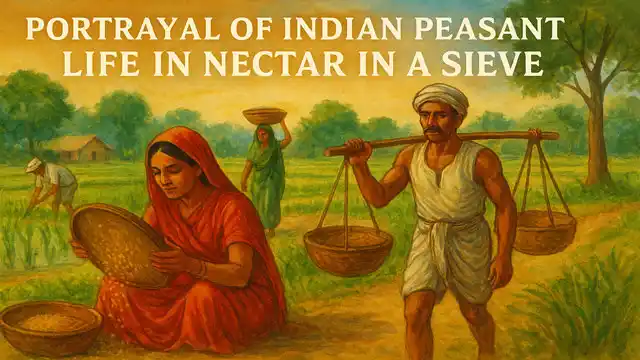
"Nectar in a Sieve" presents portrayal of Indian peasant life through the perspective of Rukmani, a rural woman who witnesses the relentless weight of poverty, famine, and social injustice.
Read morePoem “Marriage” by Nissim Ezekiel, Summary and Critical Appreciation
Nissim Ezekiel’s poem “Marriage” offers a grounded, often ironic depiction of the institution, stripping away romanticised notions to reveal a frank—even at times sceptical—view of married life.
Read morePoem “Awake” by Sarojini Naidu, Summary and Critical Analysis

“Awake,” written by Sarojini Naidu, is a stirring patriotic poem that calls upon the people of India to rise from passivity and embrace a renewed sense of unity, pride, and action.
Read morePoem “In India” By Nissim Ezekiel, Summary and Critical Analysis
Nissim Ezekiel’s “In India” is a satirical piece that adopts the voice of a tourist overwhelmed—and often repelled—by what he encounters in the country.
Read morePoem “Guerdon” by Sarojini Naidu, Summary and Critical Analysis

“Guerdon,” a short but evocative poem by Sarojini Naidu, reflects her characteristic blend of lyrical beauty, emotional depth, and symbolic richness.
Read morePoem The Tree of Life by Toru Dutt, Summary and Critical Appreciation
Toru Dutt’s “The Tree of Life” is a symbolic poem that meditates on the unity shared by all forms of existence and the continual rhythms of life.
Read more“Where the Mind Is without Fear” (poem No.35 in Gitanjali), Summary and Critical Appreciation
“Where the Mind Is Without Fear” (Poem No. 35 in Gitanjali) is a devotional verse by Rabindranath Tagore, composed before India achieved independence.
Read moreMysticism in the Poetry of Rabindranath Tagore
“Mysticism in the Poetry of Rabindranath Tagore” highlights his search for an immediate, intuitive, and deeply personal communion with the Divine—the universal spirit or ultimate truth—revealed through the richness of human experience, the beauty of nature, and everyday relationships.
Read more“Thou Hast Made Me Endless” (Poem No. 1 in Gitanjali), Summary and Critical Appreciation
“Poem No. 1—Thou Hast Made Me Endless” serves as the opening work of Rabindranath Tagore’s celebrated collection Gitanjali (Song Offerings).
Read more