Introduction of the Poem “Church Going”:
The poem “Church Going” was published in Philip Larkin’s second collection, The Less Deceived, and was composed in 1954, a period marked by a noticeable decline in church attendance. The poem establishes Larkin as an agnostic and reflects his questioning attitude towards religious belief. It explores the enduring role of religious institutions within human civilization. The speaker, who appears to be a non-believer, nevertheless acknowledges the continuing significance of churches in human life despite his lack of faith.
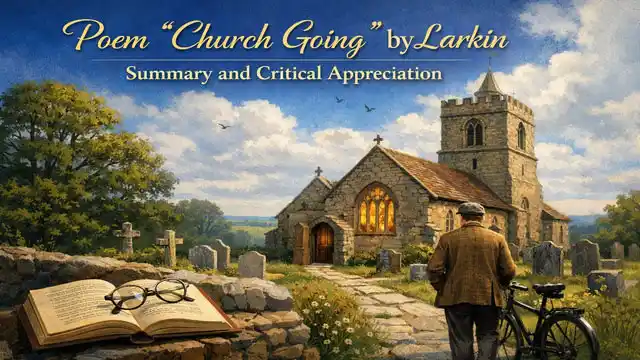
By the early 1950s, fewer than ten percent of the population regularly attended church, leading to concerns that churches might lose their relevance in modern society. In “Church Going,” Larkin examines both the usefulness and the apparent pointlessness of visiting a church. His treatment of the subject combines irony with seriousness. The poem takes the form of a dramatic monologue in which the speaker initially ridicules the church and its furnishings, as well as the practice of churchgoing itself. However, by the poem’s conclusion, he concedes that even when churches no longer function as centers of worship, some will still serve a meaningful purpose for the community.
Summary of the Poem “Church Going”:
The speaker opens by describing his curious custom of dropping into churches. Oddly enough, he chooses moments when no service is being held and the building stands empty. Entering such a church, he casually surveys the interior—the worn floor, the rows of seats, and the Bibles placed there. He inspects the organ, runs his fingers over the baptismal font, and walks up to read a few lines from the Bible. Before leaving, he pauses at the doorway to sign the visitors’ register and leaves a small coin as an offering, after which he departs.
Each visit leaves him with the sense that he has spent his time uselessly, for there seems to be little of real interest inside. Yet, despite this feeling, he is unable to break the habit. He often reflects on the future of churches once people completely stop attending them. Some, he imagines, might be converted into museums, with their religious objects carefully preserved behind glass. Others might simply be deserted, left open to rain and wind, with sheep wandering in to graze. There is also the possibility that such places would come to be feared and avoided, regarded as ominous or unlucky.
He then considers another scenario. A few superstitious women might still visit the ruins, hoping to cure their sick children by touching a stone, finding a herb, or seeking out some spot believed to be sacred. Others might linger in churchyards, hoping for a glimpse of the spirit of a buried loved one. But in time, superstition, like faith, would also fade away. Eventually the churches would be entirely forsaken, choked with grass, weeds, and thorny growth, no longer recognisable as former houses of worship.
The speaker then speculates about who might be the final visitor to enter a church for spiritual reasons. Perhaps it would be someone who once attended only on Christmas and now wished to relive the old atmosphere. Or perhaps it would be someone like the speaker himself, drawn there by habit rather than belief.
In the end, the speaker reflects that a church is a place of deep seriousness. Even if religious faith and rituals disappear, it would never become completely useless. There would always be some inner urge, felt by someone or the other, to visit a church—even a ruined one—because people, in every age, would remember hearing that such a place offered wisdom. They would believe that simply entering a church might help a person grow wiser.
Critical Appreciation of the Poem “Church Going”:
Introduction:
“Church Going” can be regarded as a typical poem by Philip Larkin, included in his collection The Less Deceived. It has a strong autobiographical tone. In this poem, Larkin reflects on both the seeming uselessness and the possible significance of visiting a church. The speaker openly presents himself as an agnostic. Through this voice, the poem portrays an average Englishman who shows little interest in religious faith or formal church practices. It also suggests that the influence and relevance of the church are steadily declining over time. Overall, the poem stands as a serious and thoughtful effort by a respectful agnostic to confront and articulate his complex feelings about religion, especially Christianity.
Development of Thoughts:
In this poem, Larkin recounts a visit he makes to a church. He enters the building only after ensuring that no service or religious ritual is taking place. At the start, he carefully notices the details inside—the matting on the floor, the rows of seats, and the several Bibles kept there. He also sees flowers that were placed in the church the previous Sunday, which have now withered. His attention is drawn to a small organ resting on a table, a piano-like instrument used to accompany hymns.
Curious, he climbs the lectern and reads a few lines from the Bible. After finishing, he announces aloud that he has read them, and his voice echoes through the empty church, making it seem as though someone is mocking him. He then walks back toward the entrance.
Before leaving, he drops a sixpence coin and steps outside, feeling that stopping to enter the church was perhaps a pointless act. Afterward, the poet reflects on the future of churches and their significance for coming generations. While he recognises the church as an institution that once promoted human welfare, he also feels that it holds little importance in the modern world. This leads him to question what role such buildings will serve once they are no longer in use. He feels that some Cathedrals will be maintained as rare representative of Churches:
“When churches fall completely out of use
What we shall turn them into, if we shall keep
A few cathedrals chronically on show,
Their parchment, plate and pyx in locked cases,
And let the rest rent – free to rain and sheep.
Shall we avoid them as unlucky places?”
In the fourth stanza, Larkin carries forward the speaker’s reflections on the place of women in the practice of churchgoing. He suggests that women of doubtful reputation might still visit the church, bringing their children to touch a sacred stone. Such actions point to the persistence of superstition and unthinking ritual rather than genuine faith. This notion is clearly conveyed in the fourth stanza of the poem.
Larkin also expresses the view that, with the passage of time, churches are bound to decay. They will eventually become deserted structures, overrun with grass, weeds spreading across the pavements, and bushes growing freely within the church grounds. People will not be able to recognise that a Church existed at that place:
“A shape less recognizable each week,
A purpose more obscure. I wonder who
Will be the last, the very last, to seek
This place for what it was; one of the crew.”
Larkin is so hopeless about the future of the Churches that he thinks that there will be very few persons to attend Churches in future. The people who will come at the end of Churches will be some genuine worshipper or some antiquarian. The poet believes that in future the Churches will become deserted places:
“I wonder who
Will be the last, the very last, to seek
This place for what it was; one of the crew
That tap and jot and know what rood – lofts were?
Some ruin – bibber, randy for antique,
Or Christmas – addict, counting on a whiff
Of gown – and – bands and organ – pipes and myrrh?
Or will he be my representative.”
In the concluding stanza of Church Going, the poet undergoes a clear shift in attitude toward the church. He comes to regard it as a solemn and meaningful place set within a reflective world, where the deep human impulses that once drew people to worship are gathered together. For many, the church is seen as a space that shapes their fate and gives direction to their lives, and this faith is unlikely ever to fade. Thus, churches retain an enduring spiritual importance for believers. Even when a church lies in decay, it continues to draw people toward it. People will always think that Church is the place which makes them wise:
“A serious house on serious earth it is,
In whose blent air all our compulsions meet,
Are recognized, and robed as destinies.
And that much never can be obsolete,
Since someone will forever be surprising
A hunger in himself to be more serious,
And gravitating with it to this ground,
Which, he once heard, was proper to grow wise in,
If only that so many dead lie round.”
Ironical Spirit of the Poem:
The spirit of the poem throughout is ironical. The poet while pointing out the dislike of various items in the Church says:
“The echoes snigger briefly. Back at the door
I sign the book, donate an Irish six pence,
Reflect the place was not worth stopping for.
Yet stop I did: in fact I often do.”
Towards the close of the poem, the speaker turns to conjecture about who the final visitor to the Church might be. He imagines that this person will arrive not out of habit or convention, but in search of inner growth and spiritual insight. The concluding stanza is therefore not wholly ironic; rather, it conveys the poet’s belief that even in their ruined state, Churches will continue to attract those who seek understanding, wisdom, and enlightenment.
Half – mocking and Half – serious Manner:
The poet examines the usefulness and apparent pointlessness of church-going in a tone that is partly ironic and partly earnest. The speaker initially ridicules the church and its furnishings, treating the act of visiting it with casual contempt. However, by the poem’s conclusion, he arrives at a more reflective understanding, recognizing that churches—or at least certain ones—will continue to serve human needs even after they no longer function as centers of religious worship.
Thoroughly Depreciating Manner:
When the speaker enters the Church he looks at various updates of worship such as the speaker stand, the Bible, the piano and other articles. But he speaks off these objects of the Church in a depreciating manner. His depreciation is proved by the following lines:
“Some ruin – bibber, randy for antique,
Or Christmas – addict, counting on a whiff
Of gown – and – bands and organ – pipes and myrrh?
Or will be my representative.”
Form of the Poem:
Church Going is a monologue in which the speaker frankly appears as an agnostic if not as a downright atheist. This monologue has traditional iambic structure and a lucid rational argument. Every stanza contains nine lines and it is written in blank verse. There is no rhyming scheme in the stanza of the poem.
The diction of the poem is quite simple and musical. The first two stanzas are pungently detailed and have a wonderful air of verisimilitude and candour. Except for someone would know: I don’t’, the lines don’t have anything unnecessary, verbose or repetitive. In the middle of the poem, there are the speculations ; the questions or the assertions that power of some sort or other will go on and that the Church will be less recognizable each week, or the effort to imagine ‘the very last’, to seek its purpose.
Like the consciously colourful detail at the close, all this is essentially idle, a fabrication. The poem picks up again as Larkin confronts the Church in discovery and wonder : “A serious house on serious earth it is, In whose blent air all our compulsions meet, Are recognised, and robed as destinies ……” An Embodiment of Secular Anglicanism: The poem Church Going embodies what may be called secular Anglicanism which concedes that belief must die but which also insists that the spirit of tradition represented by the English Church cannot die.
As the Church seems to loose its importance, there are fears that its place in modern society would become insignificant. The poem Church Going acknowledges those fears and reveals its own specific context by locating this cross of ground at the edge of suburb scrub.
Conclusion:
Finally it may be concluded that Church Going is one of the best poems of Larkin. The poem is a expression of poet’s desire for a welfare state. Religion is not going to play an important role in the poem. This poem presents the image of an ordinary Englishman, not much concerned about religion and Church worship.