Introduction:
“Nectar in a Sieve” presents portrayal of Indian peasant life through the perspective of Rukmani, a rural woman who witnesses the relentless weight of poverty, famine, and social injustice. The novel contrasts the stability of traditional agrarian life with the upheaval brought by industrialization and a rapidly changing society, showing how these forces can trap families in cycles of hunger, debt, and moral compromise. At the same time, it explores themes of resilience, the endurance of family bonds, and the heartbreaking fight to preserve dignity amid overwhelming adversity.
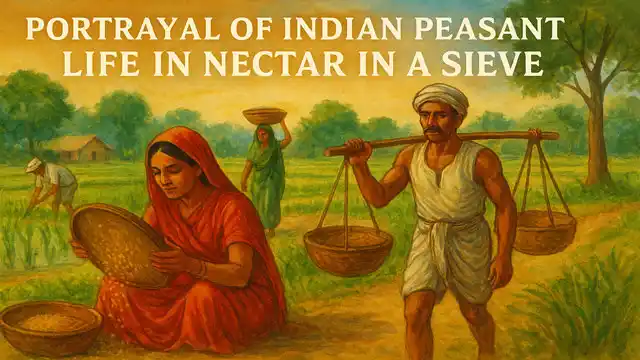
Kamala Markandaya’s Nectar in a Sieve (1954) is one of the most compelling literary explorations of Indian rural life in the twentieth century. Set against the backdrop of a rapidly changing agrarian society, the novel paints a vivid and intimate portrait of the hardships, hopes, and resilience of Indian peasants. Through the life of Rukmani and her family, Markandaya captures the harsh realities of poverty, the dependency on monsoon-driven agriculture, the pressures of social traditions, and the disruptive impact of industrialization on village life. The narrative reflects not only the physical struggle for survival but also the emotional and cultural fabric that binds rural communities. By blending authentic detail with deep human sensitivity, Nectar in a Sieve becomes both a social document and a universal story of endurance, illustrating how ordinary peasants navigate the tension between tradition and change. The novel thus stands as a significant commentary on Indian peasant life during a period of transformation, revealing the dignity, suffering, and indomitable spirit of rural India.
Kamala Markandaya’s Deep Love for India:
Kamala Markandaya loved India so deeply that all over her life she has been thinking of its welfare and in her novels she has tried her best to expose those problems that trouble the poor of India. She had her early schooling in Mysore. She entered Madras University at the age of sixteen. But she was deeply interested in writing and journalism. It inspired her to leave the university without taking her degree. She became a freelance journalist in Madras and Bombay. With a view to know more of rural India, she lived for sometime in a South Indian village. This enabled her to infuse realism and write with authenticity about Indian rural life.
Themes in Kamala Markandaya’s Novels:
Kamala’s novels illuminate a wide range of issues central to contemporary India. Nectar in a Sieve (1954), her debut novel, explores the struggles of a young woman from a wealthy family who must adapt to harsh and impoverished circumstances. The narrative also touches on themes such as the need for family planning, the negative effects of industrialization, the uncertain fate of farmers, the trauma of female barrenness and the need for proper medical care, the social work of foreigners like Dr. Kenny, and the widespread corruption born of poverty.
“Some Inner Fury”: Clash of Passion and Patriotism:
Her second novel, Some Inner Fury (1956), portrays the conflict between East and West, which gradually becomes a clash between passion and patriotism. Set against the backdrop of India’s freedom movement, it tells a love story shaped by turbulent political forces.
“A Silence of Desire”: Spirituality and Domestic Conflict:
A Silence of Desire (1960) addresses spiritual realities and the tension between tradition and modernity within the family. Dandekar, a clerk, mocks the religious inclinations of his wife Sarojini, who secretly visits a Swami for treatment. Misunderstanding her actions, Dandekar suspects infidelity, and the resulting breach of trust destroys their domestic happiness.
Possession, A Handful of Rice, and The Coffer Dams:
Possession (1963) examines the hardships faced by Indians who travel abroad in search of better prospects. A Handful of Rice (1966) critiques the harmful impact of large-scale industrialization on the rural economy. The Coffer Dams (1969) delves into the psychology of foreigners working in India; when an Englishwoman named Helen shows compassion for starving tribal communities, her husband doubts her character, causing familial turmoil.
The Nowhere Man: East–West Emotional Divide:
In The Nowhere Man (1972), Kamala explores the emotional divide between East and West. Srinivas and his wife Vasantha live in England but maintain their traditional Indian lifestyle, preserving a handful of soil from India and a few drops of Ganga water. Their son Laxman, however, rejects his heritage—until their neighbour Fred attacks Srinivas solely for being Indian, prompting Laxman to defend his father with unexpected intensity.
Two Virgins: Rural Innocence vs. Modern Dangers:
Set in a Mysore village, Two Virgins (1973) depicts the disruptive influence of reckless modernity on rural life. Teenage sisters Lalitha and Saroja, daughters of an aging freedom fighter, encounter a visiting film director. Lalitha, drawn to dreams of modern glamour, runs away with him. She eventually returns, pregnant and despondent, and considers suicide. Though Saroja persuades her to live, Lalitha once again flees, unable to reconcile herself with traditional society.
Across all her works, Kamala remains deeply engaged with the concerns, tensions, and evolving identity of India.
Realistic Portrayal of Rural Problems:
The novel offers a realistic portrayal of the problems that persist in rural India, bringing to light the harsh and often miserable lives of poor farmers. It makes clear that their suffering cannot be attributed to Fate alone. Instead, it highlights how inadequate planning, lack of education, exploitation, and corruption—often driven by selfish individuals—contribute significantly to their hardships.
Opening Situation in Nectar in a Sieve:
In the opening chapter, the central action is introduced: due to her parents’ poor financial planning, Rukmani is married to a poor farmer who lives in a half-built mud hut. The story’s central theme emerges from this situation—a girl from a well-to-do family learning to adjust to extremely difficult circumstances.
Growth of the Family and Arrival of the Tannery:
The narrative unfolds naturally with the growth of Rukmani’s family and the establishment of a tannery in the village. These developments introduce two major themes: the need for family planning and the negative consequences of industrial expansion. The middle portion of the novel explores these issues in depth, shedding light on the uncertain fate of Indian farmers who are entirely dependent on nature.
Social Issues Highlighted:
Several social issues are also addressed, such as a woman’s struggle with barrenness, the need for proper medical care, the social work performed by foreigners like Dr. Kenny, and the widespread corruption that stems from poverty. The middle section concludes with Rukmani’s decision to leave the village for the town where her son lives. This shift provides an opportunity to depict the hardships of urban life. In the city, Rukmani and Nathan are forced to break stones to survive. Ultimately, Nathan dies, and Rukmani returns to her village.
Lively Portrayal of Rural Characters:
The novel captivates readers through its vivid depiction of rural characters. The story is narrated by Rukmani, a poor widow who spends her entire life striving to create happiness for her family. Her husband, Nathan, had welcomed her as his beloved bride, cherishing a golden dream for their future together. The novel stands out for its excellent character portrayal, with Rukmani and Nathan at its center. When Rukmani first saw her husband’s hut, she was taken aback, for she found it completely bare.
“I woke: I looked. A mud hut, thatched, small, set near a paddy field, with two or three similar huts nearby. Across the doorway a garland of mango leaves, symbol of happiness and good fortune, dry now and rattling in the breeze.”
“This is our home,” my husband said. “Come, I will show you.”
“I got out of the cart, stiff and with a cramp in one leg. We went in: two rooms, one a sort of storehouse for grain, the other for everything else. A third had been begun but was unfinished; the mud walls were not more than half a foot high.”
Nathan’s Optimism and Devotion:
What was remarkable was her husband, Nathan’s confidence. He was sure to write his own destiny in rainbow colours for he was a hard working determined young man.
“It will be better when it is finished,” he said. I nodded; I wanted to cry. This mud hut, nothing but mud and thatch, was my home. My knees gave, first the cramped one, then the other, and I sank down. Nathan’s face filled with concern as he came to hold me.”
Rukmani’s Adjustment and Emotional Strength:
Nathan’s love for Rukmani was the other treasure of this poor hut. His concern impressed Rukmani so greatly that she had to show some courage.
“It is nothing,” I said, “I am tired, no more. I will be all right in a minute.”
He said, “Perhaps you are frightened at living here alone, but in a few years we can move, may be even buy a house such as your father’s. You would like that?”
It was his dream but not in vain for he had full faith in his labour and land. Rukmani discovered there was something in his voice, a pleading, a look on his face.
“No,” I said, “I am not frightened. It suits mg quite well to live here.”
He did not reply at once but went into the granary and came out with a handful of paddy. With great pride he made a display of it before his wife.
“Such harvests as this,” he said, sliding the grains about in his hand, “and you shall not want for anything beloved.”
Among other notable characters are: Dr. Kenny, Ira, Puli and Rukmani’s sons. They too impress with their individual qualities.
A Story of Human Emotions:
Nectar in a Sieve is a story of human emotions. It opens with the emotional experience of a widow named Rukmani who still feels her husband is not dead. She stands in complete contrast to those modern high class city women who take divorce to marry with the other man. For Rukmani her husband is still alive though he could not provide her with comforts of a prosperous life.
“Sometimes at night I think that my husband is with me again, coming gently through the mists, and we are tranquil together. Then morning comes, the wavering grey turns to gold, there is a stirring within as the sleepers awake, and he softly departs.”
“One by one they come out into the early morning sunshine, my son, my daughter, Puli, the child I clung to who was not mine, and he no longer a child. Puli is with me because I tempted him, out of my desperation l lured him away from his soil to mine. Yet I have no fears now: what is done is done, there can be no repining.”
Memories of Family:
Now on the screen of her mind appear other figures. Many of them have gone far from her yet she remembers them. She is lost in the memory of her parents and her sisters.
“My three sisters were married long before I was. Shanta first, a big wedding which lasted for many days, plenty of gifts arid feasts, diamond earrings, a gold necklace, as befitted the daughter of the village headman. Padmini next and she too made a good match and was married fittingly taking jewels and dowry.”
Depth of Human Emotions:
These people are dominated so greatly by human emotions that Rukmani feels no hitch in adopting Puli as her son and the other members of the family welcome him without thinking for a moment that they have not sufficient means for earning.
Sensuous Descriptions of Rural Life:
The novel is rich in lively sensuous descriptions. It seems as if a picture were going on before our eyes. For example Rukmani tells about her early married life. She had to live in a poor hut. There was no arrangement of water. Now she comes to discover a pond. The description is simple, natural, lively and or sensuous.
“I was a bride of only a week when I first followed it to look for a suitable place for my washing. I walked for nearly an hour before I found a wide stretch of water and a sandy beach; with boulders scattered about I put my bundle down, untied it and put the clothes was clear but not swift running; the linen did not float too far or too quickly away from my hands. I tucked my sari up above my knees and stood in the river, scrubbing the clothes against a large flat stone and using just a little of the washing power my mother had given me; good stuff, with a clean sweet smell and much power in it. When 1 had finished, I carried the clothes beyond the beach and laid them on the grassy bank to dry in the sun.”
Harsh Realities of Rural Life:
The novel presents a true picture of rural India. It brings to light short and simple annals of the poor, their simple joys and obscure destiny. In spite of working so hard they remain from hand to mouth. They work in the fields but they solely depend on nature. It ruins them in many ways. If there is excess of rain, they are ruined Tor the fields are flooded but on the contrary if there is want of rains, their fields become barren and they starve to the point of eating grass.
“Now that the last of the rice was gone it was in a sense a relief: no amount of scheming and paring would make it go any further: the last grain had been eaten.”
“Thereafter we fed on whatever we could find: the soft ripe fruit of the prickly pear; a sweet potato or two, blackened and half-rotten, thrown away by some more prosperous hand; sometimes a crab that Nathan managed to catch near the river. Early and late my sons roamed the countryside, returning with a few bamboo shoots, a stick of sugarcane left in some deserted field, or a piece of coconut picked from the gutter in the town.”
Effects of Calamities and Corruption:
The novel shows how people die in want of medical treatment and money-lenders exploit during calamities. How corruption prevails is brought to light and how it increases with the arrival of town men, it too is not ignored.
Glimpse of Urban India:
The novel also offers a vivid glimpse of urban India. It depicts how villagers, driven by the hope of finding work, migrate to bustling cities only to encounter hardship and disappointment. Nathan and Rukmani, compelled by circumstance, resolve to leave their village and stay with their son Murugan. They load their few possessions onto a bullock-cart and set out for the town where he lives. After a long and exhausting journey, the cart driver asks them to get down, telling them they have reached their destination. With their belongings in hand, they climb off and inquire about the route to Koil Street—only to learn it lies nearly fifteen miles away. Weary but determined, they walk the entire distance, finally spending the night in a temple when fatigue overcomes them.
Struggles in the City:
The following day brings fresh troubles: their money is stolen. Still struggling to find their way, they ask a young child for directions to Koil Street, only to be told there are several streets with that name. Nathan then recalls that Murugan works for Dr. Birla. With the child’s help, they reach her residence. Dr. Birla, a kindly woman, receives them warmly, reminding them that not everyone in the city is harsh or indifferent. After giving them food, she directs them to the Collector’s house on Chamundi Hill, for Murugan is now employed there.
Murugan’s Abandonment:
When they arrive, however, they meet only Murugan’s wife, Ammu—a frail young woman with dishevelled hair. She reveals that Murugan abandoned her nearly two years earlier and has since left the city altogether. She advises Nathan and Rukmani to return to their village, leaving them with little choice but to take their leave.
Final Hardships and Nathan’s Death:
The couple returns to the temple. To survive, Rukmani begins reading and writing letters for a small fee. They live like this for a year. Nathan and Rukmani also break stones, earning eight annas a day—just enough to give them hope that, with steady work, they might save enough to return home within a couple of months. But the toil is relentless, and despite working even through the rains, Nathan’s health deteriorates. Eventually, he collapses and dies.
Conclusion: An Authentic Rural Novel:
Through this narrative, Kamala Markandaya powerfully captures the essence of rural India. The hardships faced by Indian farmers are portrayed with striking realism. It is, therefore, fitting to say that Nectar in a Sieve stands as an authentic and compelling novel of Indian rural life.