Introduction:
Sense of alienation and Isolation in the Poetry of Kamala Das is pervasive. Kamala Das, one of the most distinctive voices in modern Indian English poetry, writes with an intensity that lays bare the inner landscape of the self—its wounds, longings, rebellions, and relentless search for identity. Central to her poetic vision is the pervasive theme of alienation, a feeling that shapes her experience as a woman, writer, and individual navigating the complexities of cultural expectations and personal desire.
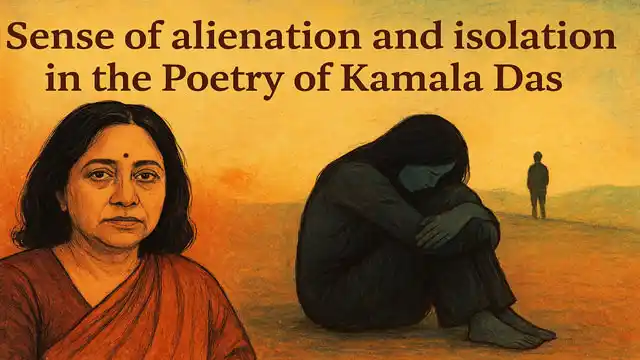
Her poems often dramatise the conflict between the self and the roles imposed by society—those of wife, lover, mother, and obedient woman—roles that frequently suffocate her innate need for emotional and creative freedom. This tension generates a deep sense of estrangement, not only from others but also from her own body and inner life.
Through confessional honesty, vivid imagery, and an unflinching exploration of female subjectivity, Kamala Das crafts a poetic universe where alienation becomes both a painful reality and a catalyst for self-expression. Examining this sense of alienation in her poetry reveals the psychological and social struggles that define her work and underscores her enduring contribution to feminist and confessional literature in India.
Kamala Das as a Feminist and Her Sense of Alienation:
Kamala Das stands as a feminist voice, and during the most productive years of her writing, Indian women were still struggling to free themselves from male dominance. Her feeling of estrangement arises partly from witnessing how deeply rooted this dominance is in the country. She experiences a wider social alienation because the very structure of society enables Indian men to overpower women.
She acknowledges that the plight of Indian women is shaped by this societal framework. In this conservative setup, men enjoy unrestricted freedom, while a woman’s gentle emotions are stifled under harsh patriarchal control. After marriage, she is reduced to an object or instrument in a man’s hands, valued primarily for his sexual satisfaction.
Loveless Marriage and Emotional Isolation:
Man pays no heed to her emotions or her delicate sensitivities. She yearns constantly for genuine affection, yet is denied it, leaving her feeling estranged and alone. Her days slip by in a secluded corner of the home, confined within four walls, with no one to comfort or understand her inner turmoil. Instead, she is pursued by the ravenous gaze of men who seek only physical gratification.
Kamala Das repeatedly experienced this sense of emotional exile—first with her husband, and later with other men she turned to out of disappointment in her marriage. In each relationship, she found herself reduced to a mere puppet, controlled first by her husband and then by those who followed. Her longing was always for authentic love, but within a patriarchal society, it is lust that takes precedence. She comes to realize that men showcase their sexual prowess while disregarding the deeper, truer feelings of the heart.
Alienation in “The Old Playhouse”:
Kamala Das felt utterly estranged from her husband. In “The Old Playhouse,” she addresses him directly, remarking that although he summoned her as a wife, he never offered the affection or tenderness a wife naturally seeks. What satisfied him instead was her reaction to his touch, his caresses, and the physical intimacy he imposed. She explains that she had entered the marriage hoping it would help her understand herself—hoping that in discovering who she was, she would also discover how to grow and realize her inner capacities.
Yet this hope remained unfulfilled because her husband’s self-absorption and egotism left no room for her self-discovery. Instead of helping her learn about herself, he allowed her to learn only about his own desires and temperament. Though he did engage in lovemaking, it served chiefly to gratify him, and he took pleasure solely in her physical response.
The Husband’s Ego and Her Emotional Suffocation:
Her husband had no real understanding of love or tenderness toward a wife; to him, she was nothing more than a homemaker and a means to satisfy his desires. He had trained her to sweeten his tea with saccharine and hand him his vitamins at precisely the right times. Crushed under the weight of his immense ego, she felt diminished to the level of a mere shadow, stripped of her own will and sense of self.
Her mind, once alive, felt like an abandoned playhouse—dark, silent, and forgotten. She felt stifled within his home, where even the air seemed heavy with his overpowering masculinity. She was expected to conform to a traditional role, while her own dreams, needs, ambitions, and, most importantly, her emotional well-being were completely ignored.
“You called me wife,
I was taught to break saccharine into your tea and
To offer at the right moment the vitamins. Cowering
Beneath your monstrous ego, I ate the magic loaf and
Became a dwarf. I lost my will and reason, to all your
Questions I mumbled incoherent replies.”
Longing for Freedom from Slavery:
The poetess aspired for complete freedom from a life of slavery. She condemned the life of snobbery and artificiality:
“The strong man’s technique is
Always the same, he serves his love in lethal doses,
For love, is Narcissus at the water’s edge, haunted
By its own lonely face and yet it must seek at last
An end, a pure, total freedom.”
Alienation in ‘The Freaks’:
In “The Freaks,” the speaker experiences a deep sense of isolation born from the absence of genuine love. Neither her husband’s nor other men’s emotionless sexual overtures awaken in her the tenderness she desperately longs for. She searches for emotional warmth and stability, yet every attempt ends in emptiness. With love missing, they merely gratify the body’s urges, mistaking physical hunger for intimacy.
Their relationship is beyond repair; though they have shared a life for years, they have utterly failed at love. Their hearts resemble dry, unused cisterns—void of the sustaining grace of affection. This hollowness reflects a profound inner barrenness and spiritual desolation.
Loneliness and Cruelty in “The Sunshine Cat”:
In the poem “The Sunshine Cat,” the speaker reveals that although she once loved her husband, hoping he would return her affection, that love eventually died. He turned out to be both selfish and cowardly. His cruelty showed in the way he confined her each morning to a room lined with books, unlocking the door only when he came back at night. A single beam of sunlight slipped in through the doorway, and this patch of light—shaped in her imagination like a yellow cat—became her only companion. Gradually, worn down by persistent loneliness and despair, she grew so frail and depleted that she felt half-alive, no longer someone whom any man would desire.
Disappointment with Other Lovers in “The Sunshine Cat”:
In The Sunshine Cat, the poet criticises not only the speaker’s husband but also the other men she turns to after being disheartened by her husband’s cold and mechanical approach to love. She does everything she can to earn the affection of these men, yet each one admits that while he can treat her gently, he cannot truly love her. As a result, these relationships bring her no real fulfilment, leaving her to drown in her own sorrow. Her disappointment becomes so overwhelming that even restful sleep escapes her. She cries so intensely that her tears seem capable of forming walls—walls that confine her like a captive of her own anguish.
Nostalgia and Lost Love in “My Grandmother’s House”:
In My Grandmother’s House, the poet remembers the home where she once lived with her grandmother—a woman who adored her and showered her with affection. After her grandmother’s death, the house fell silent and deserted. As a young child, the poet could not even read the books that filled the rooms; yet the loss of her grandmother drained her of all warmth and emotion. She felt as though the blood in her body had turned icy, cold like the moon.
She would often long to return to that house and peer inside through its windows, hoping to reconnect with what she had lost. But the windows remained shut, allowing her only a sense of deep despair rather than any real glimpse of the past. She confides in her husband that she feels adrift in life, deprived of love, receiving affection from no one. Now she wanders through life like a beggar in search of tenderness, grateful even for the smallest scrap of love offered by strangers.
Pain of Separation in ‘The Invitation’:
In the poem “The Invitation,” the poetess is tormented by the memory of her intimate moments with a former lover. After sharing physical affection with her, the man had left and never returned. Though she understood he would not come back, the memory of their union remained etched in her mind because it had been intensely gratifying.
She reminisces about how he would visit her during breaks from his office routine, seeking comfort and renewal in her presence. Exhausted from work, he would silently lose himself in her arms, finding warmth and ease there. She realises that no other man could replace the one who had once shared her bed and had now disappeared from her life. Lying beside him had felt like being in paradise; even their narrow bed—six feet long and two feet wide—had seemed like a slice of heaven.
After his departure, she is left desolate, frustrated, and deeply unsatisfied. Unable to bear the anguish of separation, she feels drawn toward the sea, which appears to beckon her to surrender herself to its depths and end her suffering.
Despair and Physical Pain in ‘Glass’:
In “Glass,” Kamala Das voices a deepening sense of frustration—almost a sinking despair—born from her unfulfilled encounters with sexuality. She recalls a man who pulled her to himself with harsh urgency, eager only for the act, handling her as though she were “a bundle of splinters.” His roughness wounded her, leaving her feeling as fragile and shattered as broken glass.
The pattern repeated itself with the other men who came into her life, until their similar insensitivity bred in her a quiet aversion to them all. In time, she sought from such unions only a momentary physical release, neither hoping for nor offering genuine affection. And yet, beneath this hardened stance, she continued to long for the tenderness she had once pursued in intimacy—beginning with her husband. Ultimately, she felt that the only true love she had ever known was the affection her father had given her, the love she had always yearned for.
Kamala Das’ Alienation from Society:
The Treatment of Society with Her:
The poem entitled “An Introduction” gives us an account of how society had been treating her. People had gone to such an extent in their criticism of her as even to disapprove of her writing poetry in the English language. People had said that English was not her mother tongue and that she should, therefore, not use this medium for the writing of her poems. Kamala Das protested against this attitude of society towards her, saying that she would speak and write in any language she liked. She accepts that this male-dominated society is responsible to create brutality in men against the women.
Society’s Failure to Cultivate Empathy:
This society never teaches them this moral how to behave with girls and women. Society is also unable to make a flow of emotions in the hearts of men for the Women. She complains about the way of a lover had treated her while performing the sexual act. He had dragged her into the bedroom, closed the door, behaved in such a rough manner during the sexual act that she had felt as if she had badly been beaten. She held felt almost crushed by the weight of her own breasts and womb.
Societal Expectations and Restrictions:
This orthodox- society is formed only to advise the girls and the women. The people had urged her to behave like a girl, to behave like a wife, to take to embroidery, to do the cooking, and quarrel with servants. They told her to call herself Amy or Kamala or better still, Madhavikutty. They urged her not to pretend to be a split personality suffering from a psychological disorder, and not to become a nymphomaniac (or a sex-crazy woman).
Protest Against Male Domination:
Kamala Das’ protest is directed against society for allowing men to domineer over women. Male domination of women in this country is repugnant to her. It is one of the strongest aversions, just as sheer lust, divorced from all love, is one of her strongest aversions.
In the poem entitled Substitute, she has written that a stage had come in her life when love became a swivel-door with one man going out and another coming into perform the sexual act with her. She had then lost count because there was always in her embrace a substitute for a substitute i.e., there was no shortage of sexual partner for her.
Questioning Women’s Submission in “The Conflagration”:
In one of her poems, entitled The Conflagration, she asks the women whether they think to surrender before men and lie beneath them only mission of their lives. Although they do not get emotional love, yet they involve in sexual act. She has also mentioned the same thing many of her poems.