Introduction of the Poem “The Royal Ascetic and the Hind”:
“The Royal Ascetic and the Hind” is a narrative poem by Toru Dutt, one of the earliest and most celebrated Indian poets writing in English during the 19th century. The poem is included in her collection Ancient Ballads and Legends of Hindustan (1882), where she retells stories from Indian mythology with lyrical grace and emotional depth.
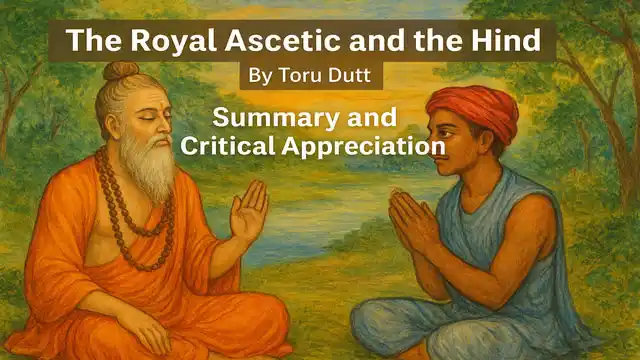
This poem is based on an episode from the Vishnu Purana and explores the spiritual journey of a king-turned-ascetic who strives for self-purification but finds his path challenged when he saves and befriends a helpless hind (a female deer). Through this story, Toru Dutt weaves themes of renunciation, compassion, temptation, human weakness, and the moral struggle between ascetic ideals and natural emotions.
Dutt’s rich imagery, musical language, and deep empathy bring the ancient tale alive, highlighting the universal conflict between worldly attachments and spiritual discipline.
Toru Dutt’s The Royal Ascetic and the Hind stands among her finest poems. Drawing on the tale of King Bharat from Book II, Chapter XIII of the Vishnu Purana, the poem challenges the rigid ideals of ascetic life. Dutt criticizes the orthodox discipline that leaves no room for human emotions—love, compassion, pity, or sympathy.
She points out that traditional asceticism requires a hermit’s isolation in the forest, far removed from ordinary life. Yet the poem conveys a deeper moral: the path to Eternity—the divine realm—and the route to salvation may be discovered not in isolation, but amid the trials, sorrows, and struggles of the world. According to the poet, true self-mastery does not come from fleeing society, but from engaging with life and its challenges.
Summary of the Poem “The Royal Ascetic and the Hind”:
Maitreya Reminds Parasara of His Promise:
Maitreya reminded Parasara that long before he (Parasara) promised him (Maitreya) to tell about the life and deeds of Bharat who was a great and mighty king and who passed a life of hermit. Addressing him (Parasara) as beloved master, he (Maitreya) told him (Parasara) that it was an appropriate occasion and he was wholly prepared to listen the story of Bharat very carefully.
Parasara addressed Maitreya as Brahman and asked him to hear about Bharat. Thus he (Parasara) began. In ancient days there lived a mighty king, named Bharat. He ruled in Saligram. He was famous in the whole world. He was a confirmed follower of virtuous, holy and moral life. In his life he never tried to harm anyone whether human beings or any other living creature. He renounced the life of a king to lead a hard ascetic life in the tough surroundings of the forest. Instead of leading a royal life of luxuries, comforts and pleasure, he accepted a life of a hermit.
He was not least inclined to the royal life of materialistic pleasures. Having renounced all royal luxuries, he began to devote his time to the observance of ascetic rites and constant prayers. In the midst of stern hardships of the forest, he struggled a lot to attain complete control on his soul. He wanted to purify his soul by overcoming his senses. He wanted to feel the divinity of soul which is badly suppressed under the sensual and materialistic pleasures. He tried his best to get the way of salvation.
During his ascetic life in the forest, he got up early in the morning and gathered fuel, flowers, fruits and holy grass for offerings made to God. He completely dedicated himself in the service of God so that he might get that divine light which is a very difficult job for the human beings. He spent all his time in stern devotions.
He was completely indifferent to activities and fascinations of the world. The worldly affairs and pleasures could not influence him. Worries, tensions, wealth, love and fame could not affect him. In his ascetic life of forest he had forgot everything related to this physical world.
The Hind, the Lion’s Roar, and the Orphaned Fawn:
While dwelling in the midst of serene and peaceful surroundings of the forest, once he went to take bath in the river flowing in the forest. After purifying his whole body with water, he sat down upon the shallow bank to meditate and pray. Just then a beautiful hind happened to pass there. She went to the bank of river in order to quench her thirst. She was badly incited by thirst. She was pregnant. She seemed to be fearless while going to satisfy her thirst.
When she was drinking water standing on the bank of river, the roaring of the lion was heard. The lion’s roaring disturbed the peace of the forest. It echoed in the forest. It created fear in all creatures. The roaring was heard coming from the nearby bushes. On hearing the sudden roaring of the lion, the hind startled. She was full of extreme fear and leapt up to save her life. By leaping up suddenly, her offspring came out from her womb and fell down in the rushing stream.
The little fawn was carried far by furious waves and strong current which had swollen by recent rain. The poor, little creature struggled hard to save its life. Under the pressure of unbearable pain and fear, its mother fell down upon the bank of the river and breathed her last. The royal ascetic who was seeing all this heart – rending sight, could not resist his overflooded emotions and pity for that poor helpless creature. For that mute animal, he felt unbounded pain.
He wanted to save the life of the young one. He at once stood up and with his staff; he succeeded to save the life of the new born creature from the violent waves. It was badly grasping, but it was alive. When the royal ascetic found that its unfortunate mother was dead, he resolved not to leave it all alone in the forest. He brought it home with the feelings of great pity.
Bharat Raises the Fawn with Care and Affection:
Bharat, the royal ascetic lived in a cottage which was made of twigs and leaves. Having saved the fawn’s life, he took it into his custody so that no wild animal might give it any kind of harm. As he was generous and full of pity for the mute creatures, he looked after the fawn very carefully. He gave it food for its proper nourishment. He began to pay his total and special attention to its care.
After some time under his tender care, it grew in its physical stature. It became physically strong. Now it was able to go in the forest in search of food. It could sustain his life going to the forest skirts. Sometimes it was out of the hut for the whole day. It set about on the journey of the forest early in the morning and by the sun set it returned home. It wandered in the forest in wantonness and in search of food.
Sometimes when it felt danger of the tiger, it returned to the hut at noon and lay down in the little courtyard of the hut peacefully. The royal ascetic’s heart was always full of emotions, affection and care for the fawn. At every moment he thought about its care whether it remained near or far, wandering in the forest or resting in its home. Bharat had developed a special kind of attachment for it.
He could think nothing besides this little fawn. Though he had left kingdom, children and a lot of friends almost without tear, the fountain of love sprang out a new within his blighted heart. He spent all his time in looking after his dumb, weak and helpless foster child. When it wandered the forest and did not return at the accustomed hour, he thought about it.
Growing Attachment: Bharat’s Anxiety and Emotional Bond:
When the fawn became matured enough to sustain its own life by searching food going in the midst of dense forest , it set out to the forest in order to search food and enjoy the life of forest . Sometimes it spent a greater part of the day – time in the forest. Sometimes it returned its home very early before its customary time , but sometimes it remained in the forest for longer and returned to its home very late . Its not coming to its home on accustomed time brought great anxiety for the royal ascetic. It filled his mind with great unexpected fears. He began to fear with some bad happening with the fawn.
After forgetting everything related to his purpose, he was completely engrossed in its thoughts: Bad ideas began to linger in his mind taking the safety of fawn. He thought that it might have become victim of some lion or some wolf or ravenous tiger. He thought that some cruel and wild animal might have torn its tender body with relentless jaws and devoured it. Mere imagination of losing this little one of the deer, filled him with great fear. When completely engrossed in its thoughts, he looked at those signs and things which were left behind by it.
He looked at the ground which was tinted with its hoofs. Surely these signs created naturally in the form of a design provided him a kind of joy and reminded the fawn. He waited eagerly for its arrival. He thought that when it would come back and rub its newly growing small horns on his arms to show its love and its happiness to see his face. When he looked at the shaven stems of grass by its new teeth clipped, he lost in its thoughts. The shaven stalks of grass stood in lines like pious boys, bereft of all their wealth of hair, who chanted the Sama Veda.
Bharat’s Spiritual Decline and Death:
In this way, Bharat, the hermit – king spent his ascetic time quite happily in the company of the fawn. Whenever the fawn was near him, he was full of joy. His emotions and attention were totally fixed at the fawn. He was always surrounded with the thoughts of his foster child. He had forgotten all the duties, principles and responsibilities for an ascetic life. Whenever the fawn remained far from his eyes and wandered in the forest, he felt restless. He remained under the burden of trouble, fear, grief and anxiety until it reached to its home safely. Its arriving home safely gave him great consolation.
For him the fawn was everything in the world. Bharat, who had given up all his relations, case, wealth and kingly power and had no worldly attachment with anything, was badly entrapped in love of a fawn. His ascetic life was completely disturbed by his overwhelming emotions and love for the fawn. He had forgotten his sole purpose of seeking the kingdom of God and the way of Eternity.
Under the impact of his great affection for the fawn, he uttered no prayers for God. He had no feelings of dedications for God. Now he did not contemplate to get the knowledge of the mysteries of the world. Now his dedications were for the fawn which came in the way of his ascetic life. Many years passed by and Death that spares none came to the saint – king at last in order to take him away. At that time, his dear hind was beside him. It was watching his sad moments of death. It was standing beside him like a child and was shedding tears. Its heart was full of utter grief.
The king also watched his dear child through a jet of tears and could not think of God or the Eternity that was standing close by him. He was overwhelmed with powerful feelings for the fawn at the time of his death because it was the time of saying good bye to his child. He was about to leave this physical world and the company of his dear child. It seemed as if the hermit – king was not ready to leave the company of the fawn. He was wholly devoted to it, and his last thought dwelt on it . He was least concerned with the present and future.
Moral Interpretation of Bharat’s Story:
This story related to Bharat’s worldly and ascetic life was written by an old Brahman sage in ancient time. But when we analyse and observe the moral of Bharat’s story, we find that God is love. In other words God dwells where there is an abode of love. In fact we think and remain under this illusion that the holiest life is that which is passed according to the rules and principles ordained in holy books. The rules and principles of the holy books are given great importance. But we ignore the truth that God is love. Indeed God can be won by love not by strict self – control, ascetic rites and hard penance.
We can have little sympathy with what the Brahman sage implied as the concluding moral of his tale. According to the Brahman sage, love, sympathy, pity and emotions were not suitable for a man who was leading an ascetic life in solitude in the forest. The sage badly denounced Bharat’s overwhelming emotions and love for the fawn during his ascetic life. The sage thought that Bharat disobeyed the rules of an ascetic life.
In the story of Bharat, he found out the moral that Bharat, who had accepted the life of an ascetic, committed a sin by loving and caring the fawn. How can love and pity be sins? We should seriously think over what wise Brahmans and monks have wisely said about the royal – ascetic. Indeed Bharat had sinned by casting off love for all by renouncing the world and taking retirement in the forest. Like a cowardly soldier he had left the post of duty where God had appointed him as a sentinel.
Bharat’s turning his back from his friends, relatives and family members was an act of sin. Fleeing away from household responsibilities and duties was an escape from the worries, tensions, griefs and sufferings of the world. When the hermit king looked after the fawn, love once again became the prime emotion in his heart. He was extremely inclined to it emotionally. His heart was overflooded with emotions for it. He always thought about it. His total attention was fixed on it. So he stopped saying prayers and doing religious practices. His way of life became totally different. He forgot that the sole purpose of his renouncement of physical world was to seek the way of Eternity.
This love for the fawn became the greatest obstacle in his love for God. Finally the poetess says that solitude and forest life are not necessary for the peace of mind. It is through sorrow, sickness and suffering and sin, a man can achieve greatness of soul. It is through this narrow gate a man can enter the kingdom of Heaven.
Critical Appreciation of the Poem “The Royal Ascetic and the Hind”:
Introduction:
The poem “The Royal Ascetic and the Hind” stands among Toru Dutt’s finest works. It draws its inspiration from the tale of King Bharat found in Book II, Chapter XIII of the Vishnu Purana, a story deeply rooted in Indian cultural memory and often regarded as the starting point of India’s historical tradition.
In this poem, Dutt strongly criticizes the rigid doctrines of traditional asceticism—doctrines that leave no room for human emotions such as love, compassion, or sympathy. According to orthodox thinkers, one who chooses the ascetic life must renounce all worldly ties and withdraw into the seclusion of forests, abandoning every earthly concern.
Yet the poem suggests a different moral truth: the path to salvation, the eternal realm, or divine grace is not discovered by running away from life. Instead, it lies within the very struggles, sorrows, and anxieties of the world. In essence, the poem argues that true spiritual fulfilment comes through engaging with life’s duties, not escaping from them; asceticism, therefore, becomes a retreat from responsibility rather than a higher calling.
Thought – Content:
Bharat, the ruler of Saligram, renounced his throne and withdrew into a life of penance. Immersed in prayer and spiritual discipline, he strove to gain complete mastery over his soul. He spent his days absorbed in rigorous devotion, turning away from the lures of wealth, affection, and renown.
One day, after bathing in the river, he settled on its bank to meditate. At that moment, a gentle, pregnant hind approached the water to drink. Suddenly, a lion’s roar shattered the stillness. Startled, the frightened creature sprang up, and in her terror, her young one was forced from her womb, tumbling into the swift current. The helpless newborn fought desperately against the waves, while the mother, overwhelmed by shock and agony, collapsed and died.
Moved by compassion, the royal ascetic rescued the tiny creature and carried it to his hermitage. He tended to it with immense care. Though he had once abandoned his kingdom, his children, and his dear companions without shedding a tear, a new spring of affection rose within his desolate heart for this frail, speechless foster-child.
Years slipped by, and when the hour of death arrived for Bharat, his thoughts would not turn to the world beyond. Instead, he was consumed with sorrow at the thought of leaving the fawn he had lovingly nurtured.
Moral of the Poem:
The poetess criticizes the king for renouncing his throne and turning into a sanyasi, abandoning his kingdom and its duties. Traditional sages and moralists claim that it was sinful for a royal ascetic to feel affection for the child he had raised. However, the poet strongly rejects this rigid and conservative viewpoint. She believes that anyone seeking true self-mastery should not withdraw into isolation or hardship. One must not cut oneself off from the world, nor seek solitude in peaceful, chosen retreats for meditation and prayer. Instead, genuine self-realization comes from labouring with a compassionate heart amid the turmoil of life—its struggles, sorrows, sickness, and sins.
“Not in seclusion, not apart from all,
Not in a place elected for its peace,
But in the heart and bustle of his world,
‘Mid sorrow, sickness, suffering and sin,
Must he still labour with a loving soul
Who strives to enter through the narrow gate. “
Form, Style and Language:
This ballad is regarded as one of the finest poems of its kind. The poetess has explored nearly every poetic form—she has composed ballads in octosyllabic stanzas and crafted three flawless sonnets. Yet this particular ballad is written entirely in pure blank verse. It begins as a dialogue between Maitreya and Parasara and unfolds the tale of Bharat, the illustrious hermit-king of Saligram. Throughout the poem, the poetess skilfully employs various figures of speech.