Romantic Phase and Emergence of New Themes in Indo-Anglian Novel:
There are many important themes in Indo-Anglian Fiction. In the early stage of the Indian English novel, which was predominantly Romantic in spirit, writers largely turned to history as their chief subject. India’s past was presented in an idealised and glorified manner.
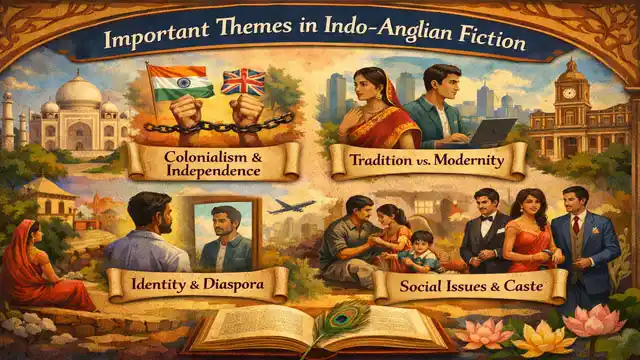
Social concerns appeared only occasionally, as seen in works like Raj Laxmi Devi’s The Hindu Wife (1876). However, with the transition to the second phase of development, the introduction of fresh themes became more consistent.
Consequently, a wide range of subjects emerged, encompassing social life, politics, issues of adjustment, poverty, love, the struggle for Independence, and related concerns.
Focus on Contemporary Indian Life and Thematic Sub-Groups:
A central and widely recurring concern in the Indo-English novel is the exploration of the pressing issues of modern Indian society. Almost all major writers engage with this theme, since literature inevitably mirrors the realities of the age in which it is produced. Closely connected to this concern are four distinct thematic categories, which have been insightfully outlined in a recent article by Professor Dieter Riemenschneider.
First Sub-Group: Social, Economic and Political Oppression:
The first sub-category includes novels that portray the social, economic, and political exploitation of individuals. Many works by Mulk Raj Anand fall within this group, along with Raja Rao’s Kanthapura, Kamala Markandaya’s Nectar in a Sieve and A Handful of Rice, Bhabani Bhattacharya’s So Many Hungers!, and Manohar Malgonkar’s The Princes.
Second Sub-Group: Search for Identity:
The second sub-category focuses on the individual’s quest for selfhood. This concern is evident in works such as Anand’s Lalu trilogy (1939–42), Markandaya’s Some Inner Fury, B. Rajan’s The Dark Dancer and Too Long in the West, Attia Hussain’s Sunlight on a Broken Column, as well as in the majority of novels by Anita Desai and Arun Joshi.
A somewhat modified treatment of this theme appears in G. V. Desani’s All About H. Hatterr, Markandaya’s Possession, Raja Rao’s The Serpent and the Rope, and Khushwant Singh’s Train to Pakistan.
Third Sub-Group: Man’s Role and Position in Society:
The third sub-category includes novels that focus chiefly on an individual’s place and function within society rather than on his independent or self-contained personality. This group covers the fiction of R. K. Narayan, Bhabani Bhattacharya’s He Who Rides a Tiger, Nayantara Sahgal’s Storm in Chandigarh, and the novels of Arun Joshi.
Fourth Sub-Group: Bridging India and the West and Psychological Fiction:
The fourth sub-group comprises only a handful of novels in which writers attempt to reduce the regrettable divide between India and the West. Examples include K. Nagarajan’s Chronicles of Kedaram, Bhattacharya’s Shadow from Ladakh, and Markandaya’s The Coffer Dams and Pleasure City.
Beyond the types of novels perceptively examined by Riemenschneider in his article, there exists an entirely distinct class of works that delicately explore human nature from a psychological perspective. In these novels, the central character is often trapped by inner conflicts and emotional turmoil. Representative works of this kind are B. Rajan’s The Dark Dancer, Markandaya’s A Silence of Desire, and the novels of Anita Desai and Arun Joshi.
Realism and Treatment of Social Problems:
While addressing social issues, Indo-Anglian novelists placed strong emphasis on realistic portrayal. This trend began with Mulk Raj Anand, who focused sharply on the curse of untouchability. The theme is powerfully explored in Untouchable as well as in Padmini Sengupta’s Red Hibiscus. Anand, along with writers like Khwaja Ahmad Abbas, also highlighted poverty and economic exploitation, a concern vividly presented in the novel Coolie.
Domestic and familial conflicts form the central concern of R. K. Narayan’s fiction, a focus similarly reflected in the novels of Ruth Prawer Jhabvala and Kamala Markandaya. Sexual relationships as a social issue appear notably in Khushwant Singh’s I Shall Not Hear the Nightingale, and are also treated in works such as Narayan’s The Guide, Manohar Malgonkar’s A Bend in the Ganges, Nayantara Sahgal’s This Time of Morning, and Kamala Markandaya’s Silence of Desire and Two Virgins.
As Kai Nicholson observes, the depiction of sexual relations between men and women in post-independence Indo-Anglian fiction is varied and multifaceted. The degree of explicitness largely depends on how far the novelist draws upon English literary models and adapts them to suit the Indian social context.
Theme of Renunciation, Suffering and Sanyas
The idea that true contentment and self-realization are attained through pain and the path of sanyas is a familiar and recurring motif in Indo-Anglian fiction, particularly in the period following 1947. Rooted deeply in Indian sensibility, this theme emerges from the country’s social and cultural traditions, where suffering is often accepted and sustained by unquestioning faith.
As a result, the concept of renunciation introduces stock figures such as sanyasi, swami, or sadhu; at times, novels also portray a spurious spiritual leader, as seen in The Guide. These contrasting figures represent two opposing responses to suffering—the authentic and the deceptive.
This thematic concern is evident in works like B. Rajan’s The Dark Dancer and Raja Rao’s The Serpent and the Rope. Similarly, R. K. Narayan’s The Guide and Bhabani Bhattacharya’s He Who Rides a Tiger explore the motif of renunciation and its implications.
Politics as a Dominant Theme (1920–1950 and After):
Between 1920 and 1950, politics dominated Indian English fiction and became an almost compulsive preoccupation of writers. This phase witnessed the rise of politically aware novels that closely mirrored the contemporary political situation in India. As R. K. Narayan observes, “the subject-matter of fiction became inescapably political,” pushing into the background elements such as comic spirit, atmospheric sensitivity, psychological exploration, inner moral conflict and its resolution, and the detached observation that normally form the essence of fiction.
Even after 1950, writers continued to show a strong inclination towards political themes. This sustained interest was largely shaped by Mahatma Gandhi’s influence and ideals. As a result, themes such as the freedom struggle, the Indian National Army and the Indian Army, contemporary political life, the decline of princely states, and the experiences of Partition and Independence frequently appeared in novels. These political concerns were explored by major novelists both before and after India attained independence.
Freedom Struggle and Gandhian Influence:
Influenced by Mahatma Gandhi, Indo-Anglian novelists writing before Independence frequently adopted the freedom movement as the central subject of their fiction. The struggle for Independence gradually emerged as a dominant literary concern. This theme finds expression in works such as Raja Rao’s Kanthapura and The Cow of the Barricades, K. A. Abbas’s Inquilab, R. K. Narayan’s Waiting for the Mahatma, Mulk Raj Anand’s The Sword and the Sickle, C. N. Zutshi’s Motherland, Aamir Ali’s Conflict, and Manohar Malgonkar’s A Bend in the Ganges.
These novels portray Gandhi’s personality and ideals, his methods of attaining freedom, revolutionary activities, satyagraha, and movements like Quit India. As Meenakshi Mukherjee observes, although several Indo-Anglian novels have addressed the Independence movement, none has yet attained the stature of a truly major novel on this momentous national awakening.
Post-Independence Politics and the Theme of Partition:
Post-Independence political life, particularly the atmosphere of Delhi, finds expression in Nayantara Sahgal’s novels, notably This Time of Morning. Several Indo-Anglian novels written after Independence also focus on the experiences of Independence and the trauma of Partition. Khushwant Singh vividly portrays the human suffering caused by Partition in Train to Pakistan (1956).
The theme of Partition is further explored in Manohar Malgonkar’s A Bend in the Ganges (1964), which presents a stark picture of its brutal consequences. Similarly, Attia Hosain’s Sunlight on a Broken Column reflects the unrest and emotional turmoil of the years surrounding Independence and the Partition of the country.
Indian Army and the Debacle of Princely India:
Manohar Malgonkar’s Distant Drum focuses on the life and functioning of the Indian Army. In A Bend in the Ganges, he turns his attention to the Indian national struggle, particularly the movement led by Subhash Chandra Bose. In recent times, another significant and productive theme has come to the forefront—the decline of princely India marked by the collapse, integration, and amalgamation of the Indian princely states.
This theme serves as the central concern of at least two novels: Malgonkar’s The Princes and Mulk Raj Anand’s The Private Life of an Indian Prince. Both works portray the mental and emotional disintegration of representative Maharajas in the aftermath of political merger. It is hoped that more Indo-Anglian novelists will further explore this subject. Kamala Markandaya has also engaged with this theme in her novel The Golden Honeycomb (1978).
East–West Encounter as a Major Theme:
E. M. Forster produced an enduring masterpiece, A Passage to India, based on an Indian subject, in which he examined the encounter between the East and the West. This theme was later taken up and widely developed by Indo-Anglian novelists. In their works, the East–West relationship is explored at multiple levels—personal, social, political, and cultural. Frequently, the Anglicized Indian experiences an inner dilemma while choosing between Eastern traditions and Western influences.
The motif of East–West interaction appears in many Indo-Anglian novels, such as Raja Rao’s The Serpent and the Rope, J. M. Ganguly’s When East and West Meet (1960), S. K. Ghose’s The Prince of Destiny, K. S. Venkataramani’s Murugan, the Tiller, and B. Rajan’s The Dark Dancer. Commenting on this characteristic concern of Indo-Anglian fiction, Meenakshi Mukherjee observes that Indo-Anglian writers have approached the metaphysical, spiritual, and romantic dimensions of this encounter in individual ways. She further notes that even when a novel does not directly engage with the Forsterian theme, the personal struggle of the Western-educated protagonist inevitably assumes an intercultural significance.
Indian Immigrants Abroad:
The experience of Indians living overseas finds expression in several novels, notably Dilip Hiro’s The Triangular View (1969), Kamala Markandaya’s The Nowhere Man (1972), Anita Desai’s Bye-Bye, Black Bird (1971), and Roman Basu’s A Gift of Love. The same concern also informs Reginald and Jamila Massey’s The Immigrants (1963), Deep Chand Beeharry’s That Others Might Live, Bharti Mukherjee’s Wife (1976), and Ram Sharan’s Look Homeward!. Regardless of their technical strengths or limitations, these works engage with a pressing and contemporary subject.
Hunger, Poverty and Human Degradation:
The intertwined motifs of hunger and poverty, along with the related issue of human debasement, find powerful articulation in novels such as Mulk Raj Anand’s Coolie (1936), Kamala Markandaya’s Nectar in a Sieve (1954), and Bhabani Bhattacharya’s A Handful of Rice (1966) and He Who Rides a Tiger (1954). These works adopt a starkly realistic approach, depicting deprivation, suffering, and rural life with the unflinching honesty characteristic of naturalistic writing.
Tradition versus Modernity:
The conflict between tradition and modernity occupies a prominent place in novels that explore hunger, poverty, and the East–West encounter. This tension, however, receives a more focused and nuanced treatment in Kamala Markandaya’s A Silence of Desire (1960) and Two Virgins (1973), as well as in Bhabani Bhattacharya’s Music for Mohini (1952).
East–West Encounter and Search for Identity
A large number of the novels referred to above revolve around the motif of the East–West encounter, a theme that has been imaginatively explored in numerous works. Among the most significant examples are Raja Rao’s The Serpent and the Rope (1960), Kamala Markandaya’s Possession (1969), and B. Rajan’s The Dark Dancer (1959). Along with cultural confrontation, these novels also engage deeply with the quest for identity.
Other Themes and Thematic Range of Indo-Anglian Novel
There are other stray themes of love, murder, village life etc-also. But the Indo-Anglian novel suffers from lack of extremely localised themes. It is, however, thematically wide-ranged. Sometimes the quality of exoticism is introduced to attract Western readers. In general, these themes are universal and have value not only for Indians but for all, irrespective of class, creed and country.