Introduction:
The play Tughlaq Is known as a tragedy of political intrigue. Girish Karnad’s Tughlaq is a powerful historical play that presents the reign of Sultan Muhammad bin Tughlaq as a complex tragedy shaped by political ambition, idealism, and continuous intrigue.
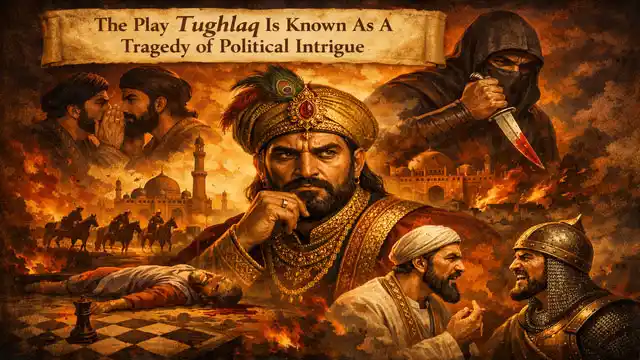
The play portrays Tughlaq not merely as a historical ruler but as a tragic hero whose visionary ideas are gradually destroyed by the web of conspiracies, betrayals, and manipulations surrounding him. His noble intentions to establish justice, religious harmony, and a rational state become entangled in the dark realities of power politics.
Intrigues operate at every level of the play—among nobles, religious leaders, rebels, and even within Tughlaq’s own mind—turning his dreams into instruments of chaos and suffering. Thus, Tughlaq stands as a tragedy of intrigues where political scheming and deception overpower moral idealism, leading to the downfall of both the ruler and his kingdom.
Atmosphere of Intrigue in the Muslim Rule:
The era of Muslim rule in India was never free from internal disorder, rebellion, plots, and political intrigue. Conspiracies were not limited to nobles and Amirs alone; even members of the royal family took part in schemes to overthrow the ruler. The reign of Muhammad Tughlaq was particularly marked by such secret plotting. At times, even those who enjoyed his complete trust betrayed him and planned his assassination.
However, Sultan Muhammad Tughlaq proved to be stronger and more cunning than his enemies. He was capable of confronting the nobles and dealt with them firmly once their treachery was revealed. At the same time, the nobles themselves conspired against one another to settle personal rivalries and past grudges. As a result, the atmosphere was filled with continuous plotting and counter-plotting, where even the cleverest and most calculating individuals could not last long.
The play Tughlaq focuses on the life and rule of Sultan Muhammad Tughlaq and portrays this world of political manipulation and betrayal. It is rightly regarded as a powerful tragedy centered on intrigue.
Types of Intrigues in the Play:
In Tughlaq’ there are three types of intrigues: (i) The intrigues of the Sultan-against his nobles and even against his royal family (ii) The intrigues of even trusted countries and Amirs against the Sultan. (iii) The intrigues of the nobles against one another. One is suspicious of one trusted friends.
Tughlaq’s Intrigue against His Father and Brother:
Sultan Muhammad Tughlaq plotted against his own father and brother and succeeded in having them put to death, which cleared his way to the throne of Delhi. By a strange coincidence, an elephant went into a must exactly at the time of prayer, causing the deaths of both his father and brother. After this incident, Muhammad ascended the throne.
It is widely believed that he was secretly responsible for provoking the elephant into this violent state. Thus, he earned the grim reputation of being both a patricide and a fratricide. From that moment, his mother became distant and alienated from him. However, his stepmother remained deeply attached to him and constantly showed great concern and affection for his well-being.
Sheikh Imamuddin’s Opposition to the Sultan:
Sheikh Imamuddin is honoured by the people as a great saint. He strongly opposes the Sultan’s liberal policies and uses the tragic incident of the Sultan’s father and brother’s deaths to turn public opinion against him. He condemns the Sultan as a shame to Islam, accusing him of abandoning the principles of the Holy Quran and of causing the killing of his own father and brother during prayer.
By doing so, the Sheikh instigates the masses to rise in rebellion against the Sultan. Consequently, severe disturbances break out in Kanpur, and it is reported that nearly half of the city was set ablaze.
The Sultan’s Plot against Sheikh Imamuddin:
The Sheikh continues to provoke the people against the Sultan, which leads the Sultan to devise a clever plan to trap him. The Sheikh is invited to Delhi to deliver a speech at a public gathering. The Sultan’s vizier, Najib, notices the remarkable physical resemblance between the Sheikh and the Sultan, and the Sultan decides to make full use of this likeness.
First, a public meeting is arranged for the Sheikh to address. However, the Sultan secretly orders his soldiers to go from house to house warning people not to attend. As a result, no one appears at the meeting. This makes the Sheikh lose his popularity and credibility, and he is soon regarded as a spy.
The Sultan then uses the Sheikh to achieve a double purpose. He sends him, dressed in splendid royal attire, as a royal messenger to persuade Ainul Mulk to abandon his plan of attacking Delhi. When the Sheikh mounts the royal elephant and begins to speak to the opposing army, the Sultan’s soldiers suddenly sound the charge. A fierce battle breaks out, leading to widespread slaughter and bloodshed, and the Sheikh is killed on the spot.
Meanwhile, the Sultan and his troops, who had been hiding behind the hills, come forward and completely defeat Ainul Mulk’s forces. Later, the Sultan forgives Ainul Mulk and sends him back. Thus, by a single strategy, he eliminates the Sheikh and subdues Ainul Mulk, accomplishing two objectives at once and emerging stronger than before.
Conspiracy of Shihabuddin and the Amirs:
The trusted courtiers and Amirs, though they enjoy the comforts, privileges, and rewards of royal life, secretly conspire against the Sultan and even plan to assassinate him. Shihabuddin, a loyal friend and courtier of the Sultan, is invited to Delhi to manage the affairs of the state during the Sultan’s absence. However, he is misled by his adopted brother, Ratan Singh, who harbours a deep personal hatred against him.
Under Ratan Singh’s influence, Shihabuddin joins hands with the Amirs, Sheikhs, and Sayyids who are determined to overthrow the Sultan. At Ratan Singh’s urging, they decide that the Sultan will be murdered during prayer time. Meanwhile, Ratan Singh pretends to support the conspirators but secretly acts as an informer. He sends a letter to the Sultan revealing the entire plot.
The Sultan immediately takes strict preventive measures, and the conspiracy is easily crushed. Shihabuddin is personally put to death by the Sultan, while the Amirs are executed and their bodies are filled with straw as a warning to others. Thus, the entire intrigue collapses in complete failure.
The Step Mother’s Intrigue against Najib:
The step mother is displeased with Najib the vizier of the Sultan and thinks that he is leading the Sultan astray. Ultimately she gets him poisoned. When the Sultan comes to know of it, he gets her arrested and orders to stone her as an adulterous. All her pleadings against this cruel punishment fall on the deaf ear of the Sultan.
Intrigue among the Nobles: Ratan Singh’s Revenge:
The nobles also plotted against one another to settle past enmities. Ratan Singh’s father had been murdered by the father of Shihabuddin, and Ratan Singh was determined to avenge his father’s death. With this aim, he pretended friendship with Shihabuddin, gained his trust, and even became his adopted brother. Through this close relationship, he enjoyed many favours and advantages.
However, when the opportunity arose, he carried out his plan of revenge. On one side, he encouraged Shihabuddin to support the rebellious Amirs, and on the other, he secretly informed the Sultan that Shihabuddin and the Amirs were conspiring to assassinate him. In this way, Ratan Singh succeeded in getting Shihabuddin executed and finally avenged his father’s murder.
Intrigue in the Sub-Plot: Aziz and Aazam:
The sub-plot of the play is equally full of suspense and secret plotting. It presents a comic imitation of the main intrigues and counter-intrigues. Aziz and Aazam begin as close companions, but gradually their interests clash and they turn against each other.
In the end, Aazam resolves to break away from Aziz and tries to flee through a tunnel in the fort. However, the moment he comes out, he is murdered by Aziz’s followers. Later, Aziz himself is captured by the Sultan, who shows him mercy and orders him to go to the Deccan, from where he is to proceed to Arabia and vanish on the journey.
Conclusion: Tughlaq as a Tragedy of Intrigue:
Thus, Tughlaq is a great tragedy of intrigue and so its cathartic effect is not profound like that of a tragedy. The hero does not die in the end. Tughlaq is seen reclining on the throne confused, exhausted and bewildered.
