Introduction: Socio-Religious and Historical Background:
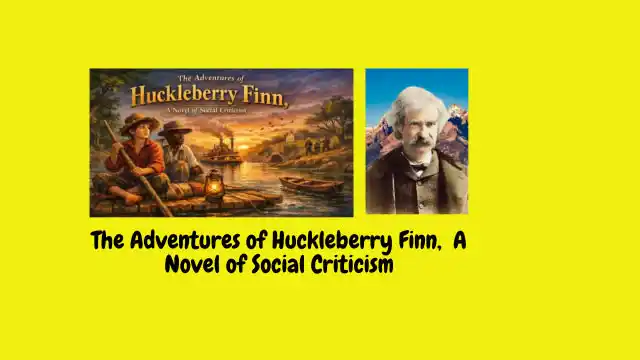
Like all great works of art, The Adventures of Huckleberry Finn, a novel of social criticism is reared on the socio-religious ethos, and embodies the ethical and moral ideas which were the prevailing norms in the mid-nineteenth century America; it recreates those historical, political and economic conditions through which the American nation was tracking its way. The novel is a bold attempt to encompass the vast frontiers of a spectacular human crusade against unknown and brutal forces of Nature, which guarded the new world. It is the re-enactment of the great experience-the struggles of a nation in the making.
The Role of the Novelist vs Historian:
Well, Mark Twain was not a historian, and could not be expected to give a chronologically arranged record of events; he was an artist, interested in giving us an imaginative pattern over the disjointed and unrelated tracts of the frontier society. Indeed, his penetrating imagination could unfold deeper and ultimate truth which even the most expert historian might not be able to apprehend. Secondly, a novelist has the added advantage of not being a scientist bound down to factual analysis committed to the finding out of the ingredients, or the cause. He cannot, and (if he is a true artist and not a fraud) he must not, shun the responsibility of value-judgement. Here lies the essential distinction between a novelist and a historian.
Moral, Social, and Spiritual Truths in the Novel:
Huckleberry Finn sums up the social and moral, more than that, even spiritual and greater human truths, which sustain the very fabric of human existence. The value-judgements, in this novel, are too obvious, though most of the time implied. He uses irony and contrast with skilful but devastating effect. Behind the reactions, attitudes, responses and protest of the boy-hero, we discover the perturbed mind of the novelist, who has seen the essential values being tragically buried under the thick layers of so-called civilization.
Five-Fold Vision of Society:
The angles from which Mark Twain looks at the contemporary society are social, economic, ethical, moral, and finally human. This five-fold vision so illuminates the crusts of society, that we can see it through, more so one against another perspective. The task that Mark Twain performs in this novel is miraculous, if indeed not a miracle.
A Society in Transition:
The south-western American society was, during the times of the novel, passing through a period of transition; it was a nation on the move. But the society that by then evolved certain codes of social conduct and behaviour, which had become fixed, in contrast with the fast-changing society. Thus, such canons had in the course of time become well-established ‘institutions’. It was natural that these static codes would, in dynamic society, expose the people to certain dangerous consequences. The novelist, like a cherub, sees these ‘dangers’ inherent in a society which thinks backwards while it moves forward.
Class Structure in South-Western Society:
The most notorious aspect of the south-western society was its class structure. The whole nation could be viewed as a heir archival pattern—each class was social enclosure by itself. The values of each class were certainly different from those of the other classes.
Hierarchy of Classes and Slavery:
The highest class was the lauded aristocracy, having large tracts of land governed by its own codes of honour, chivalry and superiority. The second was the smaller landholders, who held almost the same values as the first, but was seriously engaged in grabbing more and more land. The third class was of the peasants and farm workers, loafers and idlers, whose task was to swindle others, and to fool away their time, if they could. This class did not have any code, or moral scruples—the people in the category were mostly drunkards and criminals. These were the white classes. In that set up the last category was of slaves—who were considered to be ‘chattels’, and who were ‘owned’ by the whites for perpetuity. Slaves were ignorant and superstitious.
The Journey Motif and Narrative Technique:
It must have been a great, rather formidable task for the novelist to deal with all these classes as a whole. He could not fix his camera on one spot, for that would have incapacitated him to tell the truth, which he so powerfully tells us. He chooses to move, and to that end takes the idea of a journey along the great River which flowed across the continent. The invention of the journey in quest of freedom, like the idea of pilgrimage in Canterbury Tales, is indeed the great stroke of Twain’s genius. What Chaucer did for his country with ‘the pilgrimage’ as the ‘central cause’, so does Twain take the journey as ‘the cause’ for his purpose.
Satire on Slavery through Jim’s Character:
Let us then come to the novel. The striking part of the story is the novelist’s satire on the institution of slavery. We find slaves being owned like animals, bought and sold in the market. No regard was given to their emotions whatever. The children of slaves automatically became the property of their owner, like the young ones of a domestic animal. Here Jim represents his class. He is owned by Miss Watson whom he serves loyally and faithfully. When she is offered a considerable price by a slave-trader, she cannot resist the temptation. It is then that Jim slips away because he did not want to be separated from his family.
In Jim’s character, Mark Twain shows us certain values, which even the white community did not have. He shows a sense of humanity in his love for his family. When he tells Huck that the first thing he would do after reaching the free states would be to get money by working and then he would buy his children back, he sadly recalls the time when he gave a slap to his deaf daughter and feels sorry.
Money and Materialism in Society:
Money is seen as to be all and end all of the frontier society. For the sake of money, the people are prepared to do anything and everything. Miss Watson could not resist the temptation of ‘eight hundred dollars’. The cut- throats on the wreck of Walter Scott, are ready to kill their comrade on the issue of the division of the booty. The Duke and the Dauphin attempt to swindle the innocent Wilks sisters, having earlier fooled hundreds.
In the beginning of the novel, we find how the neglected boy, who used to sleep in hogshead, and no one bothered, was adopted by a respectable household, because of his money. In Pap’s character we are shown how considerations of money can eliminate all human and parental feeling even in a father. When Huck transfers all his money to judge Thatcher, and then runs away, in his rejection we find the novelist’s own condemnation of the cash-nexus society. When Jim is sold by the Duke and the Dauphin, Huck shows his contempt for money in his remark: “…they could have the heart to serve Jim such a trick as that, and make him a slave again all his life, and amongst strangers, too, for forty dirty dollars.”
Religious Hypocrisy and Ethical Contradictions:
What were the ethical values in practice? The religion of the south- western society was puritanism. In fact, what religion commands the people to do or not to do, the people cared two hooks. They attended the church, went to the preachings—but showed no regard for these values in their life. Thus, there was a wide gulf between theory and practice. Churches were used for gossips, for romances, and except for Sundays, the church was the frequent haunt of pigs and other stray animals.
The novel exposes the conduct of Miss Watson who asked Huck not to smoke, but herself took snuff; and who had converted her religion into a mechanical one; there being the bell for meals, for prayer-perhaps for everything. In the Shepherdson episode, we are told these families went to the church with their guns loaded. We come across a camp meeting where preaching was on, but the young folk were busy courting ‘on the sly’.
False Notions of Honour and Feuds:
In the Grangerford-Shepherdson episode, we see the false values in fuller operation. The family, one such of the feudal aristocracy, prided itself on their culture and high sense of honour. Here each member was given a slave. Even Huck was given a slave to serve him. Owning slaves was considered to be a mark of respect and honour. This family involved in a deadly feud takes pride in killing others for the sake of honour and dignity. Shepherdson’s on the other hand are no less vain and proud. The cause of their feud was a dispute decided more than thirty odd years ago, but ironically their feud continues. Similarly, we see the tragic consequences of such a false and hypo-critical notion of honour in the shooting of Boggs, by Colonel Sherburn. What a human waste in the name of honour, the novelist seems to imply.
Critique of Romanticism and Literary Traditions:
Mark Twain does not pardon even the men of letters, who indulged in such writings as romantic adventures of fops and dandies after the tradition of Walter Scott. The episode of the wreckage of Walter Scott has symbolic function in the novel. The name Walter Scott did not come to Mark Twain just by the way. The wreck of the great steamboat caused by the flooded Mississippi, signifies the novelist’s belief that the adventurism of Walter Scott cannot stand the onslaught of reality.
In the destruction of Walter Scott, we can read our novelist’s attempt to bury the romantic tradition in literature. The failures of Tom Sawyer’s schemes, and Huck’s reaction to all his plans in the beginning and at the end where Tom is hit by a bullet, we are asked to read the dangers inherent in the slavish imitation of the so called “authorities”. In contrast, we are shown greater wisdom and commonsense of both Jim and Huck.
The Raft as an Ideal Society:
The novelist leaves no episode without structures. The running structure on society is perhaps the society on the raft—the fellowship between a white boy and a negro—a fellowship based on mutual love, regard and respect, self-sacrifice and above all, understanding. On the raft, we are shown the ingredients of an ideal society, as against the actual society on the shores of the river. This contrast intensifies the ideals symbolised by the raft and exposes the tragic downward move of the ‘damned human race’. The novel gives not merely a photographic picture of the society, it also shows us the inside of the social structure; but more than that, it is a running commentary packed with value-judgements.
