Introduction:
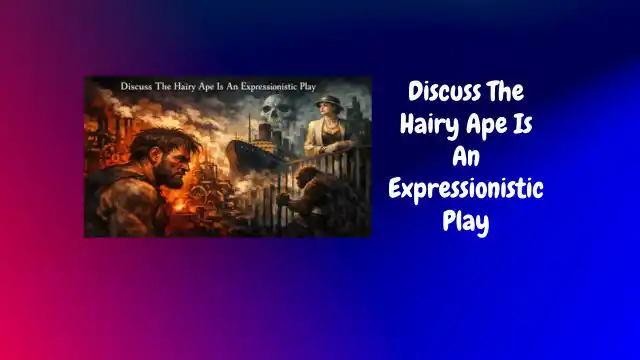
‘The Hairy Ape’ is an expressionistic play. In it, realism is the basis of expressionism. The dramatist presents expressionistic characterization, expressionistic dialogue, Interior monologue and psycho-analysis of Yank’s character.
In ‘A Background to The Study of English Literature’, B. Prasad observes: “Expressionist drama tends to represent anonymous human types instead of individualised characters and replaces plot with episode while sets are often lopsided or abstract. Expressionism dominated the German theatre in the 20’s and had a tremendous impact on the American literary scene.” Expressionism is an attempt to express the inner reality in non-realistic terms by the use of abstraction, symbols and distortions. Kenneth Macgown calls it the shorthand method of expressionism. It is an excellent medium for satire and social comment. It offers an excellent opportunity for imaginative stage designs and production. In other words, expressionism is a dramatic technique. It enables a dramatist to depict inner reality of a character. The inner reality represents his soul, the voice of conscience and the psychology. It includes a process in which the emphasis shifts from the external to the inner reality. The action moves in harmony with the thought processes of the character. The action moves backward and forward quite freely in space and time. The character’s sub-conscious is probed deeper and deeper to discover what goes on within his soul. Here the action is internalised with the reducing importance of the external action. The dramatic sequence of events has no importance in it. It concentrates on the stream of consciousness. The surface of life is disjointed and scattered. Having no concern with externals, the expressionist explores the idea, the source of conduct. The reality does not remain a part of consciousness. It becomes sub- conscious and character becomes abstraction.
Realism as the Basis of Expressionism:
According to J.M. Marriott ‘a realistic play is like a photograph but expressionistic play is like a photo X-ray. It aims at bringing out the inner reality. O’Neill’s ‘The Hairy Ape’ is an expressionistic play based on realism. It, therefore, becomes a necessity to know what is meant by literary realism or what are the qualities of Realistic Drama.
According to M. H. Abram its basic aim is to represent life and the social world as it seems to the common reader. It creates the impression that its characters might infect exist and such things might happen.
Regarding O’Neill it may be said that in spite of beginning his career as a writer of realistic plays, he turned to adoption of non-realistic methods in his famous plays like ‘The Emperor Jones’ and ‘The Hairy Ape’. He did not give up entirely the realistic technique but used them to non-realistic purposes. For example, in “The Hairy Ape’ a realistic account of stokers is made. They are shouting, drinking and stripped to the waist. But O’Neill makes a clear warning in the opening of the second paragraph of the Scene I (stage-direction).
“The treatment of this scene, or of any other scene in the play, should by no means be naturalistic.”
Now it becomes clear that the realistic setting has an expressionistic purpose. At many places the reality is distorted that is the quality of an expressionistic play.
Yank is introduced as the representative of the poor working class devoted to duty. He creates the impression of being a hairy ape. For the first time Mildred the suggestion enrages Yank. But when he dies, he claims that he is the one and original-Hairy Ape. It is the hidden reality preserved in his subconscious. Thus, realism becomes the basis of expressionism.
O’Neill claims that ‘The Hairy Ape’ cannot be categorized as any sort of ‘ism’. But on a lower plane the play provides a unique blend of fantasy and realism raising the question of social inequality and injustice.
Expressionistic Characterization:
An expressionistic play has only a few characters. Most of them look like shadows. The central figure is highlighted. The other characters appear for a while and then disappear into darkness. No interest is left in knowing their future. In ‘The Hairy Ape’ only Yank is focused. Stokers appear but only d Long and Paddy get recognition. Long has a longer part than that of Paddy Paddy’s role is confined to the ship. Long comes out to Fifth Avenue with Yank. But when he asks Yank to be disciplined Yank wishes to get rid of him. Long goes away and we never wish which to know what happened with him. It is very different from a Shakespearean play in we come to know about the fate of even minor character. Mildred’s comment on Yank becomes so important that Yank is upset but we have no interest in knowing her fate. The hairy ape who kills Yank and disappears into darkness in not noticed whether it kills someone else also it is caught again or shot down. We are concerned only with Yank.
Expressionistic Dialogue:
Expressionistic characters speak a direct but emphatic language. For example, Yank’s sense of belonging is thus, expressed. Yank claims that stokers are superior to the rich passengers travelling in luxurious cabins of the ship who are like worthless load without any utility. Putting stress on the importance of labour, he asks what the driving force of the ship is. It is certainly the hard work done by stokers. If proves the ship is theirs and they belong to it while the rich passengers’ contribution is nill to the ship. He clarifies that the ship seems to be hell to those stokers who have lost their courage. The ship is driven by the force of brave stokers. They make the ship run. They belong to the ship. It does not belong to cowards like Long who have no spirit to work.
“Who makes dis old tub run? Ain’t it us guys? Well den, we belong, don’t we? We belong and dey don’t. Dat’s all As for dis bein’ hell-aw, nuts! Yuh lost your noive, dat’s what. Dis is a man’s job, get me? It belongs. It runs dis tub. No stiffs need apply. But yuh’re a stiff, see? Yuh’re yellow, dat’s you.”
These speeches have tone of slang. So many sentences are left incomplete but their sense is fully suggested.
YANK. T’ hell wit youse! (He approaches a lady—with a vicious grin and a smirking wink) Hell, Kiddo. How’s every little ting? Got anyting on for tonight? I know an old boiler down to de docks we kin crawl into. (The lady stalks by without a look, without a change of pace. YANK turns to others—insultingly) Holy smokes, what a mug! Go hide yuhself before de horses shy at yuh. Gee, pipe de heine on dat one! Say, youse, yuh look like de stoin of a ferryboat. Paint and powder! All dolled up to kill! Yuh look like stiffs laid out for de boneyard! Aw, g’wan, de lot of youse! Yuh give me de eyeache. Yuh don’t belong, get me! Look at me, why don’t youse dare? I belong, dat’s me! (Pointing to a skyscraper across the street which is in process of construction-with bravado) See dat building goin’ up dere? See de steel work? Steel, dat’s me!
Use of Interior Monologue:
Yank’s consciousness is the thing of central attention in the play. His frustration is exposed in the interior monologue that suggests what he thinks i.e., his inner reality. In the play it is introduced when Yank is thrown out of the local office of I.W.W. He had entered the office and joined I.W.W. in hope of getting their support in the destruction of steel and works that make steel. But instead of giving a helping hand they take Yank for a detective appointed to spy their activities. They, therefore, throw out Yank.
It makes Yank think he belongs not to these people too. These people are expert only in making speeches. They are not inclined to do any real service to the poor working class. It is no achievement that working hours are reduced or wages are increased. There ought to be something to please the inner soul that demands not money but equal rights and human treatment in society but only that are not given. There was a time when he belonged steel. He was steel but because of inequal laws and injustice steel imprisoned him. Therefore, he wishes now to destroy it. What is the use of all this progress if man is allowed to live like man in his own world?
So dem boids don’t, tink I belong, neider. Aw to hell with ’em!
Use of Monologue— His Psycho-analysis:
Yank’s long monologue is introduced in the last scene. Yank comes to discover his belonging in the animal world. Yank is not accepted anywhere in human society. In the beginning ‘The Hairy Ape’ seemed to be an abusive term to him but now he takes pride in it and visits the monkey-house at the Zoo. He reaches the hairy ape and takes him to be his brother. It shows his psycho-analysis: his return to the animal world. Yank opens the cage and asks the hairy ape to come out of the cage to shake hands with him. He proposes to take the ape for a walk upto Fifth Avenue. He hopes the ape will help him in destroying all things present there. Yank knows there’ all things belong to capitalists. Thus, he will be able to take revenge with the help of the hairy ape.
Yank: Pardon from de governor! Step out and shake hands! I’ll take yuh for a walk down Fif’ Avenoo. We’ll knock ’em offen de oith and croak wit de band playin’. Come on, Brother.
The hairy ape disappoints Yank by hugging him so strongly that his ribs are crushed and a cry comes out of his mouth. The ape throws him in the cage and goes away in darkness. Yank realizes that the ape hugged him like Zybszko, a champion wrestler. Yank has no complaint against the ape’s violent behaviour. His heart is broken with the thought that even the ape does not accept him as his brother. It shows that Yank does not belong to him.
Yank Say— dey oughter match him-wit Zybszko. He got me, aw right. I’m trou. Even him didn’t tink I belonged.
Yank calls all ladies and gentlemen to come close to him for he is not an ordinary creature. He one and the only in the world for none belongs to him and he belongs to neither human beings nor apes. He is dying therefore he is asking them not to miss the opportunity for then after they would only hear about him but his sight would not be available. It is a great irony that even in these circumstances he is able to establish his superiority on account of being the one and only genuine gorilla, the hairy ape, brought from an unknown forest. He is sure people would be interested in having a look at him after knowing that he is a strange creature.
Yank: Ladies and gents, step forward and take a slant at de one and only-(his voice weakening)—one and original— Hairy Ape from de wilds of—
It is monologue that brings to light the hidden reality or the inward truth.
Conclusion:
Thus O’Neill’s ‘The Hairy Ape’ is an expressionistic play. But O’Neill’s expressionism is differed from the expressionism of German dramatist for he believes in a rational order.
For example, Yank thinks he is the supreme and he belongs the ship. But Mildred’s visit breaks this association. Now he tries to find place revolutionaries by joining I.W.W. He believes he belongs them but they too reject him and he descends to the animal world. But here too he experiences that he belongs neither the human nor the animal world. In this way, O’Neill’s presents a design a rational order that is plot. But this element is missing in German expressionistic dramatist.
Related Questions on the Same Topic:
How does O’Neill employ Realistic Details for Non-Realistic purposes? Discuss in the light of ‘The Hairy Ape’.
Or
Account for Realism as the basis of O’Neill’s Expressionism in the light of “The Hairy Ape’.
Or
Write a short essay on O’Neill’s use of Interior Monologue in “The Hairy Ape’.
Or
Evaluate the element of Psycho-analysis in “The Hairy Ape’.
