Illusion Versus Reality:
Introduction:
The theme of illusion and reality in the play “The Glass Menagerie” is central. The Glass Menagerie is one of the most celebrated works of Tennessee Williams. The play presents a delicate interplay between the harshness of real life and the comforting but fragile world of illusion that the characters create to escape their disappointments.
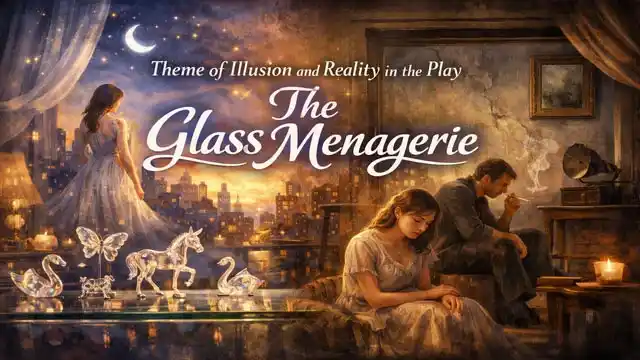
Set in the backdrop of economic struggle and personal frustration, the characters—Tom, Amanda, and Laura—each retreat into their own illusions to cope with reality. Amanda clings to memories of her glamorous past, Laura withdraws into her collection of glass animals, and Tom escapes through dreams of adventure and poetry. These illusions serve as a temporary refuge but ultimately prevent them from confronting the truth of their lives.
Through this contrast, Williams highlights how illusion can provide emotional protection but also lead to stagnation and disillusionment. The play suggests that while reality may be painful, avoiding it entirely can result in deeper suffering. Thus, the tension between illusion and reality becomes a powerful lens through which the audience understands the characters’ inner conflicts and the tragic beauty of their lives.
Williams’ ‘The Glass Menagerie’ consists of four characters: Amanda, the mother; Tom, the son; Laura, the daughter; and Jim, the gentleman caller. All the four characters are victims of their illusions. Their illusions are strong enough to shadow their reality.
Amanda, the mother:
Amanda, the mother is the most aged and therefore ought to be the most mature of them also. Her experience of life ought to have make her realistic. But she always remains lost in the sweet memory of her Blue Mountain days when she was young, attractive and aspired by many. Amanda tells that she lived in Blue Mountain when she was young. A number of young men were mad after her. They used to visit her at home to win her favour. She claims that one Sunday seventeen callers visited her at afternoon. To provide them seats folding chairs were brought from outside. Yet the gentlemen were happy for they had got an opportunity to be with her. She hopes her daughter Laura too should have so many young callers but unfortunately none visits her. Amanda’s such boastful narrations only strengthen Laura’s sense of inferiority. She feels no young man will ever like her. She grows self-centered and passes her time in a collection of glass animals.
It is Amanda’s mistake that in place of encouraging her daughter Laura and helping her in getting rid of her inferiority complex, she tells such things that affect Laura’s psychology adversely. Now Laura regards herself as unattractive, unworthy and unfortunate.
One Sunday afternoon in Blue Mountain—your mother received— seventeen! —gentlemen callers! Why, sometimes there weren’t chairs enough to accommodate then all. We had to send the nigger over to bring in folding chairs from the parish house.
It is her illusion that a well decorated house may impress the gentleman caller enough to marry Laura. Tom pleases his mother Amanda by telling that a gentleman caller is invited at dinner. He will come to their residence tomorrow. It surprises Tom that Amanda rebukes him for giving no time for preparation. Amanda rebukes Tom for his lack of common sense. Before asking a gentleman caller to dinner he should have given her sometime for preparation. She points out that the whole house is dirty enough to look like a pigsty. Besides all the ornaments are due to be polished. She feels all the table clothes too require washing. She thinks for changing all the curtains. and windows should be washed. Amanda’s demands have no bounds. She feels requirement of new dresses also. It seems she is flying in the sky of imagination like a bird having forgotten her economic limits. But she should not be accused for it is like fulfilment of her dream.
“You just don’t know. We can’t have a gentleman caller in a pigsty! All my wedding silver has to be polished, the monogramned table linen ought to be laundered! The windows have to be washed and fresh curtains put up. And how about clothes? We have to wear something, don’t we?”
She puts on a bright yellow dress under the illusion that Jim, the gentleman caller is coming to meet her instead of Laura. She speaks to him as a young girl rather than a middle-aged mother.
Tom, the Son:
Tom has his illusions. He thinks he is made for adventures. Tom says that so often he wishes to take opium to forget all. He wishes to visit opium centres where criminals gather. He tells that he has joined the Hogan gang. Now he acts for a hired criminal. In a violin case he carries a tommy gun. He runs a gang and people call him Killer Wingfield. In fact, he is leading a double life. Apparently, he is a gentleman but secretly he belongs to the underworld. He lives in disguise among criminals. He wears a patch on one eye and a false moustache. So often he wears green whiskers also. People call him El Diablo!
“Oh, I culd tell you things to make you sleepless! My enemies plan to dynamite this place. They’re going to blow us all sky-high some night! I’ll be glad, very happy, and so will you! You’ll go up, up on a broomstick, over Blue Mountain wit seventeen gentlemen callers! You ugly-babbling old-witch.”
Tom surprises Jim by saying that he wishes to be a wanderer. He wishes to visit distant places. In this matter he is like his father. Sixteen years ago, he left his family a young wife with two little children to have fun at the sea. The adventures engaged him so greatly that he never wished to come back to see his family and know how in his absence his family has been suffering for all these years. Tom claims that he is like his father with this difference that he does not wish to leave behind a family waiting for him. He intends to proceed just after his sister Laura’s marriage.
“I’m like my father. The bastard son of a bastard! See how he grins? And he’s been absent going on sixteen years!”
Movies are a vital means to avoid reality to be lost in an illusion. Tom tells his mother that every man has some instincts and he wishes to satisfy them. If in real world these instincts are not getting opportunity to be satisfied, the man makes indirect attempts. He satisfies them in the world of imagination. Dreams are a better part of that but movies too work for that. For a moment the person forgets his bitter reality. His mind is transported to the unreal world present on the screen. He identifies himself with thosc characters. Every man has instinct to be a lover, a hunter, a fighter and in movies these instincts are satisfied. Only this is the difference that the person sits idle in a seat and on the screen the hero appears doing all these activities impressively.
Jim O’Connor, the gentleman caller:
Jim is lost in illusions. He was brilliant as a student in High School but now he is an ordinary clerk like Tom. He dreams of becoming something special by completing a course in public speaking. His illusion is the American dream. Jim asks Laura to get rid of her inferiority complex. She underrates herself and fails to recognize her merit. She has lost confidence in herself. Jim claims that he has confidence. He points out that in reality he was not fit for public speaking but he worked hard to remove imperfections. He developed his voice. He had aptitude for science. He turned that to public speaking by making everything short, simple, clear and to the point. Now these things have become his qualities.
“Inferiority complex! Know what that is? That’s what they call it when someone low rates himself! I understand it because I had it too. Although my case was not so aggravated as yours seems to be. I had it until I took up public speaking, developed my voice and learned that I had an aptitude for science.”
Jim asks Laura to see the truth. All those who look successful have not one-tenth of her qualities but they have confidence. They have got success in getting rid of their weaknesses. Like Laura they have not grown self-centered. Everybody has some qualities. It is wisdom to develop them and turn into practical virtues. He gives his own example. As a student he was like her. As an employee he is like Tom but on account of his efforts he is going to be much higher than so many like him.
“Which of them has one-tenth of your good points! Or mine? Or anyone else’s, as far as that goes-Gosh. Everybody excels in some one thing. Some in many. All you’ve got to do is discover in what! Take me for instance.”
Laura, the Daughter:
Laura is always lost in her illusions created on base of her glass menagerie consisting of little glass animals. Amanda attracts Tom’s attention to Laura’s misery by pointing out Laura’s strange behaviour. A young girl like her ought to have a happy company of boys and girls. She ought to have parties to attend, letters to respond and novels to read. But quite contrary to it she speaks to no body and has no friend to talk to her. She is self-centered and takes delight in toys of glass and plays with her old records. This sort of life will make her insane. In fact, it is her sense of inferiority that obstructs her free conversation with others. She can’t have a boyfriend to propose. It is now Tom’s duty to settle Laura’s marriage by finding out a proper young man.
“She spoke to nobody; nobody spoke to her. Now all she does is fool with those pieces of glass and play those worn out records. What kind of a life is that for a girl to lead?”
Sense of Reality:
It is true that illusion dominates but reality does not disappear for ever for them. Amanda is conscious of reality when she accounts for the miserable condition of unmarried women. Amanda tells Laura that marriage is a blessing to every girl for unmarried woman lead a miserable life. She has seen such cases in South. Such women have to regard someone as their guardian. Among the nearest and the dearest they have either their own brothers or sister’s husbands. With the passing of time the warmth of natural affection is lost. The brother-in-law or the sister-in-law begin to regard such women as a burden on them. They have lived like dependents. They are confined to a little room. They are asked to visit other relations also. They are reduced to the position of a bird without nest. They are insulted everywhere.
I have seen such pitiful cases in the South—barely tolerated spinsters living upon the grudging patronage of sister’s husband or brother’s wife! —stuck away in some little mouse trap of a room—encouraged by one in law to visit another—little bird like women without any nest—eating the crust of humility all their life!
Her advice to Laura is quite realistic when she inspires her for self- improvement. Amanda points out an important fact to Laura that people pay attention to others’ defects only when they do not find any attraction in them. Otherwise, nobody has time for that. If unfortunately, a person has a defect he should never think that he can’t make any progress or impress other people. Such a person ought to develop other qualities to that great extent that everybody will feel pleasure in admiring those qualities. It is true Laura suffers from a slight deformity. One leg is shorter than the other. But it does not mean she is cursed forever. She should try to make her personality charming by talking in a lively manner and attending others impressively. Amanda tells Laura that her father had these qualities so greatly that none was able to ignore him.
When people have some slight disadvantage like that, they cultivate other things to make up for it—develop charm-and vivacity—and charm! that’s all you have to do!……One thing your father had plenty of-was charm!
Laura too recognizes reality at the end of the play.
