Introduction:
Gabriel Okara as a poet stands as one of the pioneering voices in modern African poetry, celebrated for his unique fusion of indigenous African sensibilities with Western literary techniques. As a poet, Okara is best known for his deep engagement with themes such as cultural identity, colonialism, tradition versus modernity, and the spiritual dimensions of life and death. His work reflects a conscious effort to preserve and project African thought patterns, often translating the rhythms and structures of his native Ijaw language into English.
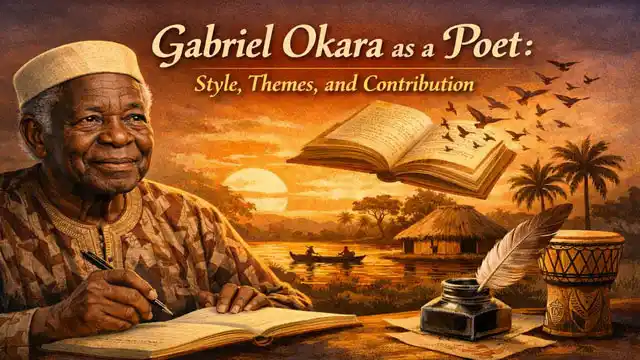
Okara’s poetry is marked by simplicity of language yet profound depth of meaning, enabling him to communicate complex emotional and philosophical ideas with clarity and elegance. He is particularly admired for his experimentation with language, where he adapts English to suit African modes of expression, thereby creating a distinctive poetic voice. Through his lyrical compositions, Okara not only portrays the conflicts arising from colonial influence but also celebrates the richness of African culture and worldview, establishing himself as a significant figure in postcolonial literature.
Gabriel Okara’s Poetic Scope, Influences, and Cultural Rootedness:
Gabriel Okara’s overall poetic output, while distinguished, is far from being voluminous or prodigious. Yet within his relatively small lyrical corpus, he has been able to address diverse poetic themes encompassing a celebration of the indigenous African culture, colonialism, war, and death. Okara, perhaps more than any other African poet, explores such a wide diversity of poetic themes against backdrop of a relatively slim lyrical structure. Okara belongs to the group of poets who are generally categorised as the ‘modern African poets’. Okara’s writing has echoes of William Blake, Gerard Manley Hopkins, Dylan Thomas, Alfred Lord Tennyson, and Robert Brooks. But of profound importance in his work is the preponderant employment of cultural and traditional images, some of which celebrate the virtues of the indigenous lores and customs of his African fatherland. Examples of Okara’s lyrics which focus on the theme of the indigenous African cultural values include The Calf of the River Nun, The Mystic Drum and The Fisherman’s Invocation. All of these poems have not only been widely antholised. but they have also been among the most famous and celebrated of Okara’s aesthetic corpus. Of course, Okara has always recognised the significance of his cultural roots and connections including the African language.
The Call of the River Nun: Symbolism of Life, Memory, and Destiny:
The Call of the River Nun, which won for Okara the Nigerian Festival of Arts Award in 1953, has its setting at the Udi Hills of Enugu. The poet’s mind radiates between the joys of youthful experience, symbolised by the River Nun, vis – a – vis the cascades and uncertainties of life, symbolised by the ‘upturned canoe’. For the poet, there is joy and fulfilment in his earlier, youthful life where the River Nun offers hallowed reminiscences. As the poet muses and reflects on the events of his current human situation and possibly the future, he has a foreboding sense of life’s insecurities. The employment of the words, ‘span’ and ‘ghost’, suggests diverse images of life and decay— the ups and downs of life—which all humans must experience during their mortal existence. This quality endorses the poem with a sense of universality. There are other interesting images about the poem. The imagery inherent in the word ‘River’ is illuminating it echoes all of the rituals and nuances commonly associated with cleansing, libations, mystification and purification, especially in the traditional African cultural setting. The word ‘call, as employed in the poem, is also important: it confines images of a clarion call to duty or responsibility and of a total submission to the elemental forces of nature, as dictated by God, or as sanctioned by the requirements of traditions and customs of the local culture. Consequently, there is a tone of apprehension. humility and submission in the poem. Finally, the imagery of the canoe plying precariously and precipitously through the river terrain, definitely suggests the contours of the vagaries of life from infancy, to adulthood, and then ultimately through death.
The Refrain and Inevitability of the River’s Call:
” I hear your call
I hear it far away;
I hear it break the circle
………………………….
I hear your lapping call
I hear it coming through.”
Existential Surrender and Universal Imagery in the Poem:
The persistent refrain inherent in above lines suggests the immediacy of the river’s call which must be promptly obeyed without hesitation or equivocation. Indeed, the river’s call is irresistible, more so as the river itself survives all humanity which, by its very nature, is mortal and ephemeral. A sense of man’s complete surrender to the ineluctable forces of nature— as symbolised by the torrential river— permeates the concluding part of the poem:
“My river’s calling too!
Its ceaseless flow impels
my foundering canoe down
its inevitable course
And each dying year
brings near the sea – bird call,
the final call that
stills the crested waves
and breaks in two the curtain
of silence of my upturned canoe
O incomprehensible God!
Shall my pilot be
my inborn stars to that
final call to Thee
O my river’s complex course? “
Archetypal Metaphors and Personalised Expression:
There are many interesting things about the lines above. First, the river serves as a nexus through which the poet gleans or perceives his own life. Further, the repetitive use of exclamation marks, symbolised by ‘O’ and ‘my’, not only personalise the poet’s experience, but it enhances the indigenous vistas and the traditionalism which the poem embodies. Finally, the poem’s archetypal metaphors— suggested by the ‘dying years’, the river’s ‘ceaseless flow’, the ‘inborn stars’, and the ‘river’s complex course’—certainly contribute to the poem’s existential continuum and paradoxes.
The Mystic Drum: Cultural Mysticism and Symbolic Imagery:
The Mystic Drum presents images of a ritualistic culture where, for example, ghosts, spirits, the dead ancestors, the natural and the supernatural, commingle and intermingle. There is, in this poem, a poignant dramatization of a bizarre world order where cultural images and symbols— including folktales, song and dance, myths and lullabies— predominate on a continuum. The poem’s title, especially the word ‘mystic’, easily suggests the poem’s cultural orientation. So also are the images contained in the ‘drum’, a traditional musical instrument; the tree, is, a symbol of where and when offerings are conducted; ‘the fishes’ and ‘the river god’ are traditionally objects of religious and fetish worship. Collectively, all of these images not only enhance the poem’s cultural base, but they energise its lyricism.
Narrative Style and Dramatic Effects in The Mystic Drum:
In terms of style, the poem is a narrative, in which Okara recalls the mysticism of the indigenous drum and the profound effect which it has on him. Further, the poem contains the employment of supernatural and spiritual object and phenomena (like the ‘roots sprouting from her feet and leaves growing on her head’); there is also the use of repetition as a refrain (like the expression. ‘But standing behind a tree’ which is repeated thrice, as is the expression, ‘she only smiled with a shake of her head’). All of these aesthetic images and metaphors add colour and intensity to the poem’s dramatic effect.
The Fisherman’s Invocation: Metaphysical Depth and Critical Debate:
Although The Fisherman’s Invocation has been unfairly criticised, it is one of Okara’s best and most successful poems. The poem is metaphysical in its imagery and it challenges the sophisticated reader to skin deeper than the mere surface interpretation in order to comprehend its full range of meaning. Some of the reasons for the criticism has to do with poet’s so – called aloofness, the poem’s turgidity and its illogical lyrical structure. In this poem, Okara unfolds the ancient mystery surrounding the Ijaw cultural mythos of the Back and the Front, with the former symbolising the various past while the latter symbolises contemporary doubts and cynicism. All the criticisms leveled against The Fisherman’s Invocation are, indeed, unconvincing. Firstly, the poet has the obligation to address issues and concerns in consonance with the dictates of his inner conscience and convictions in order to lend credibility and authenticity to his work. Secondly, the so – called turgidity of the poem’s diction, no less than the aloofness and ‘anonymity’ of the poet— even if they exist— tie in with T. S. Eliot’s principle of the ‘impersonality’ of the poet. Finally, the poet, more than anyone else, has the unique obligation to discuss the indigenous matrix of his own people and their culture as he considers appropriate.
Colonialism and African Poetic Response:
Colonialism swept through the African continent like a wild hurricane which could hardly be stopped or contained. Being the brain – child of the ‘Scramble for Africa’ of 1884, of which many European countries participated, including Britain, France, Germany, Spain, Italy, Portugal, and Belgium, colonialism led to the exploitation of Africa both materially and in human terms. Consequently, several African poets reacted swiftly to European colonialism in what they perceived as an ugly phenomenon: some scurrilously, some mildly, while others shared a via media Okara belongs to the second category of these poets. Okara’s poetry which satirises European colonialism includes Piano and Drums and The Snowflakes Sail Gently Down. In Piano and Drums, Okara praises the indigenous African culture, while railing against the European civilization through the imagery of the word ‘piano’ (as contrasted with ‘drum’).
Piano and Drums: Contrast Between African Tradition and Western Civilization:
“When at break of day at a riverside
I hear jungle drums telegraphing
the mystic rhythm, urgent, raw
like bleeding flesh, speaking of
primal youth and the beginning,
I see the panther ready to pounce,
The leopard snarling about to leap
and the hunter crouch with spears poised;
And my blood ripples, turns torrent,
topples the years and at once I’m
in my mother’s laps a suckling:
at once I’m walking simple
paths with no innovations,
rugged, fashioned with the naked
warmth of hurrying feet and groping hearts
in green leaves and wild flowers pulsing
Then I hear a wailing piano
solo speaking of complex ways
in fear – furrowed concerto;
of faraway lands
and new horizons with
coaxing diminuendo, counter point,
crescendo. But lost in labyrinth
of its complexities, it ends in the middle
of a phrase at a dagger point.
And I lost in the morning mist
of an age at a riverside keep
wandering in the mystic rhythm
of jungle drums and the concerto.
Imagery of Indigenous Culture in Piano and Drums:
In the above poem, Okara employs specific images to characterise the indigenous African culture and their impact on his psychological consciousness. These images include the ‘jungle drums’, ‘telegraphing’, ‘mystic rhyth’ and the ‘primal youth and the beginning’. Others are the ‘panther’, the ‘leopard’, the ‘hunter crouch’ and the ‘spears poised’. In the traditional African cultural setting, the drums are used for music and dancing and for celebrations and festivities. They are also employed for communication purposes as well as for special announcement of events, whether sad or joyful. The images, ‘telegraphing’, ‘mystic drums’ and the ‘primal youth and the beginning’ — all echo the simplicity or the ethereal quality traditionally associated with the agrarian African cultural setting. Further, the animal vis – a – vis the hunting images suggested by the leopard, the panther, the hunter, and the spears poised leave no one in doubt as to Okara’s profound fascination with his African cultural background setting. In contrast to the indigenous African culture, is Okara’s depiction of western colonialism, symbolised by the word ‘piano’, a musical instrument whose mystic phenomenon is suggested by ‘complex ways’, ‘fear – furrowed concerto’ and the ‘labyrinth’. These images collectively capture the hopelessness and the sense of indirection which the piano and, by implication, the Western Civilization symbolises.
Symbolism of ‘Wailing Piano’ and Critique of Colonialism:
Of particularly importance to a thorough understanding of the poem’s thematic structure is the poet’s deliberate employment of the word, ‘wailing’, to describe the piano. Wailing connotes an unpleasant, irritating and annoying or plaintive cry. The deliberate employment of the word ‘wailing’ not only suggests the unacceptability of western colonialism, but also highlights its crudity as well. Without the employment of this word, the tone of the indigenous African cultural setting and by implication, that of European colonialism, would have been viewed on an equal basis or pari passer. Also of importance are the haunting classical metaphors of the ‘dagger point’ and the ‘coaxing diminuendo, counter point / crescendo’ which are suggestive of a world ruined by confusion, violence, chaos, plunder and exploitation. Just as the first two stanzas of the poem celebrate the virtues associated with the domestic drums, so also do the last two stanzas highlight the pernicious effects of the piano and, by implication, European colonialism and imperialism.
The Snowflakes Sail Gently Down: Strident Anti-Colonial Imagery:
Okara’s castigation of western colonialism in The Snow – flakes Sail Gently Down is more strident and scurrilous than in Piano and Drums. In this poem, a very damning imagery—which centres on how the colonialist predators are destroyed in their exploitative behaviour— is employed to highlight the ironic contrast between the indigenous African culture and the western adventurism:
“Then I dreamed a dream
in my dead sleep. But I dreamed
not of earth dying and elms a vigil
keeping. I dreamed of birds, black
birds flying in my inside nesting
and hatching on oil palms bearing suns
for fruits and with roots denting the
uprooter’s spades. And I dreamed the
uprooters tired and limp, leaning on my roots—
their abandoned roots—
and the oil palms gave them each a sun.
But on their palms
they balanced the blinding orbs
and frowned with schism on their
brows— for the sun reached not
the brightness of gold!”
Philosophical Vision and End of Colonialism:
The images— ‘denting the / uprooter’s spades’, the ‘uprooters tired and limp’, ‘their abandoned roots’, ‘frowned with schism on their / brows’, and the ‘sun reached not / the brightness of gold’ —accurately illustrate the failure of the western colonialist adventure. In this poem, Okara, much like Blake in The Chimney Sweeper, is a philosophical poet who foresees a future state where colonialism and its vestiges will forever be cast into the dismal bit of oblivion.
War Poetry: Context of the Nigeria-Biafra Civil War:
Although Okara did not participate in the armed military fighting during the Nigeria / Biafra Civil War, he did have deep sympathies for the Biafran cause partly because of the circumstances of the period. Consequently, he wrote about the war both to castigate it as well as to highlight the evil phenomenon which war engenders. Okara’s poetry which discusses the war and its aftermath includes Suddenly the Air Cracks and Moon in the Bucket.
Suddenly the Air Cracks: Horrors of War and Destruction:
Suddenly the Air Cracks runs through seven stanzas of unequal lengths. The poem is descriptive, and the events described in the narrative center on the military bombardment of an un-named city from all directions, with all kinds of assault weapons fully deployed: LMGs jets, rockets, etc. The catastrophe unleashed on the populace, including ‘children’, ‘men and women’, ‘boys and girls’ is indescribable: everything is awash with violence, and with twittering and ‘cracking sound’, so much so that there is no- where to hide.
Poetic Techniques and Restoration of Peace:
The poem’s narrative structure is swift and urgent, with very little use of punctuation marks, but it is suffused with extensive employment of figurative language e.g., repetition, as in ‘blaming gunners / praising gunners’, onomatopoeia, as in the ‘air cracks / with striking cracking rockets’, alliteration, as in ‘bullets flashing fire’; and assonance, as in ‘ack – ack flacks’ and ‘hugging gutters. The political landscape is crisis – laden with ‘mangled / bodies stacked in the morgue. Yet the poet, through his deft artistry, is able to counterbalance the structural narrative so effectively that peace and harmony prevail in the end.
Hope and Didactic Message After War:
“Things soon simmer to normal
hum and rhythm as danger passes
and the streets are peopled
with strolling men and women
boys and girls on various errands
walking talking laughing smiling.”
War’s Aftermath and Universal Human Bond:
The poem’s didacticism is apparent after rainfall comes sunshine and vice versa. The Nigerian Civil War, which lasted for almost three years (1967-70), wreaked so much havoc in humans, material resources and goodwill that brothers turned against their brothers, sons against their parents and so forth. This is the perennial truism about war. However, time and space heal wounds. Prophetically, today, there is peace and concord among all and sundry in the land. Without the above redeeming lines, the poem would have lost much of its vitality and greatness. Furthermore, by bringing together all of humanity during a time of crisis — that is, children, men and women, boys and girls – the poet brings into our consciousness our common bond and destiny.
Moon in the Bucket: Symbolism of Peace Versus Conflict:
The lyric, Moon in the Bucket, re – enacts the perennial theme that war does no good, nor is it a respecter of people, places and things. The repetitive employment of the word ‘look’, which features six times in the poem, not only suggests the poet’s aversion to war, but it shows his growing sense of doubt and apprehension at the looming approach of war:
“Look!
Look out there
in the bucket
the rusty bucket
with water unclean
Look
A huminous plate is floating—
The moon dancing to the gentle night wind
Look! All you who shout across the wall
with a million hates. Look at the dancing moon
It is peace unsoiled by the murk
and dirt of this bucket war.”
Symbolism of Moon and Bucket:
Other images of the poem which illustrate the problems afflicting the nation include the ‘murk’, the ‘dirt’, the ‘rusty bucket’ and the ‘water unclean’. Indeed, the reference, ‘a million hates’, suggests that the cause of the war could range from anything to everything, including corruption, nepotism, ethnicity, tribalism, greed and illiteracy— the same socio – political reality which is afflicting Nigeria today. The poem’s two principal images are the moon, which is an object of love and harmony; and the ‘bucket’, which ordinarily is an object for collecting or preserving water, but when qualified by the adjective ‘rusty’ it connotes disaster or futility. In this poem Okara is exhorting his countrymen to focus on the good things which unite them, as symbolised by the moon, and not on the negative ones that divide people, as suggested by the ‘rusty bucket’ and the water unclean.
Allusion and Call for National Unity:
The allusion, ‘a million hates’, is interesting. It suggests the fact that the problems confronting the country could range from anything to everything, including corruption, greed, nepotism, tribalism, hypocrisy, ethnicity, and illiteracy. Also interesting is the employment of the word ‘wall’, which recalls Robert Frost’s poem Mending Wall, where the metaphor suggests the barrier which destroys good neighbourliness, or the obstacle which militate against human understanding and communication. In other words, Okara, in this poem, is urging his countrymen to be spirited or be guided by those enabling qualities which promote the spirit of unity, peace, love, courage, human understanding, and patriotism.
Theme of Death in Okara’s Poetry:
Okara’s verse which discusses the theme of death includes New Year’s Eve Midnight, One Night at Victoria Beach and The Snow-flakes Sail Gently Down. In these lyrics Okara demonstrates the fact that all things in nature— including animate and inanimate objects— are subject to the forces of time or mutability. The poem, New Year’s Eve Midnight, which recalls Dr. Samuel Johnson’s The Vanity of Human Wishes, discusses how each dying year ushers in a new season of hope and optimism, but which soon degenerates into a period imperiled by inexplicable human failure or despondency.
“Now the bells are tolling—
A year is dead.
And my heart is slowing beating
the Nunc Dimittis
to all my hopes and mute
yearnings of a year
and ghosts hover round
dream beyond dream.
Dream beyond dream
Mingling with the dying
Bell-sounds fading
into memories
like rain drops
falling into a river.
And now the bells are chiming—
A year is born.
And my heart-bell is ringing
In a dawn.
But it’s shrouded things I see
dimly stride
on heart-canopied paths
to a riverside.”
Death Motif and Imagery in the Poem:
Several images highlight the death motif of this poem, including ‘tolling bell’, ‘Nunc Dimittis’, the ‘dying bell sounds fading’, the ‘bells are chiming’, and the ‘heart canopied paths’. In employing these images Okara not only seeks to highlight the sinuous ways through which death comes about, he also illustrates one mysterious phenomenon of death. The death motif which Okara exploits in the last two poems is different from the death theme which he discusses in Suddenly the Air Cracks and The Moon in the Bucket. While in the first two poems death comes unexpectedly and tempestuously through a violent military confrontation, in New Year Eve’s Midnight we are presented with an ineluctable phenomenon of death. The poem’s first two stanzas echo an ominous note of despair, death or decay. There is a sense of sadness, sorrow, and ennui as things seem to move vertically and horizontally, in a kind of ‘steep and blunge’, where ‘ghosts’, ‘hopes’, ‘dream’ and ‘memories’ play themselves out intermittently and interchangeably. And in the poem’s last stanza, we have a mixture of life and death, with each stirring humanity squarely in the face. For life, we have images of a ‘year is born’, the ‘dawn’ and the ‘bells are chiming’, for death, we have images of ‘shrouded’, ‘dimly stride’ and the ‘heart canopied paths’— images which collectively dramatise the vagaries of life and the inevitability of death.
Poetic Strategies and Exploration of Death:
Okara employs diverse poetic strategies to illuminate the complex phenomenon of death for example, through his employment of metaphor, as when death and life are seen as a river which forms the nexus of human experience; and through use of Biblical allusions, as when he speaks of the ‘Nunc Dimittis’, which is associated with Simeon in the Christian liturgy (Luke 11.29. 32). The death motif is explored further in One Night at Victoria Beach, where animate and inanimate objects— including the ‘Aladuras’ the ‘dead fishermen long dead with bones rolling’ and the ‘four dead cowries shining, like stars’— hobnob with one another in the unending circle of life and death.
” They pray, the Aladuras pray
to what only hearts can see while dead
fishermen long dead with bones rolling
nibbled clean by nibbling fishes, follow
four dead cowries shining stars,
into deep sea where fishes sit in judgements;
and living fishermen in dark huts
sit around dim lights with Babalawo
throwing their souls in four cowries
on sand, trying to see tomorrow.
Still, they pray, the Aladuras pray
to what only hearts can see behind
the curling waves and the sea, the stars
and the subduing unanimity of the sky
and their white bones beneath the sand
And standing dead on dead sands
I felt my knees touch living sands-
But the rushing wind killed the budding words.”
Okara’s Thematic Range and Cultural Vision:
Ultimately it can be concluded about Okara and his poetic art that he explores a wide panorama of poetic themes, including the celebration of the indigenous African culture, colonialism. war and death. Okara’s treatment of the indigenous theme shows his sense of love and reverence for his people, no less than his sense of nostalgia and rootedness in what he considers germane or appropriate for his physical and psychological well – being. Okara’s treatment of the theme of wester colonialism, on the other hand, is characterised by a feeling of regret and disappointment, especially by what he perceives as European exploitation of Africa and its people. For example, while he appreciates the beauty and the virtue of the ‘drums’, symbol of the indigenous African culture, he resents the discordant tone of the ‘wailing piano’, symbol of western colonialism and imperialism.
Okara’s View on War and Its Devastation:
For Okara, military confrontation is cataclysmic and unacceptable. For this reason, he sees nothing good but resentment and condemnation for the atrocities which war brings to organised society. Consequently, images like ‘rusty’, the ‘water unclean’, the ‘air cracks’, the ‘thick black smoke’, and the ‘mangle / bodies stacked in the morgue’ are employed to characterise the unfortunate phenomenon of war.
Treatment of Death and Poetic Techniques:
In his treatment of the theme of death, Okara shows vividly that there is nothing that strikes fear in the human heart than the thought of death. Death is no respecter of people, places, and things (whether animate or inanimate). Consequently, in his treatment of this theme, he demonstrates a sense of poignancy, restraint, and compassion. The beauty of all of the above is the fact that Okara is able to employ diverse aesthetic skills— including alliteration, assonance, repetition, and Biblical allusions— in order to bring his message pointedly home.
