Summary of the Poem “Stopping by Woods on A Snowy Evening”:
Introduction
The poem “Stopping by Woods on a Snowy Evening” has been composed by Robert Frost. In this work, the poet beautifully describes a personal experience of halting during a snowy evening journey. Through simple yet profound imagery, Frost presents the allure of nature, the sense of responsibility, and the deeper reflection on life.
The Poet’s Halt in the Woods
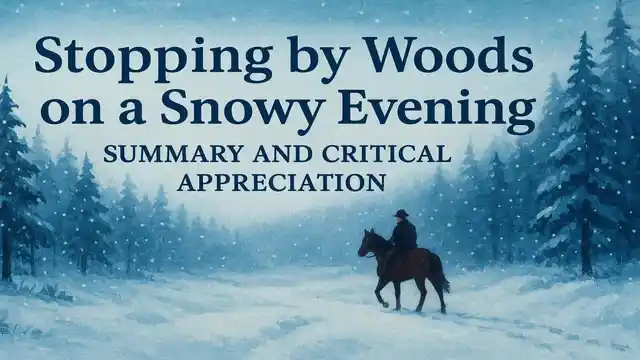
The poet narrates how, while riding his small horse, he suddenly stopped beside a forest. The enchanting sight of the snow-covered woods compelled him to pause and admire the scene. He knew the owner of the woods, but since the man lived in the village, he was unaware of the poet’s presence and his quiet admiration of the falling snow upon the trees.
The Horse’s Reaction
Soon, the poet’s attention shifts to his little horse. The animal seemed uneasy, breathing heavily, and perhaps wondering why they had stopped in such a lonely spot with no farmhouse nearby. The place lay between the woods and a frozen lake, and it was the darkest evening of winter. The horse shook his harness bells, as if questioning his master’s unusual decision to stop there.
Silence of the Scene
Apart from the gentle jingling of the bells, only two sounds disturbed the silence of the night—the soft gusts of wind and the faint, delicate fall of snowflakes. This heightened the sense of stillness, solitude, and calm beauty that surrounded the poet.
The Poet’s Reflection
In the final stanza, Frost expresses his deep inner feelings. The woods, with their dark, deep, and mysterious charm, held a strong attraction for him, and he longed to linger there. Yet, he was soon reminded of his duties and responsibilities that awaited him before rest. Repeating the thought of having “miles to go” before sleep, the poet conveys that life is full of obligations to be fulfilled before the final rest—death.
Critical Appreciation of the Poem “Stopping by Woods on A Snowy Evening”:
Introduction:
On a close and thoughtful reading, Robert Frost’s “Stopping by Woods on a Snowy Evening” emerges as one of his most touching and melodious lyrics. This poem has often been compared with John Milton’s sonnet “On His Blindness” and Matthew Arnold’s “Dover Beach” because of its philosophical undertones. Considered not only among Frost’s finest works but also as one of the greatest lyrics of the twentieth century, it continues to inspire generations of readers. In particular, the last four lines encapsulate Frost’s philosophy of life and have become timeless in their appeal.
As a Simple Lyric:
On the surface, this poem appears to be a simple lyric, composed by a master craftsman of modern American poetry. The narrative describes an apparently ordinary moment: the poet pauses by a snow-covered wood while riding on a winter evening. The scene is tranquil, silent, and enchanting, with falling snow adding to the charm of the woods. The poet wishes to linger longer but is reminded of his duties and obligations, and so he continues his journey. In this way, the lyric conveys a simple experience of beauty tempered by responsibility.
Yet, when read more seriously, the poem reveals a deeper truth. Human beings are often torn between the allure of rest, peace, or escape and the demands of promises and responsibilities. This tension is beautifully expressed in the final stanza, whose lines hold a universal significance:
“The woods are lovely, dark and deep.
But I have promises to keep,
And miles to go before I sleep.
And miles to go before I sleep.”
As a Symbolic Poem:
As we study this poem ‘Stopping by Woods on a Snowy Evening’ we find that it is regarded as a significant symbolic poem. The poet translates his own experiences of real life into the lines of this poem. He does so with the purpose of his own satisfaction as well as for the benefit of his readers. The last stanza of the poem is a clear – cut message not only to his ownself as well as to his devoted readers. As he wants to complete his daily work before going to sleep in his bed, so he also wants to complete all his unfinished work before he dies. The idea of sleep merges with the last sleep, or death. The richness and the deep significance of this lyric show the use of clear – cut symbolism.
Austin Warren admires his ‘natural symbolism’ in these significant words, “Sleep darkness and snow suggest death and the woods suggest, ‘perilous enchantment’.” In this way the symbols used by the poet explain each other. For example, the beautiful scenes of the woods are in contrast with the promises, or duties which he has made to himself as well as to others. In the last lines, he says that he can sleep only after finishing his that work which is still undone. In short, he is not ready even to die before completing his undone work, or promises. His technique of using symbolism is really unique.
The Poet’s Superb Style:
As we go through the present poem we come across his unique style and superb craftsmanship in a large and effective manner. His art is well known for his condensed expression in the rich composition of his lyrics. It is true that his symbolistic expression is not only superb but it is highly excellent. His art is also very clear from his simple language and fine versification. His expression is pure melody and sweet music. He makes use of his rhymes in an accurate and impressive manner. The concluding lines of this poem show the fine use of rhyme. It is for the unique style and superb craftsmanship that Robert Frost is very well remembered as a great poet of America.
The Poet’s Message:
After making a close study of the present poem along with its impartial analysis, it can be said that the poet gives a clear and useful message to his readers. As he himself does not want to sleep without completing his unfinished work. He also wants to keep his those promises which he has made to others. The same message is given to the readers by the poet. He advises his readers that they should also complete their all work before they sleep. In short, it is the advice of the poet that all promises should be kept before death.
In this respect, the last four lines are given below as a useful message to all persons.
“The woods are lovely, dark and deep,
But I have promises to keep,
And miles to go before I sleep,
And miles to go before I sleep.”
Conclusion:
In conclusion, Frost’s “Stopping by Woods on a Snowy Evening” is remarkable both for its simple narrative and its profound symbolic meaning. On one level, it portrays a horseman pausing on a wintry evening, entranced by the woods. On another, it reflects the universal truth that duties and promises must be fulfilled before one departs from the world. The beauty of the poem lies in this blend of simplicity and depth. The last four lines, often quoted, stand as a reminder to every reader: before embracing rest or death, one must keep one’s promises and complete life’s journey.
