Introduction “The Priest’s Son”:
“The Priest’s Son” is a short, vivid, and ironic poem by Arun Kolatkar, one of India’s most distinctive modern poets known for his sharp observations, minimalist style, and blending of the sacred with the ordinary. The poem appears in his acclaimed collection Jejuri (1976), a series of poems centered around the pilgrimage town of Jejuri in Maharashtra.
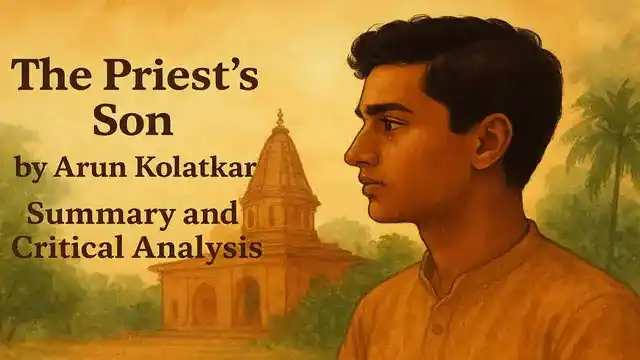
In this poem, Kolatkar presents a brief but striking portrait of a priest’s son, a boy who stands at the edge of religious tradition and modern disinterest. Through simple, conversational language and understated irony, the poet contrasts faith and indifference, ritual and curiosity, belief and alienation. The boy, despite being the son of a priest, treats the sacred temple space with casual familiarity—he seems more amused or detached than reverent.
Kolatkar uses this image to explore a larger theme found throughout Jejuri: the tension between spirituality and skepticism in modern India. The poem’s power lies in its restraint—few words evoke an entire world of decaying faith, changing times, and quiet rebellion against inherited beliefs.
Summary of the Poem “The Priest’s son”:
The Priest’s Son as a Guide:
The priest’s son takes the protagonist to the different places connected with the various legends about Khandoba and his deeds. There are five hills situated close to one another which the priest’s son describes as being the stone figures of five demons killed by Khandoba. The protagonist asks the young boy whether he really believes in the legend. The priest’s son has no reply to this question; he merely shrugs his shoulders and looks away. Then perceiving a moment in the grass, he says: “Look, there is a butterfly in the grass.” He thus cleverly tries to divert the attention of the protagonist and to evade the question the protagonist had asked.
Exposure of Blind Faith and Superstition:
Kolatkar here exposes the hollowness of the legends associated with Khandoba. The superstitious pilgrims from all over Maharashtra, who visit the temple at Jejuri, genuinely believe in the story of the five demons slain by Khandoba. It is doubtful whether the priest’s young son himself believes in the stories he doles out to credulous pilgrims, which explains why he tries to divert the attention of the protagonist on being asked about it.
Critical Analysis of the Poem “The Priest’s son”:
Introduction to the Poem and Its Central Character:
This poem depicts not the priest, who has been depicted in the poem entitled The Priest, but the priest’s son who is a young boy and who is often deputed by his father to take the tourists to different parts of the temple and to its environs and explain to them the significance of the various statues and of some of the hills.
The Priest’s Son as a Guide and the Legend of Khandoba:
In this poem, the priest’s son takes the protagonist to the different places connected with the various legends about Khandoba and his deeds. There are five hills, situated close to one another, which are described by the priest’s son to the protagonist as being the stone figures of the five demons whom Khandoba had killed. The protagonist asks the young fellow if he really believes that these hills are the stone figures of the five demons whom Khandoba had killed.
The Boy’s Evasion and Clever Distraction:
The priest’s son has no reply to this question and he , therefore , looks uncomfortable. He merely shrugs and looks away from the hills and away from the protagonist also. Then, perceiving a movement in the grass growing nearby, the young fellow says to the protagonist: “Look, there is a butterfly in the grass.” Thus the priest’s son is clever enough to think of a device by means of which he can try to divert the protagonist’s attention and to evade answering the question which the protagonist had asked.
Irony and Exposure of Blind Belief:
Here is another ironical poem in which the hollowness of the legends relating to god Khandoba has been exposed as being merely superstitions. Of course the Maharashtrian pilgrims, who visit Jejuri, genuinely believe that the statues in the temple there actually represent gods and deities; and, likewise, they sincerely believe in the five demons having been transformed into hills after having been murdered by Khandoba.
Rationalist Perspective of the Protagonist:
Actually, of course, the whole story of Khandoba is a fabrication from the point of view of a rationalist like the protagonist; and the protagonist has used his own method or device in giving expression to his scepticism and unbelief. In the poem before us, the priest’s son, who has been trained as a guide to take the tourists around the place, shows his cleverness by evading a question to which no sensible reply is possible.
The Priest’s Son’s Inner Conflict and Moral Dilemma:
In fact, the young fellow himself does not believe in the authenticity of the stories which are current about Khandoba. But, being the priest’s son, and being dependent for his livelihood on the credibility of the legends, he cannot deny the legends. And yet, being somewhat of a conscientious fellow, he cannot affirm the truth of those legends. That is the reason why he tries to divert the protagonist’s attention to a butterfly in the grass. It is certainly a most amusing poem, like most others in Jejuri.
