Introduction: Folk Theme in Sarojini Naidu’s Poetry:
The theme that Sarojini Naidu most distinctly made her own—where her voice is least imitative—is the folk theme. Its significance in her poetry is evident from the fact that two sections of her verse collections are titled “Folk Songs” and “Indian Folk Songs.” Moreover, traces of the folk spirit can be found throughout her other poems as well. Although the folk theme itself is not new—since India has a rich and ancient tradition of folk poetry—Sarojini gives it a fresh meaning and direction. In her folk-inspired verses, she successfully embodies the essence and charm of traditional folk poetry.
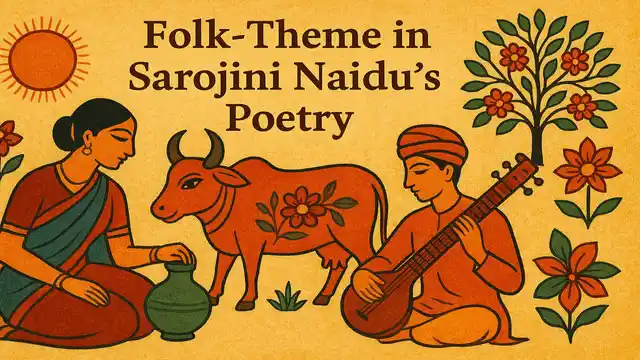
Vitality and Simplicity of Folk Inspiration:
The folk influence infuses Sarojini Naidu’s poetry with a natural vitality and freshness often absent in her more formal works. Her folk-lyrics are unpretentious and accessible, marked by a simplicity of language and imagery rooted in ordinary life. Through these vivid reflections of daily scenes and experiences, she conveys a deep sense of connection and unity with the rhythms of folk existence.
Depiction of Common Life and Folk Identity:
Through her folk poetry, she depicts the everyday life that surrounded her—life she personally witnessed and experienced—with its unique settings, events, people, and their occupations. In doing so, she forges an artistic unity with the life of her community, embracing its folk traditions and timeless wisdom passed down from generation to generation.
The Wandering Singers: Voice of the Folk Community:
For instance, “The Wandering Singers” is a lyric that captures the true spirit of India’s traditional bards—the wandering minstrels who sang for the people and of the people. These singers speak collectively, as voices of a community rather than as individuals, emphasising that in folk poetry it is the shared life and culture of a people that hold importance, not personal identity or character.
The wandering singers embody the truths of their communal existence—the unending cycle of birth, life, and death; the fundamental emotions of love and sorrow; and the customs of worship and courtship. Through their songs, we glimpse the rhythm of everyday folk life, and this authenticity draws readers into an emotional bond with their world.
They move from place to place singing, “All men are our kindred, the world is our home,” celebrating both joy and sorrow, simplicity and depth, as they follow the call of the wind. Their songs weave together the present with memories of the past, of its grandeur and heritage. Deeply rooted in the life of the common people, their music reflects an enduring tradition that has survived through the ages.
Thus, the charm of their song is timeless—and so too, we feel, is the folk poetry of Sarojini Naidu, whose verse captures this immortal spirit.
Depiction of Indian Festivals and Folk Rites:
A number of Sarojini’s folk poems, deal with common Indian festivals like Vasant Panchmi; The Festival of Serpents (Nagpanchmi); The Festival of Lights, The Festival of Sea, Nariyal Purnima, Raksha Bandhan, etc. Indian folk-culture is dominated by rituals and performance of collective rites, and these poems stress this aspect of folk-life. “Moreover, Indian festivals serve to link up the community life with the life of nature, there is rejuvenation both of the life of nature and of community life and this aspect is also stressed.
In The Festival of Serpents, as in many others poems on the folk-theme, Sarojini Naidu reveals a profound understanding of the meaning of Hindu festivals, which provide not only a kind of social catharsis but also an elevation of the individual consciousness. The principle of reality leads the folk-personality to a sense of structure and continuity in life.” The Festival of the Sea may rightly be called a litany of the sea, and it expresses complete identification of the fishermen with the sea which they address as their “Bountiful Mother”, and invoke her blessings.
Harmony of Hindu and Muslim Folk Traditions:
Despite the political polarization, and tension, between the Hindu and Islamic sides of the Indian personality there has always existed a synthesis and fusion of their religious and spiritual elements in the folk-culture. In rural India, the Hindus pay homage to Muslim saints, while the Muslims exchange gifts and benedictions with the Hindus on festive occasions. Steeped in the folk customs and rituals, Sarojini captures the true spirit of Muslim folk-festivals.
Muslim Folk Festivals and the Spirit of Sacrifice:
Her poems are resonant with the muezzins’ prayer-calls, litanies and incantations of Islam. The Night of Martyrdom is splendid evocation of the spirit of sacrifice and brotherhood, through suffering and purification, which underlies the Muslim festival of Moharrum.
As a mark of faith and devotion, the act of martyrdom is dramatically relived by the followers of Mohammad who take out a procession and perform the fire-walking. Moharrum, with its religious trance and magical ordeal and procession, assumes the quality of a collective rite of renewal and restoration.
The festival has, like the Holi, Deepavali and other Indian festivals, the intensities and freedoms of folk-drama. It aims at a reintegration of the individual into the total culture, through a revival of the memories of sacred history.”
Invocation of Folk Deities and Religious Fervour:
In a number of other poems, Sarojini invokes the various gods and goddesses of common belief, thus highlighting not only the religious beliefs of the folk, but also their fears and terrors, and urgently felt need for the protection and guardianship of some supernal being. Lakshmi, the Lotus-born, Kali the Mother, Hymn to Indra, etc., are the poems which express this aspect of the folk- ethos.
The Hymn addressed to Kali is itself a choric song of worship. Maidens and brides, mothers and widows, artisans and peasants, victors and vanquished, and scholars, priests, poets and patriots, all offer their devotion and invoke her glory and grace. “Sarojini Naidu captures in this poem the Hindu ideal of fusion, by observing a simple and direct relationship between the folk reverence for the mother and the sacramental ecstasy induced by group worship.”
Folk Influence in Sarojini’s Love Poetry:
Sarojini’s love-poetry is rooted in Indian folk-lore, myth and legend. The way in which the lover offers adoration to the beloved is derived from immemorial forms of folk-worship. In the festival rites of Holi, the folk lovers tease and force each other and thus seek to achieve a union through love-play in the folk tradition of Krishna and the Gopis.
“Sarojini’s lover-beloved relationship is so rooted in folk-lore that her lover (a woman) needs a master to achieve mastery over herself. This is vindicated by the pattern of symbolic action in the rituals observed by Indian women. The songs of Padmini, Mayura, and Sarasvati in the “Spinning song” illustrate the process.
The village maidens are unsophisticated, but they show an extreme refinement in coquetry. They invite their dream-beloveds to master them and teach them in turn the art of mastery as well as the grace of submission. Yielding, they conquer. In short, in her love-poetry, Sarojini reveals an unconscious creative identity with her folk inheritance which lends substance, and meaning, and credibility to her psychology of love.
Portraits of Indian Folk Characters:
Sarojini’s poetry is a veritable portrait-gallery of Indian folk characters, living their lives, and carrying on their different vocations against a rural background, which is a faithful representation of the Indian rural landscape, with its vividly realised flora and fauna. The picture of India and the life of her masses thus evoked may be romantic, but it is not false or anachronistic.
There is heightening of reality, but no falsification, or distortion of it. Her “Palanquin- bearers” were very much a reality when Sarojini wrote in the opening decades of the century and have not entirely disappeared from the Indian scene even to-day. Her ‘Snake-charmers’ and ‘Pardahnashins’ are not “Kipling’s India”, but very much a part of the Indian scene even to-day.
They are not merely picturesque or decorative characters, they have been endowed with life and vitality and are suitable representatives of the genius of the land out of which they arise. They are suitable symbols of the Indian folk-culture and traditions. They are not out-moded or faded types but rather figures who, for the first time, have emerged from the folk-life to find a place in the world of literature.
Folk Myths, Legends, and Heroic Tradition:
Innumerable myths and legends are a part of folk-consciousness, and they rightly provide the background to a number of Sarojini’s folk songs. For example Village Song is a folk-song sung, “by the Indian maiden who must go a long way to the outskirts of the village, or the river-bank, to fetch home her daily pitcher of water.” “Panghat” is one of the familiar haunts of Indian village women.
It is a concourse of rural belles—where gossip, rumour, scandal and judgement are exchanged, and where liasons, secret trysts with lovers, and lost causes in romance are promoted and nurtured. In the poem, the folk-heroine is presented in search of her lover, terrified by her own daring, but goaded on by indomitable instinct to defy all obstacles.
She seeks the guardianship, guidance and active assistance of the spirits of Nature. She evokes the gods of the wood, and the river and the presences that fill the lonely spaces of the rural wilderness. A poem built on the theme of Radha and Krishna, the “Village Song” remains faithful to the form and spirit of Indian folk-song.
Similarly, her poems on a number of great contemporary personalities-Gandhi, Jinnah, Nizam, Gokhale, Tilak, etc.-are related to the Indian heroic tradition. Her portraits have unmistakable stamp of folk-lore, as the moral and ethical background is provided by popular Indian myths and legends. The mythical and legendary background of The Flute Player of Brindaban and the Kanhaiya group of poems is obvious.
