Introduction:
Novel The Guide is known as Indian regional novel. R. K. Narayan’s The Guide (1958) stands as one of the finest examples of the Indian regional novel written in English. Set in the fictional South Indian town of Malgudi—a microcosm of traditional Indian life—The Guide captures the essence of a particular geographical, cultural, and linguistic milieu while simultaneously exploring universal human themes.
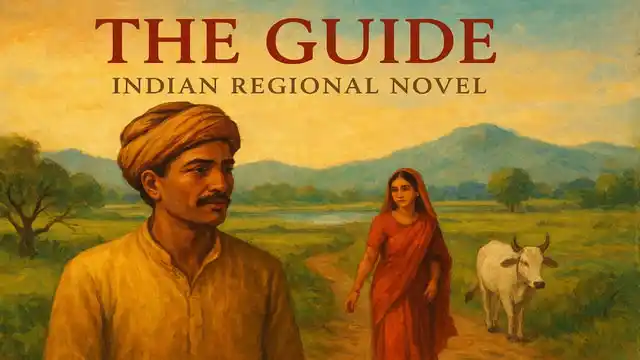
As a regional novel, it draws its strength from the vivid portrayal of local colour: the rhythms of rural and small-town life, the dialects, customs, superstitions, and moral codes that define the Indian social landscape.
Through the story of Raju, the railway guide who transforms into a spiritual guide, Narayan skilfully intertwines the physical landscape of Malgudi with the spiritual and moral terrain of India itself. His simple yet evocative prose brings out the ethos of the region, making The Guide not merely a localised narrative but a profound reflection of Indian identity rooted in its soil and traditions.
Authentic Portrayal of Indian Society:
The Guide offers an authentic portrayal of Indian society, particularly reflecting the rural life of South India. Most of R. K. Narayan’s works are centered around the fictional town of Malgudi, and The Guide stands out as a fine example of a regional novel. Such novels highlight the distinctive qualities of a specific region—its landscape, people, way of life, customs, manners, traditions, language, and overall cultural atmosphere.
Malgudi as the Central Setting:
Malgudi serves as the sole setting for R. K. Narayan’s novels—an entirely fictional town that he firmly established on the literary map of India. More than just a backdrop, Malgudi emerges as a living character in his works. One critic has aptly observed that Malgudi is the true hero of Narayan’s ten novels and numerous short stories. Beneath the surface of changing events and human dramas lies the enduring spirit of the place—its very soul—unchanged yet accommodating change, remaining triumphantly itself.
The Geography and Layout of Malgudi:
The inhabitants of this town are inseparable from it; they are born of it, live within it, and wholly belong to it. In The Guide, Malgudi is depicted as a town situated along the banks of the Sarayu River. At its center lies the bustling Market Road, intersecting with Race Course Road, surrounded by a network of streets, lanes, and by-lanes.
The novel mentions Kabir Street and Kabir Lane—where Raju’s teacher runs the Pyol School—as well as Sarayu Street leading to the riverfront. Other streets include Anderson Lane, Kulam Street, Smith Street, and Abu Lane, among others.
Institutions and Urban Growth in Malgudi:
Malgudi also houses two schools: the Albert Mission School, which imparts Christian education to Indian children, and the Board High School, where Raju studies. In The Guide, the growing need for a college reflects the town’s gradual expansion. Civic institutions such as the municipality, town hall, and club further mark its development. By this time, Malgudi has a railway station and a taxi stand, signaling its increasing modernity and connectivity. The novel even hints at its approximate distance from Madras.
Natural Surroundings and Indian Authenticity:
Overlooking the town are the Memphi Hills, cloaked in bamboo forests where wild elephants roam, and dotted with tea estates. Atop these hills stands the Forest Rest House, known as the Memphi Peak House. Together, these vivid geographical and cultural details lend The Guide an unmistakable touch of Indian authenticity, making Malgudi not just a fictional setting but a microcosm of India itself.
Satire on Post-War Indian Society:
In The Guide, the vicissitudes of Raju’s fortunes provide an excellent opportunity to R K. Narayan to satirise the nouveau riche (a person becoming suddenly rich and displaying his riches) of post war independent India. The story of a sinner like Raju an impresario (dance manager) becoming a saint, is a story that has the magnanimity and grandeur of the Indian scene.
The Guide has a unique Indian rural setting-an ancient temple, surrounded by hills, the river Sarayu flowing in front of it.” Then there is the village Mangala. Raju who pretends to be a mahatma and goes on fast to bring rain to the drought-stricken wasteland is peculiarly Indian.
India has many such “Sadhus” and “Dharmatmas” practising hypocrisy and fraud in the name of religion and ultimately meeting their tragic doom, like Raju. The continued absence of rain evokes fantastic speculations from the villagers who do so like Indian rural people. One villager wants to know if the rains fall because the movement of aeroplanes ruffles the clouds while the other seeks to know if the atom bombs are responsible for drying up the clouds. This reveals a humorous and funny aspect of the reality of the ignorance of the Indian people.
Religious Faith and the Indian Psyche:
Indians have been deeply religious since ancient times, placing immense faith in sadhus and mahatmas. Raju embodies the role of such a holy man. As a supposed spiritual figure, he reflects a familiar reality in India. Like many self-styled Indian sadhus, Raju is a false swami. The scenes around his temple vividly mirror true aspects of Indian life. He sits on an elevated platform covered with a soft rug, assuming a pose of sacred meditation.
Men and women—particularly women—have great faith in Raju, the mahatma. They seek his counsel on practical matters and feel spiritually uplifted after spending a few moments at his feet. Ultimately, Raju immerses himself in the river and meets a tragic end after fasting for twelve days in a desperate attempt to bring rain to the drought-stricken village. The story of Raju the saint is, in essence, a reflection of the many pretentious holy men found in India.
Reflection of Economic Conditions:
The novelist has no explicit intention to emphasise the economic condition of India but it gets referred to. The picture of Indian masses with their attending poverty has been shown in the crowds that gather round Raju, the Swami. They are poor and uneducated. They are superstitious and ignorant. They live in misery. Velan is also poor.
Class Division in Indian Society:
All the characters in The Guide belong to the lower middle class or poor class. They are the poor villagers, the low shopkeepers, the low wages earners, guides and low workers. On the other hand, there are rich people also. They are the moneylenders, rich lawyers, rich owners of theatres and circus companies and aristocrats.
Poverty, Education, and Social Reality:
Irrigation in the region relies entirely on rainfall. The village of Mangala frequently suffers from drought and famine whenever the rains fail. There are neither schools nor teachers in the village, and even the residents of Malgudi live in poverty, unable to educate their children due to financial hardship. Raju himself grows up uneducated because of his father’s poor economic condition. Those who manage to gain wealth often fall prey to its vices—they indulge in drinking, gambling, and deceit, for which they eventually face punishment. Raju, too, forges Rosie’s signature and is consequently convicted.
