An Introduction of “A Hot Noon in Malabar”:
Kamala Das’s poem “A Hot Noon in Malabar,” from her 1965 collection Summer in Calcutta, captures the essence of a sweltering afternoon in Malabar to reflect on themes of nostalgia, lost innocence, and displacement.
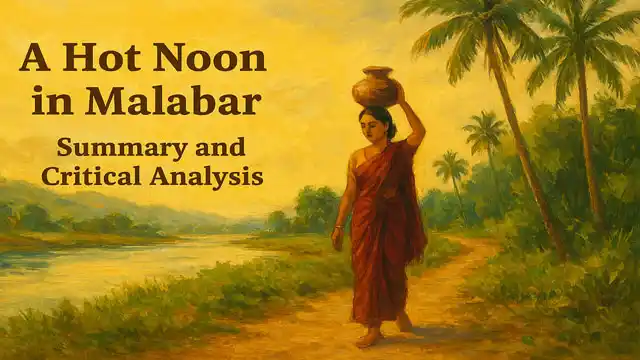
Set against the vivid backdrop of a bustling village, the poem contrasts the poet’s serene childhood memories with the isolation and confinement of her adult life in the city.
Through rich sensory details—the calls of street vendors, the murmur of fortune-tellers, and the hum of village life—Das conveys a profound yearning for the comfort and intimacy of her grandmother’s home, now a symbol of warmth and belonging that feels heartbreakingly out of reach.
Summary of the Poem “A Hot Noon in Malabar”:
Fond Recollection of Malabar Noon-Time:
The poetess reminisces about her experiences in her Malabar home during the noontime of her life. She recalls those moments with warmth and yearning, cherishing the serenity, charm, and freedom of the past. She vividly remembers the scorching afternoons when various people would pass by her house — many of them vendors calling out to sell their goods. They brought with them a variety of items and announced their wares in loud, rough voices, proclaiming the merits of what they had to offer.
The Beggars and Their Pitiful Voices:
The poetess first recalls the beggars who would visit her home seeking alms. Many of them appeared to be in a pitiful state. As they pleaded for charity, their distinct voices revealed both their misery with their present condition and their deep dependence on others’ generosity.
The Fortune Tellers and Kurawa Girls:
Next, she recalls the fortune tellers who descended from the hills, carrying cages filled with parrots and stacks of brightly coloured fortune cards. The cards, worn and smudged from years of use, bore the marks of countless prophecies. Then her memory drifts to the Kurawa girls, who foretold people’s destinies by tracing the lines on their palms. Their voices, flat and repetitive, echoed the same set of phrases over and over, with little change in tone or wording. Yet, through long experience and sharp understanding of human nature, they managed to satisfy the curiosity and hopes of those who sought their guidance.
The Bangle Sellers and Their Hardships:
The poetess reminisces about the bangle sellers who travelled long distances to sell their wares. Moving from one village to another, and from town to town, they carried bangles of many vibrant hues—red, green, and blue. Their journeys on foot took them across endless dusty roads, leaving their heels cracked and sore. Dust clung to their clothes and bangles alike. Exhausted from their long travels, they still went from house to house, calling out to the women and girls. Even climbing the porticos was a struggle for them, yet they would carefully lay out their dazzling bangles on the floor for the women and girls to admire.
The Strangers and the Poetess’ Reflections:
Then she remembers the strangers who would pass by her house, pausing to peer through the thin window curtains. Yet, they could see nothing inside—the rooms were dim and shadowed, while their eyes still held the glare and heat of the burning sun. These wanderers sought refuge from the oppressive noon, hoping to find some rest and a touch of hospitality from the house’s inhabitants. But when no one answered their silent pleas, they drifted instead toward the brick-lined well, where they could drink and cool themselves beneath the harsh light.
They were peculiar figures—wild-eyed, rough, and mostly silent. When they did speak, their voices carried a raw, untamed echo, as if they belonged to the wilderness itself.
Now, the memory of those noons torments her even more, for they stir reminders of other scorching afternoons long gone—days when the heat was just as fierce, but her heart was content and full of love. The present, by contrast, feels sullied and alien—everything around her appears soiled, harsh, and estranged, unlike the past, when the world had seemed innocent, familiar, and pure.
Critical Appreciation of the Poem:
Introduction:
The poem entitled A Hot Noon in Malabar was first published in the poetess’s first anthology Summer in Calcutta, in the year 1965. This poem deals with a theme similar to My Grandmother’s House. It also deals with the nostalgic yearning of the poetess for happy and love filled childhood and the family home in Malabar. Like other poems in Summer in Calcutta, this poem scatters its fallout of heat, sweat and weariness over the heat, urban modes, vital heat, urban sophistication.
Thought-Content:
Kamala Das reminisces about her midday experiences in her ancestral Malabar home, recalling them with deep affection and yearning. She remembers the beggars who often came to her door, their distinct voices filled with both complaint and a plea for compassion. Then, her thoughts turn to the men from the hills who carried caged parrots and sets of fortune cards—old and stained from long use. She also recalls the brown-skinned girls from the community of basket-makers and bird-trappers, who were a familiar presence in Malabar. These girls would predict the future by reading the lines of people’s palms.
Next, she remembers the bangle sellers who trudged along the dusty roads, walking great distances to sell their colourful bangles. She also thinks of the strangers who would pause by her house, peeping through the window curtains, but unable to see inside because the rooms were dark while their eyes still carried the glare and heat of the noon sun. These strangers sought shade and kindness—some respite from the oppressive heat—but when no one from the house responded, they turned to the well to quench their thirst and rest a while.
The poet’s heart aches with a deep desire to return to that place and behold once again the people she had once watched so closely. The realization that she now stands far away from that home fills her with pain—a sense of distance and estrangement from the simplicity, purity, and familiarity that once defined her life there.
The Use of Realistic Imagery:
In this poem, Kamala Das presents a vivid catalogue of scenes she once witnessed while living in that house. She portrays the men and women who passed by or visited—beggars, fortune-tellers, Kurawa girls eager to read palms, bangle sellers with their wares, and strangers seeking shelter or some form of help.
The imagery is strikingly realistic, lending the poem an unmistakable sense of authenticity. This realism is deepened through precise details—the bangle sellers’ dust-covered bodies, the cracks on their heels, and the mention of the “brick-ledged well”—all of which bring the scene to life with tangible clarity.
Style and Language:
In the choice of words, Kamala Das exercises a special cure; and her words and the combination of those words into phrases, clauses and sentences, she shows a rare understanding of the meanings, the appropriateness, and the subtleties of words. In the poem, some of the phrases including a couple of similes show the verbal felicities which Kamala Das is capable of devising in her poem.
‘The bangle-sellers’ feel ‘devouring rough miles’, the hot eyes of the bangle sellers ‘brimming with the sun’, and the strangers who rarely spoke so that when they did speak, their voices ran wild ‘like jungle-voices’ are among the verbal felicities here. The feeling of home-sickness has effectively been expressed in the words: ‘To be here, far away, is torture’.
The poem is characterised by the maximum possible economy in use of words. The poetess is capable to write rhythmic lines, though not using any rhyme. The use of commas, whenever they are needed in this poem, certainly contributes to its clarity.
Her Feeling of Alienation, Irony and Pathos:
Summer heat is a torture to the poetess but it reminds her of hot summer noons which she experienced in the family home in Malabar. How happy she was then! Everything seemed to be familiar and intimate, innocent and pure. But now everything is strange and conveys a feeling of alienation and horror. She yearns for the bygone time, for summer noons in her old family home in Malabar. But the pathos and irony lie in the fact that despite her passionate yearning for the old family home, she cannot relive the past. She has to live in the unpleasant and horrible present.
