Introduction:
“Mysticism in the Poetry of Rabindranath Tagore” highlights his search for an immediate, intuitive, and deeply personal communion with the Divine—the universal spirit or ultimate truth—revealed through the richness of human experience, the beauty of nature, and everyday relationships. This spiritual vision is most vividly expressed in Gitanjali, the work that earned him the Nobel Prize.
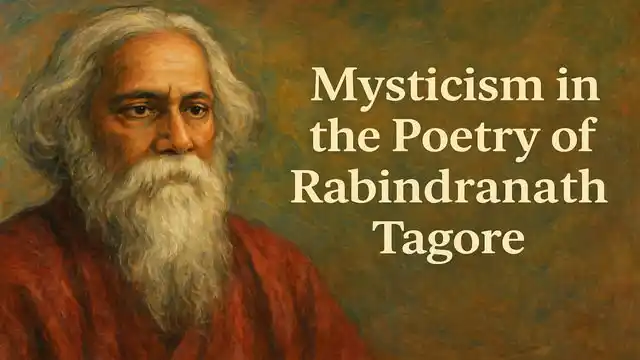
In contrast to mystical traditions that emphasise withdrawal from worldly life or strict ascetic practices, Tagore’s mysticism is grounded in humanism and a keen awareness of reality. He sought the ever-present Divine not within the isolation of temples or through solitary contemplation, but in the rhythms of common life—among people, in their work, and throughout the living world around us.
Rabindranath Tagore occupies a unique place in modern Indian literature as a poet whose creative vision seamlessly blends artistic expression with profound spiritual insight. A central feature of his poetic universe is mysticism—a quest for the eternal, the infinite, and the divine that runs like a vibrant undercurrent through much of his work. Rooted in the philosophical traditions of the Upanishads, the Bhakti movement, and his own deeply personal spiritual experiences, Tagore’s mysticism is neither abstract nor esoteric. Instead, it emerges through intimate, humanistic, and often sensuous encounters with nature, love, and everyday life.
For Tagore, the divine is not distant but immanent; it resides in the human heart, in the beauty of the natural world, and in the bonds that connect all beings. His poetry transforms spiritual longing into lyrical expression, using images of light, music, and nature to suggest the soul’s continuous dialogue with the Infinite. Unlike traditional mystics who withdraw from the world, Tagore celebrates life as a pathway to spiritual realization. Thus, his mysticism is marked by harmony rather than renunciation, joy rather than austerity, and a universalism that transcends religious boundaries.
Exploring mysticism in Tagore’s poetry reveals not only the evolution of his spiritual philosophy but also the broader cultural synthesis that defines his literary legacy. Through works such as Gitanjali, Gitimalya, and Gitali, Tagore presents a vision of spirituality that is profoundly personal yet universally resonant, making his poetry a timeless testament to humanity’s eternal search for meaning and communion with the divine.
Tagore as Mystic and Seer:
Rabindranath Tagore was far more than a poet; he was a visionary and a mystic. Deeply aware of his inner self, he possessed an extraordinary sensitivity of feeling. His life was marked by an intense inner fervour, and this emotional richness sprang from his spiritual and mystical insights.
At the heart of his mystic experience was a sense of unity—a perception of an underlying oneness that binds together the seemingly diverse elements of the universe. Tagore’s mysticism was not a formal doctrine or a structured philosophy; rather, it was a lived, practical approach to viewing the world with a clear and purified soul. Through his works, he expresses a vision of life devoted to the cleansing of the spirit and the realization of one’s essential harmony with all creation.
Unity, Rhythm, and Harmony in Tagore’s Mysticism:
Tagore’s mysticism rests on a deep conviction in the fundamental unity, rhythm, and harmony that run through existence. Even scientists acknowledge that what sets life apart is the intricate interplay among the atoms that constitute matter. While all matter is composed of atoms, in living organisms these atoms combine into highly complex molecular structures.
This network of relationships is what makes living matter different from the inert. Life emerges from matter, and in that sense, the two are bound by an essential unity. All of nature is interconnected, and the laws of science strive to understand the principles that govern this underlying oneness.
Mysticism in Gitanjali:
Mysticism refers to the deep, spiritual union between the human soul and the eternal, divine presence. When this experience of inner communion finds expression through verse, the poetry is said to possess a mystical quality. Gitanjali is filled with this sense of spiritual connection, capturing the poet’s intimate relationship with the Eternal—whom he addresses in many forms: as friend, companion, beloved, Lord, and Master.
Each song in the collection serves as an offering placed reverently at the feet of the Divine. Through these poems, we witness the poet’s shifting moods and reflections—his longings and emotions, his aspirations as well as his moments of sorrow and doubt.
The Invisible Spirit Behind the Visible World:
As a mystic, Tagore believes that the world perceived through the senses—through sight and sound—though outwardly varied, is suffused with an unseen spiritual presence. This hidden spirit enlivens both human beings and every element of nature. To Tagore, all living things partake in “one undivided, changeless life,” a unity that binds the seemingly separate. Awed by the nearness of the divine, he feels God’s presence permeating everything around him.
“Spirit of Beauty, how could you, whose radiance overbrims the sky, stand hidden behind a comdle’s ting flame? How could a few vain words from a book rise like a mist, and veil her whose voice has hushed the heart of earth ineffable calm.”
Tagore’s Vision of God:
Tagore envisions God as an “unbroken perfection,” the source of “simple, great gifts” that reach him only through his own “small hands.” Ages roll by, yet the divine keeps pouring blessings, and still there remains space within to receive more. At the same time, God can manifest as the “king of the fearful night,” wielding a blazing sword, brilliant like fire and weighty as a thunderbolt. In every form, He is present everywhere.
Influence of the Gita and the Immortality of the Soul:
Deeply shaped by the teachings of the Gita, Tagore affirms the soul’s immortality. To him, the soul is a transcendent reality that realizes its true nature by moving toward what lies beyond its present state—toward its highest possibilities. The finite continually strives for the infinite, and the individual reaches out toward the universal.
The human soul, limited in form yet limitless in aspiration, attains its fulfilment by uniting with the universal spirit, and in that moment of union it experiences an immeasurable joy. Though the body perishes, the soul takes on new form; its continuity renders mortality insignificant. Death, in this view, is not a calamity but a divine envoy, guiding the soul back to its creator.
Mystic Innocence of Children
Like Blake and Wordsworth, Tagore too finds a mystic quality in children. He found in them beauty, innocence, humour and charity. He gives us the typically romantic view of childhood. The child, just come from heaven, is near to heaven and sces on earth the light of heaven. He writes in The Crescent Moon:
“Bless this little heart, this white soul that has won the kiss of heaven for our earth.
He loves the light of the sun, he loves the sight of his mother’s face.
He has not learned to despise the dust, and to hanker after gold. Clasp him to your heart and bless him.”
In The Child, the poet holds out the hope that one day the new-born divine child will usher the world in an era of glorious fulfilment.
Unity of Man and Nature:
Tagore never regarded Nature as an adversary of humankind. Like other mystics, he believed deeply in the fundamental oneness between human beings and the outer universe. In Vedantic terms, Nature and man—Prakriti and Purusha—are complementary manifestations of the Absolute.
Contemplating Nature, or even one of its facets, becomes a pathway to experiencing the divine. In Tagore’s vision, Nature reflects kindness, unity, and the underlying harmony of existence. For him, Nature is God’s own music, uplifting and refining the human spirit. Ultimately, human life is inseparably linked with the natural world.
Dualism and the Harmony of Opposites:
Although Tagore firmly upholds the idea of communion between the human and the divine, he rejects the notion of complete identity between them. His outlook is fundamentally dualistic, rooted in the belief that unity emerges through difference. He sees rhythm and harmony as the universal principles shaping all existence, a conviction that allows him to continually balance and integrate life’s opposing forces.
His poetry repeatedly weaves these contrasts into a deeper unity. In this sense, freedom implies release from bondage, yet it becomes attainable only through the very constraints it seeks to transcend.
Love, Devotion, and Self-Purification:
According to Tagore, man can achieve God through self-purification, self-surrender, that is through Love and Devotion to Him. Tagore says, “In love, we find a joy which is ultimate because it is the ultimate truth.” Therefore it is said in the Upanishads that the advaitam is anantám—”The One is Infinite” that the advaitam and anandam, the One is Love.”
The Supreme Spirit at the Heart of the Universe:
A central idea in Tagore’s mysticism is the belief in a supreme spirit that lies at the core of the entire universe. This spirit pervades everything and serves as the unifying force that brings harmony to all forms of creation, whether living or non-living. Its presence and activity in the cosmos are everlasting. All beings emerge from this spirit, ultimately return to it, and are reabsorbed into its unity. The souls of all creatures are, therefore, fragments of this Supreme Soul.
Karma, Life, and Realisation of God:
Tagore stands as a strong advocate of the philosophy of Karma. He holds that the divine can be experienced in the very life we are living now. For this reason, he does not support ascetic withdrawal or acts of self-denial.
Since God resides continually within the human soul, one can discover Him through genuine love for one’s spouse, children, and all of God’s creatures. There is no need to abandon the world in search of Him. This idea is echoed in Tagore’s song “At midnight the would-be ascetic announced…”, where God declares the same truth.
“At midnight the would-be ascetic announced;
“Why does my servant wander to seek me, forsaking me?”
Rabindranath Tagore’s poetry emerges from his deep mystical vision and his unshakable belief in the essential oneness of all existence. He rejected every form of division—whether based on religion, caste, nation, or any artificial claim to superiority.
As a mystic, Tagore upholds the unity of humanity and embraces an international outlook. A spiritual realist, he achieves his distinction by giving spiritual thought a profoundly human character. For Tagore, the path to the divine runs through harmony with one’s fellow human beings and communion with the natural world.
