Introduction of poem No.35 in Gitanjali:
“Where the Mind Is Without Fear” (Poem No. 35 in Gitanjali) is a devotional verse by Rabindranath Tagore, composed before India achieved independence. In it, Tagore imagines a perfect, liberated nation and appeals to the divine for such a homeland—one where learning is accessible to all, narrow beliefs do not confine people, and social divisions do not limit human potential. The poem stands out for its compelling portrayal of a bold, enlightened, and truly free India.
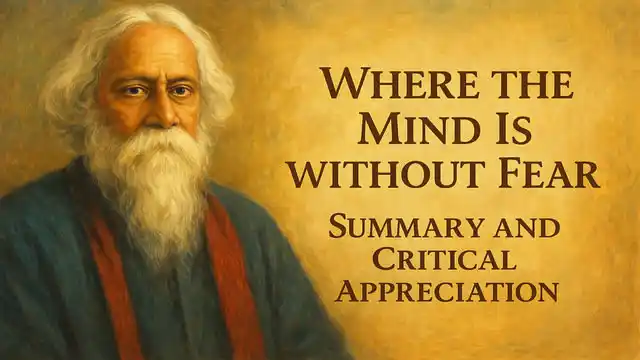
“Where the Mind Is Without Fear” is one of the most celebrated poems from Rabindranath Tagore’s Gitanjali, a collection of spiritual and philosophical verses for which he won the Nobel Prize in Literature in 1913. Written originally in Bengali and later translated into English by Tagore himself, the poem expresses a powerful vision of an ideal nation—one founded on freedom, truth, reason, and human dignity.
Composed during India’s struggle for independence, the poem reads like a prayer to the divine, asking for a world where people can think freely, speak truthfully, and rise above social divisions and oppressive customs. It blends patriotism with universal human values, making it as relevant today as it was a century ago. Through its lyrical simplicity and moral force, the poem invites readers to imagine a society guided not by fear or narrow-mindedness, but by courage, knowledge, and spiritual awakening.
Summary of the Poem No. 35:
Stanza-1:
“WHERE the mind is without fear and the head is held high:
Where knowledge is free;
Where the world has not been broken up into fragments by narrow domestic walls;
Where words come out from the depth of truth;
Where tireless striving stretches its arms towards perfection;
Where the clear stream of reason has not lost its way into the dreary desert sand of dead habit;”
Word-Meanings:
1. Without fear = dauntless. 2. The head is high = feeling honoured. 3. Where…is free = nobody should be deprived education on grounds of poverty, caste, creed or sex. 4. Education = knowledge. 5. Where the world…walls = petty considerations of nationality, caste and creed should not divide the people. 6. Fragments = small units. 7. Narrow = not broad. 8. Domestic walls = considerations of caste, religion and community. 9. Depth of truth = based on truth. 10. Tireless = constant. 11. Striving = attempting. 12. Stretches = spreads forward. 13. Perfection = faultlessness. 14. Streams of reason = one’s reasoning power. 15. Dead habit = blind custom and traditions. 16. Dreary…habit = antique and outdated customs and traditions.
Paraphrase:
The poet envisions a form of genuine freedom. He longs for a nation where people can think openly, their minds unburdened by fear. They should stand tall with confidence and live lives marked by dignity. Education, he believes, must reach everyone—without barriers or prejudice. Knowledge should not be limited by wealth, gender, or caste. Narrow ideas of nationality, caste, and religion should not fracture society. In his ideal country, there is no place for division or internal strife.
People must rise above narrow barriers of caste, religion, and community. As citizens of one nation, they should remain united, setting aside all minor differences. They must be honest and sincere in character, making promises with integrity and fulfilling them with dedication. Hard work should be their guiding principle, and they should strive continuously toward excellence.
The light of reason must not be allowed to fade in the dry sands of outdated customs and traditions. Instead, people should let rational thinking guide their actions rather than blindly clinging to the past. Their outlook should be enlightened and progressive, not rigid or orthodox.
STANZA-2
Where the mind is led forward by thee into ever-widening thought and action–
Into that heaven of freedom, my Father, let my country awake.”
Word-Meanings:
1. Led forward = motivated. 2. By thee = by the help of God. 3. Ever-widening = ever growing onward. 4. Heaven of freedom = happy state of being free. 5. My Father = God and Creator. 6. Let …awake = should get up from the sleep of slavery.
Paraphrase:
The poet appeals to God to guide his people toward a balanced and harmonious growth. He asks that they be led toward pure and honest thoughts, and that those thoughts may inspire right action. He longs for his countrymen to become wise and strong. At present, they lie dormant, lost in the slumber of ignorance. Therefore, the poet earnestly begs the Divine Father to awaken them completely.
Critical Appreciation of poem No.35 in Gitanjali:
Introduction:
Poem No. 35, “Where the Mind Is Without Fear,” is one of Rabindranath Tagore’s most celebrated works. It comes from his renowned poetry collection Gitanjali, the very book that brought him worldwide acclaim and won him the Nobel Prize in Literature in 1913. Composed during the era of colonial rule, the poem reflects Tagore’s lofty vision of true freedom and the noble ideals he cherished for an independent India.
The poet envisions a form of freedom he deeply longed for his motherland to attain. Beyond political independence, he yearns for Indians to achieve spiritual liberation—a true release from fear, bias, and rigid traditions. He prays that God will guide India toward becoming a land where knowledge flows openly and is accessible to everyone.
This poem stresses spiritual freedom. Spiritual freedom is permanent freedom while political freedom is worth ruining.
The poem is full of alliterations and has been written in a sing-song manner. The rhythm is catching and the selection of words is noteworthy.
Thought-Content:
The poet envisions an India where fear has no place in the human mind and every person can hold their head high with dignity. It is a land where learning is accessible to all, where harmony prevails, and where truth guides every action. He imagines a nation unscarred by divisions of caste or religion, where people speak honestly, labour sincerely, and strive toward excellence.
Outdated customs, blind faith, and superstition have no space in this ideal world; instead, reason lights the way. Above all, the poet seeks God’s guidance in leading the country into this realm of freedom—a heaven marked by universal liberty, fellowship, unity, peace, truth, rationality, and love for humanity and the divine.
Theme of the Poem:
Rabindranath Tagore presents his own vision of genuine freedom. For him, true liberty means freedom from fear and from narrow divisions based on nationality, caste, creed, or colour, ultimately leading to a universal sense of brotherhood.
He appeals to the Almighty to bless India with this higher form of freedom. The poet highlights the importance of spiritual liberation, considering it enduring and meaningful, whereas political freedom alone can be fragile or even destructive. In the poem, he also reflects on the consequences of clinging to outdated customs and traditions.
Language, Style and Diction:
Tagore possesses an innate gift for song. He commands language with effortless mastery, ruling over words as their natural sovereign. To him, speech and sound arrive as instinctively as petals take on their color. He shapes his expressions into enchanting, rhythmic designs. The vocabulary he chooses for his poetry is often plain and largely monosyllabic, yet it carries a musical grace and vivid imagery.
“Where words come out from the depth of truth;
Where tireless striving stretches its arms towards perfection;
Where the clear stream of reason has
Not lost its way into the dreary desert sand of dead habit…”
The poem is both unpretentious and powerful. It reaches straight into the reader’s emotional center. Rich in metaphor and alliteration, it flows with a musical ease. Its rhythm is engaging, and the choice of words stands out for its precision and beauty.
